From Qatar to Jerusalem: The Bloodstained Continuum of History
Israeli Aggression and the Honour of the Ummah

The history of the Middle East has, time and again, borne witness to the melancholy truth that its soil has been less a sanctuary of peace than a theatre of powder and intrigue. From the twilight of the Ottoman dominion until our own troubled hour, this land has served as the board upon which the grandmasters of global politics have moved their pieces with cold calculation. At times wars have been waged for the black gold beneath its sands, at times for the banners of creed, and at yet other times the ordinary peoples of these lands have been consumed as mere fuel for the ambitions of empires.
This is that sacred soil of the Middle East where the footprints of the Prophets still breathe their fragrance, where the minarets of Jerusalem rise to proclaim the eternal call to prayer, and where the blood of martyrs still courses through the very veins of the earth. And yet again, this soil finds itself swept by the tempests of oppression and the gales of tyranny.
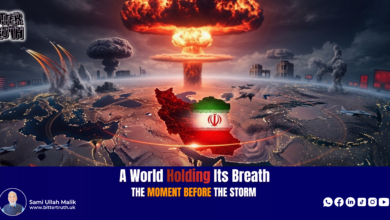
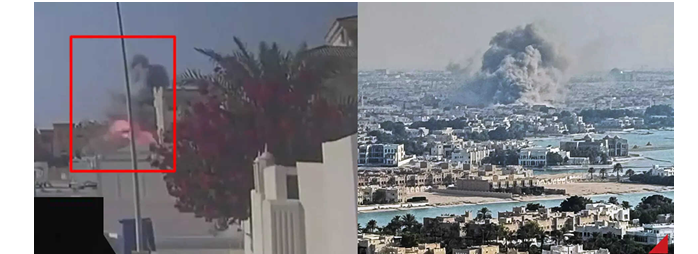
Today we gather to reflect upon a tragedy that has shaken the heart of the Muslim world. Doha, long deemed a symbol of tranquillity and negotiation, has itself come under the shadow of Israeli bombardment. This assault is not merely an aggression against Qatar; it is, in truth, a brazen assault upon our dignity, our honour, and upon the faith that binds us.
The latest chapter of Israeli belligerence has startled the world anew. The strike upon Doha is not only a direct challenge to Qatar, but also a grave test for the chambers of international politics. It is not simply a military manoeuvre; it is an attempt to provoke the very conscience of the faithful. It echoes that same voice of falsehood which once resounded in the ranks of the Crusades, and it wields the same dagger that once gleamed in the alleys of Baghdad.
Thus, Israel’s strike upon Doha has set in motion a discourse far larger than the bounds of Qatar’s sovereignty. It is a mirror held up to the contradictions of global diplomacy, and in this mirror one discerns both hypocrisy and impotence. Within this setting, President Donald Trump’s pronouncements, the posture of Qatar, and the response of the wider Muslim world demand sober reflection.
President Trump has voiced his anger, his dismay, and his displeasure, insisting that he is “very unhappy” with Israel’s actions. Yet the Muslim world greets his words with scepticism; they have learned to read such pronouncements as the hollow vocabulary of diplomacy rather than the true coin of conviction. History stands as their witness. Was it not the same America that chose silence when Palestinian blood was spilt? Was it not American presidents who, at every turn, spoke the language of condemnation but pursued policies ever tilted towards Israel’s intransigence? Did not the same hand reduce Iraq to rubble, and drench Afghanistan in fire for decades? The people are not deceived: they know too well that American statements are embroidered with expedience rather than truth.
In their eyes, these protestations are but the well-worn clichés of diplomacy—platitudes that ring hollow when measured against the record of deeds. History has taught them that the condemnations of American presidents rarely rise beyond words. From Palestine to Iraq, the evidence has seared itself upon the collective memory: the gulf between Washington’s words and Washington’s deeds is as wide as heaven from earth. And so the Muslim mind inquires: is this not the same America that blinded its eyes to the rivers of blood in Palestine? Is this not the same America that left Baghdad in ashes? Is this not the same America that steeped Afghanistan in blood?
How, then, shall we trust the declarations that for centuries have proven little more than verbal sleight of hand, unaccompanied by substantive action? If America were truly impartial, Palestine would not today lie bathed in grief and ruin.
When Mr Trump declared that he is “never surprised” by the happenings of the Middle East, he uttered words that are themselves a confession. At first glance, they appear as helpless resignation; upon deeper scrutiny, they reveal the mask of design. These words intimate that America’s silence amidst carnage is not borne of ignorance but of strategy. Washington has long turned a blind eye to Israel’s unbridled aggression, and Mr Trump’s words are less the astonishment of a statesman than the weary acknowledgement of a policy long enshrined.
The question thus arises: is this impotence—or is it the old stratagem that cloaks Israel with impunity? For America, each fresh Israeli assault has become but a matter of routine. Yet if America is never surprised, when, then, shall America awaken? Or perhaps it is not silence at all, but the stillness of complicity—the tacit approval that wraps Israel’s brutality in the cloak of legitimacy. These words, in truth, are both confession and cover.
Israeli aggression is no novelty. One recalls Beirut in 1982 reduced to rubble, Lebanon in 2006 pounded into submission, Gaza in 2008 and again in 2014 made to endure apocalyptic assault. Israel has consistently shaken the very foundations of the region. Yet the strike upon Qatar is of a different magnitude. For Qatar is no ordinary state: it is home to Al-Udeid, the largest American base in the Middle East. This paradox suggests that Israel is no longer merely a ward of Washington but presumes itself a sovereign overlord of the region.
Israel has already sought to impress upon the world that, under American patronage, it may rain fire upon Gaza, upon Lebanon, upon Syria, upon Iran at will. But Doha is another matter. It is America’s ally, its partner, and the very host of its air operations. Thus, we are compelled to ask: has Israel truly slipped the leash of Washington—or is this a drama staged upon America’s own prompting?
And here lies the most vexing of contradictions: a land that shelters America’s own aircraft has been ravaged before Washington’s very gaze, and yet America contents itself with the perfunctory phrases of condemnation. What assurance remains if even the soil beneath America’s own wings cannot be secured? O people of Islam, reflect! If a land that hosts America’s mightiest base is not immune, then who is safe?
🔹 Qur’ānic Resonance
At this juncture, the Qur’ān reminds us:
«وَاعْتَصِمُوا بِحَبْلِ اللّٰهِ جَمِيعًا وَلَا تَفَرَّقُوا»
(“And hold fast, all of you together, to the rope of God, and be not divided.” — Āl ʿImrān, 3:103)
For the true safeguard of nations does not lie in foreign bases, nor in alliances of convenience, but in the steadfast unity of faith and the fortitude of justice.
The Prime Minister and the Emir of Qatar alike have denounced the Israeli assault as both criminal negligence and state terrorism. This declaration is no mere outburst of indignation, but rather a solemn testimony before the tribunal of international law—that Israel’s actions are not simply military operations but rank as the most egregious instances of terror exercised under the authority of a state. The significance of such words, within the grammar of international jurisprudence, cannot be overstated.
Let it not be forgotten that in the 1970s, when the quarrel between Iraq and Kuwait first emerged, the very concept of state aggression entered the vocabulary of the world order. Today, Qatar speaks that same tongue, proclaiming that Israel’s deed is not only an act of war, but a rebellion against the very architecture of the international system.
The Prime Minister’s statement is thus more than anger—it is a reaffirmation of a principle of universal law. History itself reminds us: when in 1990 Iraq trespassed upon Kuwait, the world condemned it as an act of state aggression. Today, Qatar invokes that same principle against Israel. And the Emir, with deliberate precision, has branded the Israeli onslaught as both a criminal act and as state terrorism. Such words recall to us a timeless truth—that even the small nations, when they speak with honour, may inscribe their place in history. It is the same proud cadence that once rang from the lips of Salāḥ al-Dīn, who vowed that he would not rest until Jerusalem was free.
After the assault, the Emir of Qatar reached out to President Trump. The American President, in his characteristic register, professed solidarity with Qatar and affirmed support for its sovereignty. Yet the Emir, undaunted, persisted: he termed the assault “criminal negligence” and vowed that his nation would take every measure necessary to defend its safety and its honour. These words, coming from a modest yet proud nation, are the mirror of dignity and the language of national pride. Once again, the ghost of Salāḥ al-Dīn seems to rise: scant resources, yet immense resolve. And yet, history is stern in its reminder—that American condemnations often fade into mere rhetorical thunder, rarely accompanied by the storm of action.
Hamas, for its part, has declared the assault to be a failed plot against its leadership. The six lives laid down in sacrifice have only lent greater legitimacy to its struggle. Hamas proclaims that its leadership remains unscathed, and in that survival Israel’s plan has been confounded. Through the glass of history this signifies more than survival—it is the rebirth of Palestinian resistance, the echo of an immortal defiance. As the Muslims at Uhud, wounded yet unbowed, stood their ground, so too today the skies over Gaza and Doha resound with that same spirit of resistance. These martyrs are the light of our eyes; their blood quickens the conscience of the Ummah.
And here the words of the Prophet ﷺ resound:
«اَلْمُؤْمِنُ لِلْمُؤْمِنِ كَالْبُنْيَانِ يَشُدُّ بَعْضُهُ بَعْضًا»
“The believer is to the believer as a solid building, each part supporting the other.”
The question presses: are we the pillars that uphold our martyrs, or are we merely silent spectators to their sacrifice?
Meanwhile, Jordan hastened to clarify that its airspace had not been used by Israeli aircraft. Every state is anxious to disassociate itself from the blaze, each eager to prove its innocence in the hope of escaping the fire that threatens to engulf the whole region. These spectacles recall to us 1967 and the Gulf conflict of 1990, when every Arab state, under the weight of global pressure, sought to absolve itself of responsibility—only for Jerusalem to be lost amidst their evasions.
Striking too is the astonishment voiced by Senator Chris Coons, a Democrat, who remarked with gravity that Israel had not even troubled to inform its greatest ally, the United States, of its intent. This omission is no accident—it is a message to Washington that Tel Aviv now deems itself sovereign, beholden to no master. This posture reveals fissures within the alliance; it is both a proclamation of America’s waning authority and a bold assertion of Israeli self-will. Once regarded as the “junior partner,” Israel now struts as an unchained actor, answerable to none—not even to its patron.
This reality marks a departure from the days of the Iraq War, when Israel moved in concert with American strategy. Today Tel Aviv charts its own course, and Washington must reckon with a new and disquieting challenge. History whispers to us in sombre tones: such are the moments when empires stumble. Was it not thus in the twilight of Rome, when its allies ceased to heed the Senate’s commands and followed their own devices? These are the portents of imperial decline.
The Arab League, too, has condemned the Israeli assault as a menace to international peace. Yet history, that stern arbiter, records that the pronouncements of the Arab League have too often been the mere dust of words. Action, the test of all declarations, has rarely followed. Since the wars of 1967 and 1973, the fragility of Arab unity has stood exposed; each state has sought to shift the burden upon its neighbour, until at last Jerusalem slipped from their grasp. It is this weakness that emboldens Israel still further. And yet—even the frail reed of condemnation bears witness that Israel’s aggression is no parochial matter of Qatar or Palestine, but a threat to the security of the entire region.
Cast your gaze across the annals of time, and the truth becomes unassailable: since 1948, in every conflict, Israel has enjoyed American patronage. In 2006, during the devastation of Lebanon, the American administration openly urged that Israel be given “more time” to weaken Hezbollah. The war of 1991, between Iraq and Kuwait, likewise proved that even the presence of American bases could not guarantee the sovereignty of Muslim states. Those wars, too, were cloaked in the banner of the “war on terror,” while the true spectacle was the desolation of Muslim lands and the seizure of their resources. Today, the assault upon Qatar is but a new bead strung upon the same thread, a new link forged in the same chain.
Thus an avalanche of questions presses upon us: Is the assault upon Doha a harbinger of a new epoch? Is America truly powerless, or is this but another act in a play already scripted? Will Qatar rise to defend its sovereignty with deeds, or will its protest remain confined to words? And above all, will the Muslim world ever stand united in the face of Israeli aggression?
For now, the only certainty is this: the soil of the Middle East, steeped in the blood of prophets and martyrs, has once again become the theatre of history’s most tumultuous chapter.
Trump’s discontent, Israel’s audacity, Qatar’s defiance, and the Arab League’s laments—all converge to re-enact that same drama of fire and blood that has scarred this region for centuries. The question, then, is not who speaks what words; the true question is who shall act. Time, the sternest of judges, will decide whether these words are but the dust of rhetoric—or the heralds of a coming storm.
The Final Reckoning of Doha
The assault upon Doha is not merely an act of military aggression; it is a tempest on the political horizon of the Middle East, a storm whose gathering clouds foreshadow a crisis yet deeper than those already endured. The indignation of President Trump, the recklessness of Israel, the dignity of Qatar, and the ritual condemnations of the Arab League—all point to one undeniable truth: a new chapter of convulsion is being inscribed upon the troubled annals of the region.
The question that now reverberates is stark: is this but a dust-storm of words, or the prelude to
another bloodstained chapter in the book of history?
O Ummah of Islam! The cry of faith and the summons of history shake us with the urgency of awakening. The bombs that rained upon the skies of Doha have not struck Qatar alone; they have pierced the very heart of the Muslim world. Let none forget the timeless command of the Qur’ān:
وَاعْتَصِمُوا بِحَبْلِ اللَّهِ جَمِيعًا وَلَا تَفَرَّقُوا
“And hold firmly to the rope of Allah all together, and do not be divided.” (Āl ʿImrān 3:103)
If we remain riven by division today, then let us not delude ourselves—after Doha, neither Mecca nor Medina will remain untouched by peril. This assault is not merely a crime against sovereignty; it is a trumpet-blast calling us to reckon whether we shall yet set our ranks aright, whether we shall redeem al-Quds, whether we shall discharge the debt of blood owed to our martyrs.
O nation of Muhammad ﷺ! This is no season for slumber, but for awakening. The attack on Doha reminds us with piercing clarity that our enemy is one, even as our faith is one. Should we falter in negligence, history will write us in shame; but should we unite beneath the banner of īmān, the world shall behold once more that the Ummah which triumphed at Badr and Khaybar yet lives, vibrant and immortal, ready to sacrifice in the name of Allah.
History knocks once again upon our door. O Ummah! Have you forgotten the blood of your martyrs? Have the echoes of Badr and Uḥud faded from your ears? Has your sense of honour grown numb? Beware! If we fail to marshal our ranks, history will not forgive us. But if we rally beneath the standard of faith, if we proclaim our unity with one voice, then once again the world shall witness that the Ummah of Badr and Khaybar is not dead—it is alive, eternal, and unbowed.