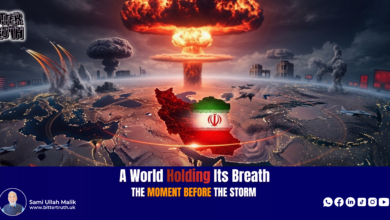

From Kabul to Moscow: The Turning of the World’s Axis
The Lamp of Peace and the Shadow of Empire

The Ties of Blood and Faith: A Turning of the Asian Tide
In the chronicles of history, whenever the tale of neighbouring nations is inscribed, the relationship between Afghanistan and Pakistan shall be remembered not as one of mere proximity, but as a bond sealed by blood and faith. There was a time, amid the thunder of Russian artillery, when Afghan refugees lost their homes, their soil, and their serenity — and Pakistan, opening the doors of its heart, did not receive them as guests, but as brothers. Yet, upon those very frontiers where once the banner of hospitality fluttered, the acrid scent of gunpowder now hangs in the air.
Today, the hearts of the Pakistani people bear wounds — wounds not inflicted by an enemy’s bullet, but by a brother’s neglect. Under the shadow of the Taliban government, Afghan soil is once more trampled by the feet of terrorists — and what pains the heart most is the echo of India’s patronage resounding beneath their tread.
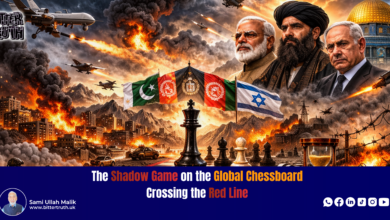
At this delicate juncture in history, the Moscow Format Conference has emerged as a glimmer of hope — a candle flickering against the winds of despair. Russia, China, Iran, and Pakistan, speaking in one voice, have declared that if those who seek to extinguish the flame of peace continue to stoke the fires of their own ambition, then the East shall pierce the darkness with its own dawn.
This conference was not a mere diplomatic assembly, but a renewal of the moral covenant of mankind: that no nation’s soil shall henceforth be used as a theatre for terror — neither for power, nor for vengeance.
In the chronicles of civilisation, there are moments when diplomacy transcends dialogue, and becomes the compass of the ages. The recent Moscow Format bears precisely such weight. It is not merely a regional forum; it is the vocabulary of a new equilibrium of power.
Its members — Russia, China, India, Pakistan, Uzbekistan, Kazakhstan, Kyrgyzstan, Turkmenistan, and Tajikistan — are heirs to that historic geography through which once flowed the civilisation of the Silk Road. As if they sat encircling the embers of destiny itself — the fire called Afghanistan — veiled now in a shroud of snow.
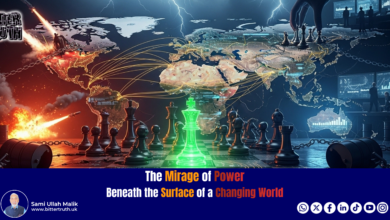
It is a moment of irony and history alike that the doorway through which once America entered, now welcomes the foreign ministers of Pakistan and Afghanistan. This is no trivial coincidence; it is the symbol of a shifting axis of power — the world’s centre of gravity inclining away from Washington and toward Moscow. The gathering was, in essence, a proclamation that the age of Asia has dawned; that the world, once enthralled to the throne of the West, now seeks rebirth in the lap of the East.
Its significance is doubled by the conspicuous absence of the United States — and the honoured presence of Afghanistan’s foreign minister — that same Afghanistan which two decades ago was dragged into the mire of ruin by Western intervention. Moscow, it would seem, has turned the tables of history.
When the Russian Ministry of Foreign Affairs announced that the Moscow Format would henceforth serve as a “contact group” for regional peace, it was in fact an acknowledgment that Pakistan and Afghanistan are no longer the problems of one people or one ideology, but the touchstones of global balance.
Sergey Lavrov, welcoming the Afghan foreign minister, observed with seasoned wisdom that “the stability of Afghanistan is indispensable to the peace of the region.” It was, in truth, a recognition of that eternal truth which the West has long ignored — that the pulse of Central Asia’s peace beats through the heart of Kabul.
How stark the hypocrisy of the Western world, which proclaims itself the guardian of “human rights,” yet freezes Afghanistan’s assets, condemning its people to hunger, unemployment, and exile. The freezing of assets is but a metaphor for the freezing of conscience. If any concept of international justice still breathes, it shall be vindicated only when the West repays its moral and financial debts to Afghanistan. Lavrov’s critique was no mere political rhetoric, but the solemn testimony of a reawakened conscience — a moral summons to the world.
Pakistan, true to its tradition, played a role both cautious and significant. The presence of Muhammad Sadiq, Gayan Chand, and Ubaid Nizamani signalled that Pakistan is not merely Afghanistan’s neighbour, but its fellow in destiny. For over four decades, Pakistan has borne the burden of Afghan crises upon its shoulders. Despite the trials of refugees, economy, and border security, it has remained steadfast in its allegiance to peace.
When the conference turned to the security of Afghanistan and the spectre of terrorism in the region, it was as if time had reopened an old wound. The principle was reiterated that Afghan soil must not be used against any other state — a simple statement, yet beneath it lies buried the warlike psyche of centuries. All parties agreed upon this principle, but the greater question lingers: how long shall the world continue to use Afghanistan as its battlefield? The hour demands that Afghan soil become its own sanctuary of peace.
Afghanistan — ever the crossroads of imperial ambition — must now rise with the resolve that it shall no longer serve as the fuel for others’ wars.
One of the conference’s central themes was humanitarian aid. The hardships afflicting the Afghan people are not born of natural calamity, but of political selfishness. Russian and Chinese delegates insisted that humanitarian concern must be severed from political calculation. It is a reminder to mankind that when humanity itself becomes hostage to interest, civilisation is but an empty shell.
Alongside counterterrorism, the discussion of humanitarian relief led to a confession: that beneath the shadow of the gun, humanity cannot flourish. The Afghan people, battling hunger and deprivation, now depend less upon global conferences than upon the conscience of their neighbours.
Russia, China, Iran, India, Pakistan, and the Central Asian republics emerged from this gathering with a renewed sense of regional identity — not as adversaries of the West, but as custodians of equilibrium. It is a revival of the dream first kindled at the Bandung Conference of the 1950s: that Asia shall resolve its own problems and define its destiny by the voice of its own conscience.
The Moscow Format, then, is the first step towards the fulfilment of that dream — seeking not only peace in Afghanistan, but liberation of the region from Western tutelage. It is, in essence, an intellectual jihad against the colonial mindset, waged with the twin weapons of pen and dialogue.
As future proposals were deliberated, Russia’s foreign minister aptly observed that the failed
policies of the West now imperil the entire region. Those governments that carry the corpse of their own promises cannot compose the prescription for others’ peace. Asia must now draft its own charter of wisdom.
China’s appointment of an ambassador to Afghanistan was not merely a diplomatic gesture, but a historic signal — that Kabul’s government is emerging from isolation. Yet to consolidate this renewal, Kabul must once more repose trust in its steadfast benefactor — Pakistan. China has demonstrated that in the realm of international relations, moral courage surpasses mere power.
Russia, entangled in the war in Ukraine, recognises that opening another front would be an act of folly. Thus, Moscow now seeks not military confrontation but diplomatic ascendancy. The Kremlin understands that leadership in Asia shall be won not by the sword, but by the word — through negotiation and accord. This prudence is proof that today’s Russia is not the Soviet Union of old; it values balance over expansion, and stability over dogma.
Afghanistan today is like a traveller who has lost his destination, yet the dust of the road still remembers his footsteps. Pakistan and its neighbours sit in prayer and in preparation — in prayer, that peace may return; in preparation, that peace may endure.
The collective resolve of the Moscow Format nations is, in truth, an attempt to reverse the tide of history. The declaration that “Afghan soil shall not be used against any other state” is no mere phrase — it is the testimony of years of sacrifice and bitter experience.
The people of Pakistan still wish only well for their Afghan brethren, yet they understand that the duty of friendship lies in keeping the lamp of trust alight. If Kabul can cleanse its soil of the thorns of terror, this region may once again become a valley of peace, a crossroads of commerce, and a cradle of civilisation.
The wheel of time now turns eastward — and if Moscow, Beijing, Tehran, and Islamabad remain true to their pledges, generations to come shall remember this age as the dawn of a new Asian awakening. It is the declaration of a timeless truth: that peace is no longer a slogan, but a shared responsibility.
﴿وَإِن جَنَحُوا لِلسَّلْمِ فَاجْنَحْ لَهَا وَتَوَكَّلْ عَلَى اللَّهِ﴾
“And if they incline to peace, then incline to it also, and place your trust in Allah.” (Al-Anfal, 8:61)