
Fidelity or Expedience: The Convergence of Kabul and Delhi
Pragmatism and Forgotten Favors: A New Chapter of Kabul and Delhi

The Shadow of History and the Theatre of Diplomacy: Afghanistan, India, and the Reversal of Time
When the quill of time first inscribed the name of Afghanistan upon the parchment of history, destiny, too, began to script an unending chronicle of conflict. It is a land that has served alternately as the thoroughfare of empires, the crucible of ideologies, and the chessboard of imperial ambition. Upon this soil — where for centuries the language of the gun reigned supreme — diplomacy now dares, hesitantly yet distinctly, to lift its head.
The Taliban government, once regarded merely as a militant enterprise, now knocks at diplomatic doors, conversing not through the thunder of arms but in the lexicon of political dialogue — and that, too, in the tongue of its former adversaries. When Amir Khan Muttaqi, the Taliban’s Foreign Minister, sets his foot towards Delhi, it is not merely an official visit; it is an anchor cast into the deep waters of history — a deliberate attempt to open a new intellectual corridor between two ancient rivals of the Subcontinent: India and Afghanistan.
There are moments in the long current of history when nations do more than make decisions — they enter into a dialogue with their own past. The growing proximity between Afghanistan and India evokes, in the hearts of many Pakistanis, a muted anguish. This is the same Pakistan that for four decades bore the Afghan burden as its own — opening its lands, its homes, its resources in the spirit of brotherhood. And yet today, that very nation is compelled to ask:
Is this the reversal of time, or the betrayal of history itself?
Within the quiet chambers of their hearts, Pakistanis ponder why the very soil for which they sacrificed their economy, their peace, and their blood has now become a refuge for groups such as the TTP and the BLA. Why does that same land, once the emblem of fraternal affection, now send forth caravans of terror and hostility?
Behind this shifting tableau stands the eternal political rival — India. The same India that, for decades, sustained every anti-Taliban faction, now extends its hand in the name of conciliation. It is the same India that only months ago tasted humiliation in May’s confrontation with Pakistan, and now, driven by the psychology of vengeance, seeks to wound Islamabad through the corridors of Kabul.
Thus, while Pakistan contemplates under the shade of its brotherly sentiment, history once again stands at the crossroad of friendship and enmity — asking why the harvest of love we watered with our blood now yields only thorns against us.
Amid Pakistan’s traditional closeness with China and Russia’s quiet re-entry into the regional theatre, this proposed visit bears the tremor of a silent yet seismic political shift. It proclaims that the future politics of this region will not be defined by the barrel of a gun, nor by the nobility of the pen, but by the cunning and the calculus of revenge. India, though yet to formally recognise the Taliban regime, seems already to have extended the recognition that begins not in official decrees but in the soft chambers of intent and the subtle phrases of diplomacy. Yet here, such recognition rises not from goodwill, but from the smoke of intrigue and the ashes of ingratitude.
It is from this very point that the new politics of South Asia begins — where from the ashes of hostility emerges the first spark of dialogue. This is that rare inflection in history when former foes prepare to shape the architecture of the future, and diplomacy, once mistaken for weakness, becomes — or rather is wielded as — the most potent instrument of self-interest.
South Asia’s political history has ever been a tempest of transformation. The axis of power may have shifted, but the geography of influence has never lain vacant. Afghanistan, throughout, has been both a door and a wall — a door that connects civilisations, and a wall that demarcates rival ambitions.
Thus, when news breaks of Amir Khan Muttaqi’s impending visit to India, it is no mere itinerary — it is a proclamation of a new alignment in the flow of history. For those among us who trusted in Afghan fraternity, this shift cuts deep; it is the ache of watching the labours of brotherhood surrendered to the rancour of expedience.
Moments such as these are rare upon the scroll of time — when politics transcends the mere management of power and becomes a dialogue between civilisations, poised between collision and concord. If this proposed visit by the Taliban’s acting foreign minister were a genuine stride toward regional equilibrium, it might have been a noble chapter in the chronicle of brotherhood. Yet, alas — the Afghan brethren, too, seem ensnared in the cunning web of the shrewd Hindu Brahmin.
This diplomatic overture is, in essence, an attempt to recalibrate the balance amidst the tug-of-war of regional powers. Pakistan and China both wield considerable influence in Afghanistan — China through its deep economic roots in the Belt and Road Initiative, and Pakistan through the historic and geographic intimacy that long shaped the Taliban’s path. In this light, Muttaqi’s journey to India suggests a pursuit of multi-vector diplomacy — a desire to be beholden to no single power. Yet the undercurrent whispers another story.
After years of United Nations sanctions, this visit becomes possible only through the narrow window of a temporary exemption — a gesture small in appearance, but vast in its implications.
﴿وَتِلْكَ الْأَيَّامُ نُدَاوِلُهَا بَيْنَ النَّاسِ﴾
“And such are the days We alternate among mankind.” — Surah Āl ʿImrān (3:140)
Indeed, history’s wheel turns, and the proud learn once more that friendship and betrayal are but alternating seasons in the long year of nations.
Diplomacy in the Shadow of Power: Afghanistan, India, and the Reawakening of Realpolitik
The journey of Amir Khan Muttaqi to India is not merely the Taliban government’s first formal diplomatic undertaking; it is, in a broader sense, a symbolic re-entry of Afghanistan into the global political consciousness. It is remarkable in its paradox — for India, to this day, has not formally recognised the Taliban regime, and yet within the corridors of its foreign policy, new windows of engagement have begun to open.
This visit was rendered possible when the United Nations Security Council granted a partial relaxation of travel restrictions on Taliban leaders. Thus, Muttaqi’s journey is not a ceremonial excursion but the first cautious step toward Afghanistan’s reintegration into the international order. It comes at a moment when China’s influence in Kabul is expanding with calculated speed, Russia has established direct channels of communication, and the United States, after its withdrawal from Bagram Airbase, has retreated into the margins of regional relevance. In this context, Muttaqi’s visit may well signify a reconfiguration of power in South Asia — a recalibration which, if wisely managed, could serve the region well.
Though the UN sanctions upon Taliban leaders remain intact, the exemption itself stands as a tacit acknowledgment that the world does not wish to sever its ties entirely. The Taliban, in turn, must seize this diplomatic aperture to declare before the world that they are no longer a purely domestic force, but aspire to present themselves as guarantors of regional stability.
India — once the staunchest critic of the Taliban and patron of their opponents — now seeks a path of dialogue with the very movement it once condemned. This, indeed, is the story of shifting interests and the remapping of geopolitical necessity.
The Taliban’s foreign ministry has confirmed Muttaqi’s visit, though details remain veiled in discretion. Such reticence itself is a gesture — a sign that the Taliban, in this new diplomacy, seek to reconcile prudence with dignity, and to send an unspoken message to Pakistan: that silence need not be weakness, nor restraint a form of submission. This quiet diplomacy — subtle, measured, and deliberate — is the hallmark of a newfound political maturity, an understanding that power, when expressed in whispers, can echo far louder than when shouted from the ramparts.
Muttaqi’s journey to India, therefore, is more than a headline; it is an emerging line on the map of South Asian diplomacy. India has not yet granted official recognition to the Taliban regime, yet the warmth perceptible on both sides attests to a simple truth — that the river of diplomacy never truly runs dry.
The UN exemption is, in effect, a half-open door — a hesitant yet meaningful gesture by the global order. Since the Taliban’s return to power in August 2021, this marks the first occasion upon which a minister of the regime undertakes an official visit to a major state. It is not merely diplomacy in motion; it is the first tide of restored credibility, a cautious step in the long pilgrimage toward international acceptance.
﴿إِنَّ اللّٰهَ يُؤْتِي مُلْكَهُ مَنْ يَشَاءُ﴾
“Indeed, Allah bestows His dominion upon whom He wills.” — Surah Al-Baqarah (2:247)
Thus, while formal recognition may still be distant, the acceptance of dialogue — the beginning of speech after silence — has already commenced.
India’s Afghan policy has ever oscillated between two poles: historic mistrust of the Taliban and the pragmatic need to safeguard its investments and influence in Afghanistan. It has publicly maintained a cautious distance, even as it pursued quiet channels of confidence-building behind the veil. It is a policy of relation without recognition, presence without partnership, and proximity without embrace — an exquisite demonstration of Chanakyan realpolitik.
After the Pahalgam attack of May 2025, the Indian Foreign Minister, S. Jaishankar, reportedly reached out directly to Muttaqi. That attack was more than a security incident; it reopened old wounds of mistrust across the region. Yet the fact that New Delhi chose dialogue over denunciation — that it picked up the telephone instead of the sword — revealed that even amidst enmity, diplomacy still breathes. It was, as one observer put it, a whisper of friendship in the hall of hostility — a brief diplomatic exhalation that warmed a frozen relationship.
The significance of this visit grows when placed against the backdrop of China and Russia’s expanding ties with the Taliban. China deepens its presence through investment; Russia reasserts its influence through diplomacy; and Pakistan, as ever, remains the historical axis around which Afghan politics has revolved. For India, this is a moment to establish a new equilibrium — an opportunity to craft a fresh dialogue with Kabul that might, under the discreet veil of diplomacy, offset the advancing influence of both Pakistan and China.
Historically, India has aligned itself with every Afghan faction opposed to the Taliban — from the Northern Alliance to successive Kabul administrations. The Taliban were long perceived as instruments of Pakistan. Yet with their return to power, India has recognised that to ignore the Taliban is to deny Afghan reality itself.
Delhi’s attitude, therefore, has shifted. It now perceives engagement with the Taliban as a strategic necessity — not least because it seeks greater latitude to sustain its covert ties with anti-Pakistan elements such as the TTP and the BLA, groups that, under the indulgence of Afghan soil, continue to threaten Pakistan’s peace.
As early as 2010, it was evident that the Taliban would re-emerge as a central force in Afghan politics. Many nations prepared for that inevitability — India did not. Yet by 2022, Delhi’s cautious opening of a limited diplomatic mission in Kabul signified the beginning of a reluctant pragmatism. The subsequent meeting between Vikram Misri and Amir Khan Muttaqi in Dubai in 2025, followed by their telephonic engagement, marked a quiet but unmistakable progression — the slow architecture of trust rebuilt upon the ruins of the past.
﴿وَجَعَلْنَا بَعْضَكُمْ لِبَعْضٍ فِتْنَةً أَتَصْبِرُونَ﴾
“And We have made some of you a trial for others — will you then be patient?” — Surah Al-Furqān (25:20)
So moves the wheel of history — grinding slowly, yet inexorably. The visit of Amir Khan Muttaqi may appear a gesture of courtesy, but within it lies the stir of a deeper tide: a quiet contest for influence, a shifting balance of power, and the first cautious murmurings of a new order in South Asia.
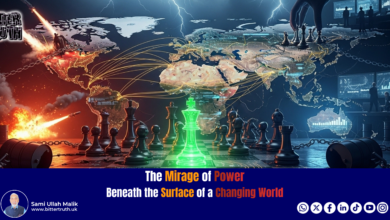
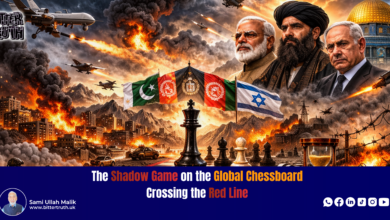
The vacuum that followed President Joe Biden’s declaration of withdrawal from Bagram Airbase became a theatre for new ambitions. Into this void stepped China, Russia, and Iran—each seeking to shape the contours of post-American Afghanistan according to its own design. Beijing advanced with the quiet confidence of economic gravity; Moscow moved with the studied calculation of diplomatic continuity; Tehran, ever the opportunist in regional tides, sought to weave influence through proximity and ideology alike. For New Delhi, however, the encroachment of these powers has been more than a strategic discomfort—it has been a reminder that the geography of influence seldom tolerates absence. Afghanistan has once again become an international chessboard, where every move, however subtle, redraws the map of power in South Asia.
In this charged milieu, India’s cautiously assertive outreach marks the opening of a new chapter—one that seeks to temper the ascendant influence of China and Pakistan through the art of dialogue rather than confrontation. Amir Khan Muttaqi’s visit to New Delhi is not merely a diplomatic gesture;
it is a calculated rejoinder, a signal that India no longer intends to remain a bystander but wishes to reclaim a participatory role in the regional order. His arrival signifies more than the resumption of contact—it embodies a tacit acknowledgement that the Taliban administration has become an unavoidable reality of contemporary geopolitics.
Although the United Nations sanctions against the Taliban remain formally intact, their engagement with India underscores a quiet yet profound shift: the world, while unwilling to embrace the regime, recognises that it cannot be ignored. India, characteristically prudent, advances with a two-steps-forward, one-step-back rhythm—a cautious diplomacy born of historical experience. Afghanistan, after all, has always offered friendship with one hand and peril with the other. Yet Delhi appears prepared to accept that peril, kindled by the strategic fire of its rivalry with Islamabad.
Muttaqi’s sojourn thus suggests a new pragmatism: Delhi now seeks tangible engagement rather than ideological opposition—a shift gradual, deliberate, and potentially enduring. Still, to some observers, the emerging proximity between India and the Taliban risks reviving among ordinary Afghans the age-old fear that their land is once more the playground of greater powers. This is not merely a political perception; it is a psychological inheritance. Nations are not always shaped by facts but by the shadows those facts cast upon collective memory.
Scholars remind us that as early as 2010 the re-emergence of the Taliban was written on the political horizon. The world read the writing; India, however, hesitated. When Kabul fell to the Taliban, New Delhi withdrew its diplomats in haste, yet soon after reopened the discreet channels of communication that are the lifeblood of realpolitik. Of special note was the clandestine visit of Ibrahim Sadr, the Taliban’s deputy interior minister, to India—a quiet encounter that opened a door no communiqué announced. His meeting with the head of RAW symbolised a profound recalibration of India’s diplomatic temperament: from opposition to accommodation, from moral distance to strategic realism.
Such secret parleys reaffirm a timeless truth of statecraft—that diplomacy often works best when unseen. The regional lexicon of power has acquired new meanings. The Taliban’s tilt toward India, and India’s newfound leniency toward them, is in part the residue of Prime Minister Modi’s humiliation on the world stage following the May Indo-Pakistani confrontation. The age we inhabit is less a time of ideological clarity than of pragmatic convergence, an era that prizes equilibrium over emotion, calculation over conviction. Afghanistan once again stands at the crossroads of history, its soil inscribed by the footsteps of those who come professing friendship but bearing the silent weight of self-interest.
India’s Taliban policy is the very embodiment of Chanakyan statecraft—cunningly balanced between recognition and repudiation: neither acknowledgment nor denial, neither full partnership nor studied indifference. It is a diplomacy of shadows—presence through aid, influence through conversation. As Delhi sees it, Afghanistan is to be engaged without being endorsed, assisted without being absorbed. It is a policy of restrained activism, where action speaks in whispers and declarations are left unsaid.
In 2022, the Taliban dispatched a representative to Delhi, and India in turn reopened a modest diplomatic office in Kabul. Yet New Delhi, ever wary of premature symbolism, refrained from granting it the formal status of an embassy. By 2024, reports surfaced of a Taliban envoy quietly stationed at the Mumbai Consulate, though both governments maintained a disciplined silence—an eloquence of omission that has become the preferred idiom of this delicate rapprochement. The continued presence of Taliban representatives in Delhi amounts to an unspoken recognition. India remains publicly mute, aware that certain decisions must mature with time; for words, once spoken, bind more tightly than silence ever could.
In this silence lies strategy—a Machiavellian poise that shields India from Western displeasure, particularly that of the United States, while keeping the door ajar for regional manoeuvre. The year 2025 witnessed another moment of quiet evolution: the meeting in Dubai between Indian Foreign Secretary Vikram Misri and Amir Khan Muttaqi, followed by a phone conversation in the aftermath of the Pahalgam attack. That exchange, like a candle flickering in the frost, testified that even amid political winter, warmth endures.
China and Russia may enjoy closer relations with the Taliban, but UN restrictions continue to confine the movement’s international reach. The Taliban thus occupy a peculiar space in global diplomacy—conditionally included, never fully embraced. Sanctioned though they remain, the world recognises that no architecture of regional stability can be built without them. In this context, Muttaqi’s visit to India is more than a diplomatic milestone; it is a bridge across isolation, a door left half open in a house of closed corridors.
India’s stakes in Afghanistan are manifold—economic, defensive, and cultural. With anti-Taliban factions now fragmented and politically irrelevant, New Delhi perceives Kabul not merely as a stage for checking Pakistan’s influence but as an arena for asserting its long-term role in the broader Asian order. From infrastructure to education, India’s investments in Afghanistan are both tangible and symbolic, and rapprochement with the Taliban, however reluctant, has become a political necessity—one shrouded in prudence but driven by purpose.
Indeed, Muttaqi’s visit represents a deliberate act of equilibrium—a quiet counterweight to the expanding influence of China and Pakistan. Delhi understands that if it withholds engagement, Beijing and Islamabad will dominate Kabul’s corridors, and India’s own proxies will lose relevance. By extending a cautious hand to the Taliban, India declares in essence that Kabul’s gates no longer open in a single direction. It is a symbolic assertion that Delhi has ceased to be a silent observer and now steps forth as an active participant in the great game once again. Muttaqi’s cordial reception, then, is not a mere diplomatic courtesy but a calculated move on the chessboard of power—at once subtle, silent, and strategically eloquent.
وَقُلِ ٱعْمَلُوا۟ فَسَيَرَى ٱللَّهُ عَمَلَكُمْ وَرَسُولُهُۥ وَٱلْمُؤْمِنُونَ
“And say, ‘Act as you will, for Allah will observe your deeds, and so will His Messenger and the believers.’” — Surah At-Tawbah (9:105)
Perhaps no verse captures the present moment more aptly: for in the grand theatre of nations, it is not words but deeds that history remembers.
Some analysts warn that the budding intimacy between India and the Taliban may well harden in Afghan minds the old, disquieting conviction that their country remains a chessboard upon which hostile neighbours continue to plot. That suspicion — that New Delhi might use Afghan soil as an instrument against Pakistan — is not merely political conjecture; it gnaws at the very legitimacy of the Taliban in the court of public opinion. Perception, in the realm of statesmanship, often outweighs fact; and in this regard the optics are plainly not in Delhi’s favour. The greater struggle, therefore, will not only be of geopolitics but of psychology: how to sustain a balance when every gesture is read through the prism of prior grievance.
The clandestine visit of Ibrahim Sadr, the Taliban’s deputy interior minister, to India was the unadvertised foundation of this delicate choreography — meetings with senior officials, including, as reported, the head of RAW, that opened a channel of communication whose existence was never proclaimed in press conferences but nonetheless altered the diplomatic arithmetic. That meeting took place at a moment of acute tension between Islamabad and New Delhi, when the region teetered on heightened brinkmanship; the implications of such timing are not trivial. Pakistan has watched these developments with a scrutiny that borders on apprehension; in circumstances so charged, Muttaqi’s voyage may only confirm the worst suspicions and harden them into conviction.
Ibrahim Sadr is understood to be among the closest confidants of Hibatullah — not merely a warrior but a man of consequence within the Taliban’s inner councils. His embrace of contact with Indian officials signals an internal shift in decision-making: a discernible movement to recast Taliban diplomacy away from a narrowly theological posture toward one framed by regional exigency. In this new calculus, even the sacrifices rendered by Pakistan — the fields offered, the homes opened, the decades spent in shared suffering — count for less than the cold arithmetic of strategic advantage. That readiness to consign past benefactors to the margins and clasp the hand of a formerly avowed adversary is a trenchant testament to the ruthless selectivity of statecraft.
Indian media has treated this development as a matter of consequence. The Sunday Guardian, among others, framed it as the discreet inauguration of a pragmatic, functioning relationship — realism triumphing over rhetoric. From Delhi’s vantage the affair is being reinterpreted: not as a return to sentiment but as a recalibration in the mirror of interest. For New Delhi, this is less triumph of reconciliation than of reprise: a cabinet of diplomacy that sees in rapprochement an instrument of retribution as much as of influence.
Whether this episode will prove to be a transient tactical expedient or the prologue to a lasting partnership, it has already made plain a perennial truth of international affairs — the doors of diplomacy are seldom bolted for good. Amir Khan Muttaqi’s planned visit is not merely another entry in the ledger of foreign trips; it is a marker of the changing climate in South Asian politics. Where once trenches of creed and conviction criss-crossed the landscape, bridges of convenience are now being constructed. The conversation that has begun between Taliban and Indian interlocutors acknowledges a reality that too often, in politics, is the only master that matters: practicality over principle.
We stand, then, at a sombre inflection. The valley breezes of Kabul have reached the chambers of Delhi, and with them a savour of Chanakyan guile that may yet rewrite the compass of regional alignment. Where interests and expediencies intersect, nations begin to compose new chapters — chapters that can, if ill-starred, unspool into fresh nights of calamity across the subcontinent. It would be no small hyperbole to suggest that this proposed visit opens a chapter in the annals of the region wherein words become fewer but meanings more consequential, and where the yawning potential for mischief carries with it the risk of a darkness far more enduring than the diplomatic courtesies that heralded it.
History reminds us, as an old moral would have it, that those who raise knives in the name of friendship may find their own throats costlier for the kindness. Pakistan, which has long regarded Afghans as neighbours and co-religionists rather than instruments of power, has never sought dominion; it sought only peace and mutual respect. Yet as Kabul’s thresholds appear to open southward toward Delhi, bewilderment and sorrow have fallen upon the gates of Islamabad. It is true — and this cannot be overstated — that the language of diplomacy often subjugates feeling to utility. Yet the relationships of peoples are built not merely upon balance sheets of interest but upon histories of fidelity.
The memory of those who sought refuge on Pakistani soil is still vividly alive: the tents, the hospitality, the bedside vigils of brotherhood that once erased the distance between two nations. To witness, therefore, the flowering of anti-Pakistan movements on Afghan soil — and to see India cast itself now, with such equanimity, as the quiet director of that game — provokes a profound national question: is this the Afghanistan for which we offered our best years?
India’s smiles to the Taliban may yet prove to be a mask of reprisal; the Afghan leadership ought to remember that a hand extended today in the name of convenience can be the same hand offered tomorrow in sacrifice to expediency. The lesson of history is stubborn: daggers of amity are drawn invariably from the enemy’s sheath.
Pakistan remains a country of dialogue, a people of peace; but it also knows, with the hard wisdom of experience, that where seeds of enmity are sown upon the soil of affection, no season will ever suffice to bloom the flowers of concord. The choice now rests with Kabul: will it honour the ledger of fraternity, or will it barter that debt for the petty profit of geostrategic calculation? History will not remain silent — it will bear witness to which among its actors tended the lamp of brotherhood and which used its fuel to kindle the flames of hostility.
Each new dawn brings with it a simple, unrelenting question: will the Taliban’s turn toward Delhi soothe the old wounds of history, or will it be, at best, a temporary contrivance? That question has yet to find its full voice. What unfolds between India and Afghanistan is not merely the forging of bilateral amity; it is the re-mapping of the subcontinent’s collective imagination. It tells us, with bleak candour, that enmity is rarely eternal and that interest is ever fluid.
Those who once regarded the Taliban as an insular, doctrinal movement now peer through the aperture of realpolitik and find, to their surprise, a silhouette of pragmatism. India, erstwhile the Taliban’s most uncompromising opponent and a supporter of their adversaries, stands today upon the threshold of history speaking, in the measured tongue of diplomacy, of the Taliban’s future. Here is the seam where merciless history takes hands with ruthless politics, and where geography, hitherto mute, is being redrawn in the ink of expedience.
Muttaqi’s visit may not culminate in treaty or covenant; it may not yield the architecture of durable accord. Yet it will furnish the intellectual scaffolding for decisions to come, and it poses, for those who bled in fraternity, a disquieting question: by closing the doors of dialogue with the country that once sheltered us and opening them with the ancient adversary, in what terms shall our descendants read our epitaph?
History has taken up the pen once more. It remains to be seen whether the meeting of Delhi and Kabul will inscribe a lament of renewed enmity or the sober preamble to reconciliation. My prayer, stubborn and sincere, is that among the elder statesmen of both countries — those who weep yet hide their faces in the mantle of disillusionment — some path may be found to stitch together the riven hearts; that, rather than a fresh annunciation of conquest, we might yet witness the rarer miracle of rapprochement.
إِنَّمَا الْمُؤْمِنُونَ إِخْوَةٌ فَأَصْلِحُوا بَيْنَ أَخَوَيْكُمْ وَٱتَّقُوا ٱللَّهَ لَعَلَّكُمْ تُرْحَمُونَ
“The believers are nothing else than brothers: so make peace between your brothers, and fear Allah, that ye may receive mercy.” — Surah al-Ḥujurāt (49:10).
If the polity of nations can ever be guided by such a maxim, then perhaps the last word will not be a dirge but a covenant of repair. Yet if realpolitik prevails unchecked, then the script being written today may yet summon a night for the subcontinent from which it will take generations to awake.