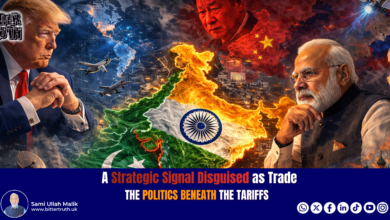

False Flags and Real Agendas: South Asia’s Unfolding Drama
Blood and Strategy: When Empires Collude, Innocents Bleed

Lament of Pahalgam — A Cry in Silence
Kashmir — that restless heart pulsing beneath the icy bosom of the Himalayas — bleeds once more. The verdant meadows of Pahalgam, once a tapestry of laughter woven by wandering tourists, now echo with the mournful silence of tragedy. What was once a sanctuary of serenity has turned sepulchral; a pastoral haven transmogrified into a theatre of mourning.
Nestled within the geopolitically fraught bosom of South Asia, the Vale of Kashmir is a region as entrancing in its natural splendour as it is tortured by a history carved with colonial chisels and post-Partition ambiguities. Upon the twilight of British imperialism, when the Subcontinent was hastily sundered, the princely state of Jammu and Kashmir was left dangling upon the thorns of indecision and ambition. That unresolved status continues to smoulder, igniting periodic conflagrations.
The recent attack on tourists in Pahalgam constitutes not merely an act of violence — it is an affront to the fragile hope of peace, a sabre raked across the quiet fabric of stability. Since 1989, the valley has known the drumbeat of militancy, echoing from foreign interventions, domestic disenchantment, and an unceasing chess match of geostrategic interests. No group has, as yet, claimed responsibility — a rare silence in a valley where culpability is often a shouted slogan. This vacuum, as ever, is filled with the smoke of conspiracy.
In the deserted plains of Baisaran, the echo of gunfire has not only claimed lives but wounded the valley’s very soul. Once a playground for children chasing butterflies and shepherds summoning the winds with their flutes, these fields now stand stained with blood and sorrow — mute witnesses to the ceaseless cruelty of politics played with human lives.
Pahalgam, an idyllic retreat in the Anantnag district, sits at the crux of strategic geography and spiritual pilgrimage. As a vital stop along the Amarnath Yatra, it is under near-perpetual surveillance — which makes the occurrence of such violence not only alarming but suggestive. This was no mere ambush; it bore the imprimatur of a message — a cipher in carnage, perhaps orchestrated to coincide with the high-profile visit of an American delegation. Is it coincidence, or is it a shadowy prelude to broader geopolitical designs?
One need not be a cynic to observe a macabre pattern: whenever the world’s gaze turns eastward towards India, the streams of Kashmir run red. The ghosts of history whisper of similar synchrony. In March 2000, as President Clinton set foot in India, 35 Sikhs were massacred at Chattisinghpora — a tragedy hastily pinned upon Kashmiri insurgents and Pakistan, only for subsequent inquiries, led by a retired judge and an army general, to point toward the Indian intelligence apparatus itself.
In 2016, Pathankot was breached days before President Obama’s state visit. In 2024, during the sacred Amarnath Yatra, nine pilgrims perished under mysterious fire, with fingers swiftly pointed toward Pakistan. But once the dust of rhetoric settled, the shadows of India’s own covert agencies flickered behind the smoke.
Even the infamous 1995 abduction of six foreign tourists in Pahalgam by the so-called “Al-Faran” — initially broadcast as a terrorist outrage — was eventually unmasked as a false flag operation, with fingers again creeping toward India’s Research and Analysis Wing (RAW).
Now, as the U.S. Vice President visits New Delhi, another outrage coincides. International analysts, with brows furrowed and pens poised, whisper once more: was this the orchestration of sympathy, or the diversion of scrutiny?
The “Troika” — an axis of the United States, Israel, and India — stands accused by several quarters of manipulating unrest in both Kashmir and Balochistan, threatened as they are by the leviathan promise of CPEC: the China-Pakistan Economic Corridor. A completed corridor would rewire global trade arteries, shifting the fulcrum from West to East — a prospect Washington and its allies regard with ill-concealed unease.
To stymie Beijing’s blue-water ambitions, the U.S. has girded alliances such as the Quad — a maritime entente with India, Australia, and Japan. Born in the wake of the 2004 Indian Ocean tsunami under the noble banner of humanitarian coordination, the Quad has since curdled into a containment cordon. Its present incarnation, masked in the rhetoric of democratic solidarity, is little more than a strategic noose for China.
The Pahalgam incident may well serve as a fulcrum for a renewed diplomatic onslaught against Pakistan. Already, New Delhi has escalated: expelling Pakistani diplomats, revoking all issued visas, and instructing those within its borders to depart by May 1st. In a further gambit, India has threatened to halt water flows under the Indus Waters Treaty — a treaty brokered and guaranteed by the World Bank.
Islamabad has not remained mute. The Foreign Office has convened emergency consultations, and the diplomatic chessboard is being reconfigured. What emerges is not simply another skirmish, but a slow, deliberate tightening of geopolitical ligatures.
One wonders whether the winds that whisper through the deodar forests of Pahalgam carry, too, the dirges of diplomacy gone rogue — where every drop of blood becomes a pawn, and every tear a message drowned in silence.
How long will the ruthless bloody shadow and the cross of compulsions last?
In the gathering dusk of modern geopolitics, where the silhouettes of power dance ominously across troubled lands, a new axis of strategic concord has emerged—India, Israel, and the United States. This triune alignment, forged in the crucible of mutual interests and veiled ambitions, now casts its long and troubling shadow over the heart of South Asia. It is an alliance where military cooperation is no longer a matter of diplomatic euphemism but is embodied, stark and chilling, in the presence of Indian volunteers actively enlisted in the Israeli Defence Forces—men who now partake in operations that have drawn global ire for their alleged war crimes in Gaza.
The stage, however, is not confined to the scorched earth of Palestine. As the world reels from the harrowing images of suffering and siege, another theatre is quietly ignited—Kashmir, the ever-bleeding wound of the subcontinent. Therein lies a pattern too deliberate to be dismissed as mere coincidence. For every crescendo of international condemnation against Israel, there arises, like a dark echo, a fresh eruption of violence in Kashmir. The spectacle is not unfamiliar: a bloodstained valley, muted weeping among the pine groves, and headlines designed to recalibrate global attention.
The Indian establishment, under the ideological tutelage of the Modi regime, appears to have woven this orchestration into its domestic political tapestry. Internal unity, it seems, is to be cemented not through reconciliation but through the manufacturing of perpetual external threats—chiefly in Kashmir. The narrative is disturbingly familiar: acts of terror with murky perpetrators, media trials devoid of evidence, and accusations hastily hurled across the border before investigations can draw breath.
One such episode, fresh in its carnage, unfolded on March 11, 2025, when the Jafer Express became the vessel of yet another tragedy. Innocent passengers, en route through the troubled soils of Balochistan, met a fate scripted in the intelligence bureaus of New Delhi—at least, so assert preliminary findings. The assailants, linked to outlawed outfits with prior affiliations to India’s Research and Analysis Wing (RAW), brazenly declared their intent to sabotage the China-Pakistan Economic Corridor (CPEC)—a project Beijing regards as the lifeline of its Belt and Road Initiative, and Pakistan considers the spine of its economic renaissance.
Is this, then, mere terrorism? Or is it political dramaturgy—theatrics choreographed to deflect, distract, and destroy?
To the discerning eye, this is but the latest act in a sinister and sprawling script. The harrowing saga of Kashmir is replete with spectral whispers of “false flag” operations. Chatti singh pura, Pathankot, and even the Mumbai attacks have each, in their time, been scrutinised through the prism of internal orchestration—events engineered to Mold international sentiment and silence critical inquiry. Pakistan, in its efforts to expose this architecture of subterfuge, has presented dossiers and data at various global fora—often met with little more than polite nods and diplomatic inertia.
Yet, beneath the surface of silence, tectonic plates shift. For what unfolds in Kashmir or Balochistan is not the squabble of neighbours but the proxy battlefield of empires. The United States, eager to contain China’s surging influence, sees in India a willing partner. Israel, embattled and emboldened, supplies not only arms but ideology. And India, basking in this strategic patronage, becomes the instrument through which this triad tests its limits in the East.
Thus, the Quad—the so-called “Asian Arc of Democracy”—emerges not as a beacon of cooperative prosperity, but as a cordon sanitaire drawn against Chinese ascendancy. CPEC, with its arteries through Gwadar and Gilgit, now finds itself in the crosshairs of a strategic calculus that views stability not as a virtue but as an obstacle.
Are the peoples of Kashmir and Balochistan, then, to be pawns sacrificed on the altar of great power rivalry? Shall every bombing be followed by a tweet, every massacre by a muted UN resolution?
The evidence is compelling: India, through proxies and propaganda alike, seeks to unmoor Pakistan’s regional standing while simultaneously diverting attention from its domestic quagmires—whether economic disarray, political dissent, or sectarian discontent. And while Washington remains notably circumspect—perhaps unwilling to jeopardise its courtship of New Delhi—Beijing watches with sharpened gaze. For China, CPEC is not merely a project; it is sovereignty woven into infrastructure. Should proof emerge of Indian complicity in its destabilisation, a geopolitical reckoning may well ensue—be it in the halls of the United Nations or across the silken corridors of Eurasian diplomacy.
In this grand narrative of deceit and devastation, the world must ask: Who benefits?
India’s military presence in Israeli conflicts, its belligerence in Balochistan, and its longstanding oppression in Kashmir are not disparate phenomena but threads in a single, sinister tapestry. One that binds together the ambitions of empires with the blood of innocents. If history has taught us anything, it is that peace cannot be built upon the ruins of truth. And yet here we stand, again, on the precipice of forgetting.
Let not the smokescreen of manufactured terror cloud the conscience of the world. Let not Kashmir’s cries be drowned in the applause of strategic summits. And above all, let not the machinery of imperial ambition grind into silence the stories of the oppressed.
For every scripted tragedy demands, at last, an unscripted reckoning.
The Triumvirate of Shadows: A Chronicle of Calculated Turmoil
In an age where nations don the guise of virtue whilst bartering in blood, a nefarious alliance has emerged — a triptych of strategic ambition composed of India, Israel, and the United States. Their cooperation in the realm of defence, though veiled under the rhetoric of security, stands today as a monument to shared interests pursued at the expense of regional peace and human dignity.
Reports of Indian nationals enlisting in the ranks of the Israeli military are no longer hearsay but a stark testament to this unholy pact. These recruits, it is alleged, now find themselves complicit in operations that have wrought unimaginable suffering upon the beleaguered people of Palestine. Yet what is more chilling is the calculated choreography behind the scenes — a shifting of global attention from the war crimes in Gaza to other simmering theatres of unrest.
Kashmir, long a canvas for imperial manipulations and nationalist fervour, once again finds itself centre stage in this pageant of geopolitical spectacle. The Modi administration, ever deft in the theatre of public persuasion, appears poised to employ renewed violence in the valley not only as a means of internal consolidation but as an instrument of diversion.
Meanwhile, across the restless expanse of Balochistan and Khyber Pakhtunkhwa, India stands accused of underwriting separatist insurgencies and fomenting chaos through the patronage of extremist factions such as the TTP. The recent carnage aboard the Jaffer Express on the 11th of March, 2025 — a tragedy soaked in the blood of innocents — has been linked to the sinister designs of India’s intelligence apparatus. The perpetrators, brazen in their cruelty, issued public threats to derail the China-Pakistan Economic Corridor, warning Beijing of dire consequences should their imperial pipeline proceed unmolested.
One is compelled to ask: is this merely terror, or is it, rather, theatre — a ghastly drama enacted on the battered boards of South Asia, scripted by strategists far removed from the human cost of their machinations?
The echoes of past deceptions linger still. From Chitti singh pura to Pathankot, from the trembling nights of Mumbai to the haunted alleys of Pulwama, India’s intelligence services have repeatedly found themselves beneath a cloud of suspicion. The technique, it seems, is tried and tested: create a spectacle, incite outrage, and thereby manufacture consent.
Such false flags not only seek to deceive the global conscience but to serve as pretexts for the
perpetuation of force and the silencing of dissent. Likewise, Pakistan has, on multiple occasions, presented credible evidence to international bodies implicating India in acts of sabotage and sedition — evidence that has, more often than not, fallen upon the deaf ears of realpolitik.
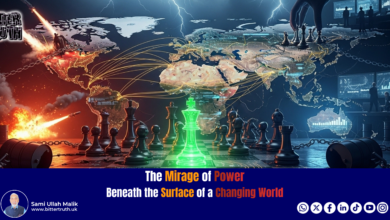
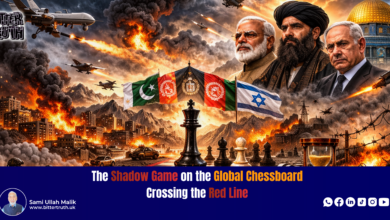
The geopolitical chessboard upon which this game is played extends far beyond mere national rivalries. It is a contest of imperial will and regional resistance, of capital’s cold arithmetic versus the aspirations of a people. The CPEC, lauded as a spine of development by both China and Pakistan, has become a thorn in the side of Western hegemony. The nexus of Indo-American strategy, bolstered by Israeli military prowess, has cast its long shadow over South Asia.
The Quad alliance — that cabal of democracies comprising the United States, India, Japan, and Australia — may present itself as a coalition for peace, yet in its undertones one hears the familiar cadences of containment, of curbing China’s ascent, of throttling the East before it can truly rise.
One must not be naïve. The West views India as a bulwark against Beijing’s growing influence and thus remains conveniently mute on the travails of Kashmir. But should irrefutable proof surface linking Delhi to these orchestrated outrages, the Western stance may fracture under the weight of its own proclaimed ideals.
China, in turn, views CPEC as integral to its national destiny — and its support for Pakistan, particularly on the matter of Kashmir, is no longer just diplomatic courtesy but a strategic necessity. And yet, Russia, ever the pragmatic broker, must balance its growing alliance with China against its long-standing arms trade with India.
Thus arises the critical question:
Is India engineering these tragedies as a smokescreen for its failures in Kashmir? Or does it merely seek, as all empires do, to maintain dominion through the orchestrated chaos of conflict?
Do (India-Israel-US) want to open a new front and weaken the alliance of China, Pakistan, and Iran?
Will the Western media try to tarnish the local Kashmiri resistance by portraying this incident as “Islamic terrorism”?
The role of the media troika (US, Israel, and India) in media, narrative war, and strangling the truth in the international tragedy has become despicable. While on one hand there is an attempt to cover up the Israeli atrocities in Gaza, on the other hand, the world is being misled by calling such incidents in Kashmir a “reaction”. The silence of the international media, especially the bias of the Western media, pushes these actions into the background so that the actions of Israel and India are not questioned. Do the eyes of the world now only see those tears that are shed at the will of the US?
In the international legal context, the silence of the world powers that have signed the agreement on Kashmir’s right to self-determination as a guarantor in accordance with the UN resolutions, UN resolutions, especially Resolution No. 47 passed in 1948, support a plebiscite in Kashmir. However, India has been reluctant to implement it. The International Court of Justice and human rights organizations have consistently remained silent on this issue. The resolutions passed by the UN ask these people that if such an agreement and promise had been made to the people of your country, would you have remained silent in the same way, would you have turned a blind eye to the martyrdom of millions of innocent Kashmiris in the same way?
Shame on your character that you claim to be a champion of human rights all over the world, but on the issue of Kashmir, you all smell a snake and you all feel no shame in becoming prisoners of your own interests and giving a license to Israel in Gaza and Modi’s cruel army in Kashmir to openly kill Kashmiris. Under international law, targeting civilian populations is a war crime, and the United Nations must intervene in such incidents, otherwise the credibility of international institutions is questioned.
Kashmir Valley, your soil is also a lamp, the atmosphere of Kashmir is still silent. It screams from its wounds, it cries from its clouds, this is not an accident, this is a page of history – soaked in blood, adorned with screams, and wrapped in a blanket of lies, and it hides questions even in its snow. Even today, there are many questions that beat in the chest of history. The bloodshed in the lush mountains of the Kashmir Valley still asks the question that if this is a conspiracy, then who are its architects? If India itself has been staining its skirts with the blood of its own citizens, will the international community turn a blind eye to this crime? If America backs it, what will be the reaction of China and Russia?
This incident seems to be not just a tragedy but a move in the international diplomatic chess game, in which human lives have become mere pawns. If the world does not take this seriously, these flames can engulf the entire region.
It is time for the international community, the United Nations, and human rights organizations to not only demand a transparent investigation into this incident but also to expose the hands behind it who are playing the game of war in the name of peace.
There should be an independent international investigation into the incident, especially when there is historical evidence of the involvement of Indian intelligence agencies.
That geopolitical caution and further strengthening of relations with China and Russia on the issue of Kashmir should make Pakistan
and strengthen relations with its neighbours Afghanistan, Iran, China and Russia on the issue of Kashmir, while highlighting India’s possible aggression in the United Nations.
A comprehensive public awareness campaign should be launched immediately among the people of the region through print and electronic media and the conspiracies behind such incidents should be made known so that the people do not fall prey to propaganda.
The most important point in this whole matter is that the local population of Kashmir is having to pay the price of violence, while powerful countries are fighting for their own interests.
This article is a call to thought for all those elements who want lasting peace in the region. Every sentence here is a question, and behind every question there is a cry for justice.