Faith, Steel, and Alliance
Faith and Force

History delivers its verdict with unerring certainty: some relationships are not weighed in the tribunal of time; rather, they themselves weigh the ages that pass before them. Certain bonds do not grow in the filing cabinets of foreign offices; they live and breathe in the rhythm of the human heart. In the chronicle of nations, there exist relationships that owe their endurance not to treaties, interests, or carefully worded diplomatic communiqués, but to faith, civilisation, sacrifice, and a shared constellation of sacred values.
The relationship between Pakistan and Saudi Arabia belongs unmistakably to this rare and elevated category. It is a bond inscribed not merely upon parchment but etched into collective consciousness and sustained by devotion rather than documentation. It predates formal agreements and, like faith itself, endures beyond them.
At the very heart of this relationship lies the custodianship of the Two Holy Mosques—a point at which Pakistan’s collective conscience, national honour, and religious sensibility converge into a single, unwavering resolve. When the names of Makkah and Madinah are spoken, it is not only lips that move across Pakistan’s vast expanse; hearts tremble in reverence. The protection of the Haramain is not an abstract clause of state policy, but an article of faith for every Pakistani. It is not merely a diplomatic position, but a solemn covenant, deeply embedded in the national psyche, that any profane gaze raised towards the sanctity of Makkah or Madinah must be met with the ultimate sacrifice.
This sacred trust is one for which the giving of life is not perceived as loss, but as honour; and should that sanctity ever be imperilled, every Pakistani instinctively becomes a soldier—without uniform, without summons, armed only with faith. In such a context, discourse on defence cooperation between Pakistan and Saudi Arabia ceases to be a sterile discussion of aircraft, armaments, or finance. It becomes instead a renewal of an oath—an oath bound by the blood of martyrs, by prayers whispered across generations, and by the inviolable sanctity of Islam’s first and second holiest sanctuaries.
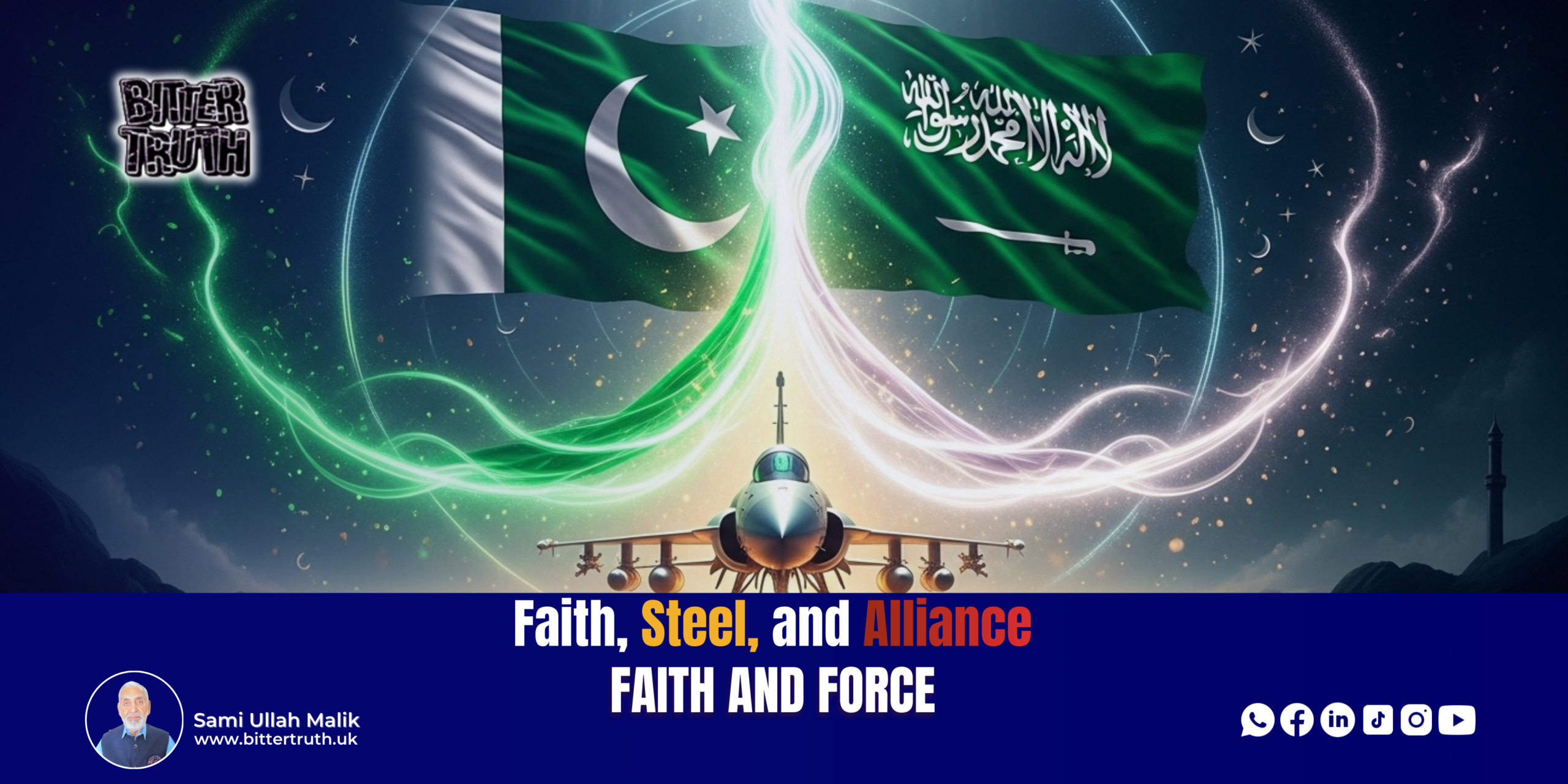
It is within this historical, spiritual, and civilisational frame that Pakistan–Saudi defence cooperation must be understood. Here, defence is not reduced to metal and machinery, but emerges as an expression of a shared Islamic strategic consciousness. Projects such as the JF-17 Thunder derive their significance from this wider canvas. They are not merely fighter aircraft; they are symbols of trust, sovereignty, and fraternal interdependence. In an international system where friendships are often weighed on the scales of expediency and promises expire with shifting seasons of interest, the Pakistan–Saudi relationship stands as a moral exception.
Yet history also teaches a sterner lesson: whenever the Muslim world has taken even a tentative step towards unity, the great powers of the age have grown uneasy. The questions therefore press themselves upon us with renewed urgency. Will the hearts of the Muslim world be permitted to beat in unison? Will this emerging framework of Islamic defence cooperation be allowed to mature by those who perceive any collective Muslim endeavour as a threat to entrenched interests? Or will this nascent unity be quietly, methodically resisted?
Will Pakistan–Saudi defence cooperation remain a bilateral arrangement, or will it evolve into a cornerstone of collective security for the wider Muslim world? Around these questions revolves the present study—where defence strategy, global politics, and the future contours of the Muslim ummah intersect in complex and consequential ways.
Against this backdrop arises a question that appears deceptively simple yet is strategically profound: does Saudi Arabia, already endowed with formidable air power, truly require the JF-17 Thunder? Why should a kingdom possessing some of the world’s most advanced combat aircraft contemplate the induction of a 4.5-generation fighter developed jointly by Pakistan and China? Military history offers a sobering answer. The mere accumulation of power does not guarantee security. Balance, strategic autonomy, and flexibility often prove more decisive than sheer technological abundance.
Defence studies have long recognised that a state’s military requirements are not determined solely by the nominal superiority of its existing platforms, but by considerations of strategic independence, cost sustainability, logistics, and political reliance. While Saudi Arabia’s air force boasts some of the most sophisticated fighters in the world, to assess the potential induction of the JF-17 purely through a technical comparison would be an exercise in analytical superficiality. The more pertinent question is whether Riyadh seeks diversification and political elasticity within its air defence architecture.
Following expressions of interest from Bangladesh in the JF-17 Thunder, media speculation gained momentum suggesting that the Custodian of the Two Holy Mosques might also be turning its gaze towards the Pakistani-built fighter. Such whispers have served to reinforce the aircraft’s credibility within the global defence market. Within this context, Saudi interest is increasingly interpreted not merely as a procurement consideration, but as the opening of a new chapter in defence diplomacy—one that reflects shifting strategic sensibilities.
According to Pakistani sources, Riyadh has explored the possibility of converting a two-billion-dollar loan extended to Islamabad into a defence arrangement, potentially centred on the acquisition of the JF-17. This proposition signals a significant evolution in the nature of defence itself: no longer confined to military calculations alone, it now functions as a financial and diplomatic instrument. Diplomacy and defence, it seems, have boarded the same vessel.
Pakistan’s Foreign Office, adhering to customary caution, has stated that while Pakistan and Saudi Arabia cooperate across multiple domains including defence, it has no knowledge of any specific platform or financial adjustment. Yet within this studied silence, questions have multiplied. Why would Saudi Arabia, already equipped with advanced Western aircraft, express interest in the JF-17? And if access to platforms such as the F-35 remains conceivable, what explains this alternative attraction?
Such reticence reflects the principle of strategic ambiguity under which arrangements of this nature are often conducted. Nevertheless, in both Pakistan and India the question resonates with growing intensity: does Saudi Arabia genuinely require an aircraft like the JF-17? If the most advanced Western platforms are available, why seek an alternative? These questions, in essence, point towards a deepening scepticism regarding Western monopolies over military capability.
Before attempting to answer them, intellectual honesty demands a dispassionate assessment of Saudi Arabia’s existing air power and the technical, operational, and logistical attributes of the JF-17. Analysis must be anchored in evidence rather than sentiment, and conclusions drawn from comparative evaluation rather than inherited hierarchies.
The Royal Saudi Air Force’s crown jewels include the Eurofighter Typhoon, complemented by formidable fleets of F-15S/SA and Tornado IDS aircraft. These multi-role platforms, spanning advanced generations, possess exceptional speed, sensor integration, and strike capability. Alongside them operate fourth-generation F-15 variants whose firepower commands respect, as well as the Anglo-Italian Tornado IDS—a testament to enduring engineering excellence. Helicopters, air tankers, and training aircraft complete an air arm of imposing breadth.
Yet for all their technological brilliance, these platforms remain tethered to Western supply chains. Upgrades, spare parts, and software control reside beyond domestic command. It is here that military superiority risks transmutation into political vulnerability—a reality increasingly difficult to ignore in an era of conditional alliances and strategic leverage.
In November, former American President Donald Trump signalled Washington’s willingness to supply Saudi Arabia with the fifth-generation stealth fighter, the F-35—an aircraft widely regarded as the very emblem of modern aerial warfare. It is, however, a platform of staggering cost, operating within an architecture of near-total American control, where data sovereignty is constrained and operational autonomy carefully circumscribed. By contrast, the JF-17 Thunder Block III—though not a fifth-generation aircraft—offers a markedly different proposition. Equipped with AESA radar, long-range BVR missile capability, and robust 4.5-generation multi-role functionality, it represents a balanced and efficient platform capable of delivering substantial operational returns within constrained resources. Lower cost, higher availability, and greater autonomy underscore the essential distinction between capability and control—a distinction increasingly central to contemporary defence thinking. It is precisely these attributes that have led many defence analysts to regard the JF-17 as a highly credible alternative for the present strategic era.
Pakistan has already exported this aircraft to Azerbaijan, Myanmar, and Nigeria, while agreements with Iraq and Libya have reportedly been concluded. These arrangements testify that the JF-17 is neither theoretical nor experimental; it is a practical, combat-tested, and export-ready platform. As Pakistan’s Defence Minister Khawaja Muhammad Asif has observed, the aircraft’s operational credibility was established during conflict with India, and demand has reached such levels that Pakistan may soon find itself less dependent on institutions such as the IMF. The pertinent question, therefore, is whether the echoes of this success have reached Riyadh.
Although neither Islamabad nor Riyadh has officially confirmed or denied any agreement, defence experts increasingly suggest that this Pakistan–China jointly developed aircraft could represent a viable option for Saudi Arabia. The JF-17 offers Riyadh not only an alternative platform but also indirect access to a non-Western defence supply chain, thereby reducing exclusive reliance on the United States. In an era where alliances appear transient and interests increasingly permanent, this logic aligns closely with Saudi Arabia’s emerging multipolar foreign policy orientation.
Defence analysts consistently emphasise that aircraft procurement is never dictated by prestige or raw power alone. Rather, it rests upon four foundational pillars: mission requirements, weapons compatibility, cost and maintenance sustainability, and the political reliability of the supplier. On each of these counts, Pakistan has emerged as a comparatively low-risk and dependable partner—one where the threat of politically motivated supply disruptions or sudden embargoes remains minimal.
Western powers, by contrast, have frequently employed defence equipment as an instrument of pressure—suspending upgrades, withholding spare parts, or imposing conditionalities that compromise operational readiness. Under leaders whose policies are marked by unpredictability, such as Donald Trump, this uncertainty has only intensified, deepening mistrust and compelling many states to explore alternative pathways.
Experts affiliated with Pakistan’s Air University note that recent defence agreements between Pakistan and Saudi Arabia may indicate an intention to adopt shared systems. The evolving global order—particularly shifts in American strategic behaviour—has driven many states towards diversification in armaments, recognising that overdependence on a single power can prove strategically perilous. Joint defence arrangements, they argue, are designed to enhance interoperability, harmonise training, and ensure coordination during crises. Within this framework, the JF-17 emerges as a particularly suitable candidate.
Scholars at the University of Birmingham contend that should such an agreement materialise, it would constitute a landmark achievement not only for the JF-17 programme but for Pakistan’s defence-industrial complex and national economy. Some Western analysts further speculate that Saudi Arabia might not deploy these aircraft directly but could transfer them to an allied state—such as Sudan—where internal security pressures are intensifying. Such a move would represent a form of proxy stabilisation within a volatile regional landscape.
Ultimately, defence experts converge upon a common conclusion: the JF-17 Thunder suits Saudi Arabia on multiple levels. It offers a pathway to reduced dependence on the United States, enhances strategic autonomy, provides a combat-proven platform at manageable cost, and allows training support from the Pakistan Air Force. In this sense, it is not merely an aircraft, but a symbol—of trust, sovereignty, and demonstrated capability.
On the horizon of history, one truth shines with the clarity of the sun: the weakness of the Muslim world has never stemmed from a lack of resources, but from fragmentation. Time and again, history records that whenever the Muslim world has moved towards unity, self-reliance, and collective defence, obstacles have been deliberately erected in its path. Whenever voices have risen against disunity, whenever dreams of self-sufficiency and shared security have been articulated, clouds of intrigue have gathered, whispers of doubt have spread, and seeds of fear have been sown.
Today, as Pakistan–Saudi defence cooperation appears poised to enter a new phase, the unease of forces hostile to Muslim unity is no coincidence. The anxieties voiced over this relationship form part of a familiar continuum. Israel’s apprehension, the entrenched monopolies of Western defence systems, and the intellectual disquiet evident in segments of Western media all signal a deeper truth: even a single step taken by the Muslim world towards dignity and autonomy sends tremors through the corridors of power.
Israel’s open unease over the provision of advanced American aircraft to Saudi Arabia reflects precisely this fear—that a defence axis spanning the Middle East and South Asia might emerge, one capable of challenging longstanding monopolies. Yet the JF-17 Thunder is not merely a fighter jet; it is a message. It proclaims that Muslim nations seek to reclaim agency over their own security. It affirms that the protection of the Two Holy Mosques is not the burden of a single state, but a collective responsibility—nurtured through steel, faith, and unity.
Any prospective induction of the JF-17 into the Saudi air fleet—or any defence arrangement connected to it—would therefore represent far more than a technical decision. It would be a political, civilisational, and spiritual declaration: that the Muslim world intends to make its own security choices, free from coercion or permission.
For Pakistan, this partnership is not merely an economic or industrial success; it is an extension of a historical responsibility assumed at the moment of its birth—the obligation to place the protection of the Haramain above all else. Defence cooperation with Saudi Arabia is not simply a successful contract; it is the renewal of a pledge made at the dawn of Pakistan’s existence: that confronting any threat to the sanctity of the Two Holy Mosques is both a national identity and a religious duty.
This path is not without difficulty. The question is no longer why such unity is necessary, but whether the Muslim world will recognise this historic moment. Will it find the resolve to stand as one? Will this cooperation remain confined to limited agreements, or will it lay the foundations of a collective Islamic defence architecture? And will those forces that perceive Muslim unity as a threat succeed in obstructing this vision—or will history once again affirm that when faith, wisdom, and unity stand shoulder to shoulder, no power, no intrigue, no pressure can disperse them?
The answers lie within the corridors of the future. Yet history bears witness to one immutable truth: so long as millions of hearts beat in unison towards the Haramain, and so long as the bond between Pakistan and Saudi Arabia rests upon faith, sacrifice, and trust, this unity will remain not merely possible—but inevitable.