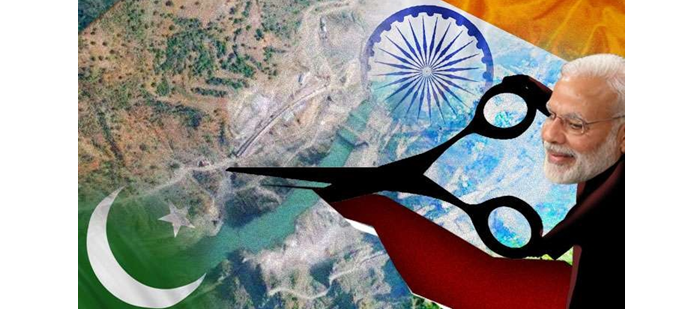
“Echoes of War…….The Illusion of Victory”
"The Cost of Pride…..Paths to Destruction"

When Words Weigh Heavier Than Gunpowder
There are rare and fateful moments in the history of the world — fleeting yet monumental — when words bear greater weight than gunpowder, and the cutting edge of a phrase surpasses the sharpness of a sword’s blade. In such times, a single utterance can prove deadlier than the salvo of a cannon.
Today, as the two nuclear-armed titans of South Asia — Pakistan and India — unsheathe their swords of rhetoric and rain blows of invective upon each other, it is not merely political tension that rides the winds; one can almost feel the dust rising from the pages of history — the same dust that once shrouded fallen civilizations in the ruins of their own grandeur.
In recent days, the relations between Pakistan and India have plunged into a perilous abyss, fuelled by a bitter war of words, efforts to cast doubt upon the Indus Waters Treaty, and increasingly belligerent posturing on both sides. This escalation threatens not only regional security but has also stirred grave concern within the broader international community.
Indeed, the verbal onslaught now unleashed between Islamabad and New Delhi is no mere exchange of heated words — it is the ominous rumbling of a volcano that may at any moment spew forth the lava of conflict.
The warning issued by Pakistan’s National Security Committee — that any attempt by India to cut off Pakistan’s water supply would be deemed an act of war — is no perfunctory statement. Rather, it is a clarion call resounding with the full force of a nation’s historic pride. On the other side, Indian Prime Minister Narendra Modi’s vow that “the attackers and the conspirators shall suffer consequences beyond their imagination” is not simply bravado; it shakes the very foundations of peace across the subcontinent.
In an even sterner tone, Pakistan’s Defence Minister, Khawaja Asif, proclaimed with unmistakable fervour that “every drop of blood spilt shall be avenged,” sending a clear and chilling signal that the nation’s patience has been stretched to its limits.
Meanwhile, the United Nations’ calls for restraint resemble a worn salve applied to a festering wound, wholly inadequate against the gravity of the moment.
The spectre before us is of a kind wherein the slightest misstep might plunge the world into convulsions of violence.
According to the Indus Waters Treaty of 1960 — one of the world’s most enduring accords of peace, which survived even the wars of 1965 and 1971 — the rivers of the Indus, Jhelum, and Chenab were allotted to Pakistan, while the Ravi, Beas, and Sutlej were ceded to India. The treaty provided both nations with clear mechanisms for water usage, dam construction, and dispute resolution.
Yet now, India has ominously declared its intention to “partially suspend” the treaty under Article 12 — a move Pakistan has denounced as a “war-like act.”
Should India proceed to obstruct the natural flow of the rivers allocated to Pakistan or erect dams that diminish their waters, it would not merely constitute a breach of treaty but a desecration of the fundamental laws of nature and an affront to the conscience of humanity itself.
Pakistan contends that projects like the Kishanganga Dam may slash the flow of the Chenab River by as much as 40%, endangering both agriculture and potable water supplies — a crisis in a nation where over 90% of the agriculture depends on riverine waters.
The use of water as a weapon would be a deliberate act of economic sabotage, an attempt to weaken Pakistan from within — a grim and dangerous strategy.
Thus, the life-giving waters that once nourished the roots of civilization are now poised to be weaponized. The Modi government’s threats to dismantle the Indus Waters Treaty stand as the most serious challenge to an accord that weathered storms, wars, and intrigue for over six decades.
Wherever blood irrigates the soil, the flowers of love can never bloom. Historians know well that wars over water are not merely fought on the fields but in the very hearts of men — and when such wars erupt, they seldom halt at borders but consume the very fabric of civilizations.
The fevered declarations — Modi’s pledge of unimaginable reprisals and Asif’s vow of blood for blood — have inflamed public passions on both sides.
Despite the United Nations’ exhortations to exercise restraint and pursue dialogue, little tangible progress has been achieved; the perfunctory rhetoric of the world’s great powers falls far short of the stern action required by the hour.
If they remain content with issuing statements alone, rather than assuming the mantle of true mediators, the fragile peace of South Asia may yet dissolve into smoke in the blink of an eye.
There is a growing apprehension that the war of words may soon transmute into a clash of arms. Both nations could, as history forewarns, drift into limited military skirmishes, border clashes along the Line of Control in Kashmir, and even targeted strikes reminiscent of the Pulwama-Balakot episode of 2019.
Should hostilities escalate, the Arabian Sea might witness rising tensions, and the world might find itself staring into the abyss of a full-fledged war.
And were that to happen — should conventionally war tilt toward defeat for either side — the dreadful shadow of nuclear engagement looms large.
With both nations possessing between 150 to 160 nuclear warheads, any full-scale confrontation could yield not merely millions of deaths but ecological catastrophe on a planetary scale.
Thus, the world stands today at the threshold of a precipice, where measured words and timely action may yet avert a descent into darkness — or where silence and indifference may conspire with fate to unleash a catastrophe without parallel in human history.
A single miscalculation, a single unbridled passion, could plunge humanity into an abyss from which no redemption may arise.
And what of the great powers, those self-appointed custodians of peace? Will they continue to murmur platitudes from afar, or shall they at last bestir themselves to meaningful action, to mediation, to intervention worthy of their vaunted responsibilities?
The hour is late.
The choice is stark.
Either the conscience of mankind shall awaken, and the charioteers of doom be reined in — or, by negligence and folly, the earth shall once more be shrouded in a pall darker than any heretofore witnessed.
The pen is mightier than the sword, they say —
But if the pen is held in trembling, indifferent hands,then the sword shall surely prevail.
In these turbulent times, when tempests once more gather upon the horizons of South Asia, the spectre of nuclear conflict casts its ominous shadow across the globe. Though the present crisis stirs grave anxieties, the voice of history counsels that, by virtue of their possession of atomic arms and the bitter memories of wars past, both Pakistan and India are likely to refrain from plunging into full-scale war. It is most probable that the current hostilities will remain confined to limited military skirmishes, diplomatic entanglements, and fierce negotiations over the waters that sustain life itself.
The immediate intervention of the international community appears not only desirable but imperative, for in the absence of a guiding hand, the embers of discord may well ignite an inferno. The great powers — the United States, China, and perhaps Saudi Arabia — are poised to assume the mantle of mediation. Already, America has voiced its deep concern, whilst the World Bank may yet be moved to breathe life anew into the Indus Waters Treaty, that venerable covenant of peace.
Both nations, beset by economic woes — spiralling inflation, mounting debt, and dwindling reserves — find themselves ill-prepared for the rigours of a protracted war. The doctrine of mutually assured destruction (MAD) looms heavily over any calculations of war, reminding all that in such a contest, there shall be no victor, only mutual ruin.
Yet within India, Prime Minister Modi’s government has long sought to intertwine the rhetoric of Kashmir and national security with the fervour of electoral ambition. The ideology of Akhand Bharat stokes the flames of hostility towards Pakistan, and there are those who surmise that India perceives Pakistan’s economic fragility — buffeted by inflation and the burdens of international debt — as an opportunity to press an advantage. It is whispered that Pakistan, facing fiscal collapse and the iron grip of foreign creditors, might be forced, under unbearable pressure, to yield even its nuclear sovereignty.
Should such perilous designs advance, Pakistan’s military, steeled by history and duty, will doubtless reaffirm its unwavering commitment to national security. And in this fraught theatre, while America regards India as its strategic partner, China stands as Pakistan’s steadfast ally — pledging its support for Pakistan’s security with the same sacred intensity that the United States bestows upon Israel. Alongside China, Saudi Arabia, the United Arab Emirates, and Turkey may offer both material support and diplomatic platforms to steady the trembling balance.
History is a stern witness to the cunning of the great powers, who safeguard their interests with nimble hands but often falter when summoned to the scales of justice. America, if it so wills, possesses the diplomatic muscle to pour cooling waters upon this furnace — but it must do so with impartiality and even-handedness, lest its partiality fan the flames instead of quenching them.
The lessons of Kargil in 1999, when even a limited conflict exacted a grievous toll, should serve as a warning. Pakistan’s swift and measured response to India’s air strikes in 2019 — the downing of a jet and the magnanimous return of the captured pilot — proclaimed not only its vigilance but also its deep-seated desire to avoid unchecked escalation. Likewise, the long months of mobilisation during the 2001–2002 standoff are etched into memory, when nuclear tensions ran perilously high.
The wars of 1965, 1971, and 1999 bore bitter fruit, proving beyond doubt that armed conflict solves nothing and devastates all. Yet, India’s threatened abrogation of the Indus Waters Treaty poses an existential threat to Pakistan’s agriculture and drinking water supply. Should India dare to tamper with this lifeline, military reprisal may become not merely possible but inevitable.
Alarming too is the role of India’s nationalist media, which fans public passions and emboldens bellicosity. The flames of conflict, once kindled, are not easily doused. Now more than ever, both nations must draw wisdom from the ashes of history, lest they commit again the grievous follies of old.
The World Bank and the United Nations must act swiftly and decisively: to admonish India against breaching the sacred trust of the Indus Waters Treaty; to restore the sanctity of negotiated settlements; and to reanimate earnest dialogue on Kashmir, perhaps revisiting the ceasefire understandings of 2003.
Economic and diplomatic hostilities — the severing of trade, the expulsion of envoys — must be halted without delay. Likewise, the dark art of cyber warfare, which threatens the very foundations of national infrastructure, must be renounced.
Both Pakistan and India must forsake the perilous temptation to seek domestic applause through “cross-border” ventures, for such gambits sow the seeds of greater catastrophe. The path to lasting peace lies not through the roar of cannons but through the whisper of reason.
The Immutable Verdict of History: In the Crucible of War, None Prevail
History — that stern and unerring tutor of mankind — imparts an ironclad lesson: in war, there are no true victors; only broken nations, shattered hopes, and a humanity forever diminished.
The chronicle of the Indian subcontinent bears grim testimony to this axiom — from the bloodied heights of Kargil to the charred ruins of Mumbai, from the hopeful overtures of the Lahore Declaration to the faltering aspirations of the Agra Summit — every encounter bears the crimson imprint of ruin, not honour.
The resonant cadences of Allama Iqbal, that sage of the East, still stir the conscience:
جنگ اپنے اصولوں پہ اگرچہ ہے قتال
ہے مگرعشقِ وطن کارِدرویشاں بھی
“Though war may unfold by codes of gallantry,
The love of one’s homeland remains the sacred labour of the humble.”
جنگ وجدل سے شہراجڑے،بستی ویران ہوئی
اے میر!اب کے ہم بھی چپ رہے،دل خون ہوا
And the plaintive lament of Mir Taqi Mir whispers its sombre wisdom across the centuries:
“Through carnage and strife, the cities lay barren,
O Mir! This time, we too remained silent, though our hearts wept blood.”
The escalating tensions between Pakistan and India are not mere matters of political contention; they are the precursors of cataclysm. One misjudged act, one reckless word, could ignite a conflagration that would engulf generations unborn. In war, no banners fly high for long; no laurels endure the fires of devastation. Only mothers weep over empty cradles; only civilisations consign their dreams to unmarked graves.
This land — which the Almighty adorned with rivers, mountains, and the fragrance of love — now smoulders with the acrid smoke of hatred and suspicion. Should reason fail to assert its dominion once more, history will be condemned to write yet another blood-soaked elegy upon the scrolls of human folly.
At such a perilous crossroads, wisdom — not wrath — must be our guide; for now is not the hour to brandish sabres in the bazaars of arrogance, but to illuminate the twilight with the flickering lamps of prudence.
The tenor of these grim times recalls that timeless admonition:
“Reason is mired in endless critique,
While love demands foundations laid in earnest deeds.”
If reason surrenders itself to sterile disputation, and love of the homeland is reduced to the fuel of demagogues’ bonfires, then both nations shall find themselves cast into the abyss where hope perishes and darkness reigns.
The parchments of history now confront us with an inexorable question:
Shall we prove ourselves the worthy heirs of a noble civilisation, or shall we become the careless architects of mutual ruin?
There are glimmers, however faintly, a shaft of hope.
Among the discerning, there persists a belief that the bitter harvests of the past — 1947’s partition, the wounds of Kargil, the scars of Mumbai — may yet temper the impetuousness of the present. Perhaps through the furnace of sorrow, a reluctant wisdom has been wrought: the realisation that total war is no less than a covenant with annihilation, and no people possessed of reason crafts its own funeral shroud.
Thus, the imperative of our age is clear: that the leaders of both nations must quell the tempests of pride within their breasts and lift high the lantern of foresight and moderation. For upon the battlefields of the world, there lies no greater casualty than humanity itself.
When the gales of hatred howl across the borders, when the flickering lamps of fraternity are threatened by the rough winds of chauvinism, true statesmanship lies not in answering fury with fury, but in binding up wounds and rekindling trust.
The growing hostility between Pakistan and India must be understood for what it is: not a momentary lapse in diplomacy, but a sword of Damocles hanging over millions. In the bitter arithmetic of war, there are no victors — only devastated fields, deserted homes, and civilisations that mourn their unborn futures.
The parable of the two princes offers a cautionary mirror to our plight:
Once, two rival heirs waged endless war across a river that sustained their realm. The river, neglected and befouled by their strife, withered away; the fertile fields cracked and perished. At last, when their arms fell limp from exhaustion, they beheld their inheritance: barren earth, broken thrones, and the ceaseless moaning of a desolate wind. Then a venerable sage proclaimed:
“Upon soil steeped in blood, no flowers of love shall ever bloom.”
Ours is the only region in the world where four declared nuclear powers — with a fifth poised upon the threshold — stand arrayed in uneasy proximity. In such a powder keg, even the faintest spark could ignite a blaze that would consume not only the subcontinent but the whole of humanity. Thus, the call for lasting peace is not a provincial plea, but a command from the conscience of mankind itself.
In pursuit of that peace, urgent and solemn measures are required:
Immediate restoration of the Indus Waters Treaty in letter and in spirit;
Establishment of a neutral forum for sustained dialogue over Kashmir;
Joint endeavours to extirpate the menace of terrorism;
Cultivation of moderation within media and public discourse, tempering passion with responsibility.
When the fierce winds of hatred threaten to snuff out every light, when the fever of political frenzy tears the diadem of reason from the brow of governance, then shall entire generations see their dreams trampled beneath the iron feet of war.
True leadership, in such dire hours, does not inflame old animosities; it seeks the healing balm of reconciliation, the humble wisdom that elevates prudence above passion, and humanity above hubris.
Now is the time to break the shackles of pride, to hoist the standard of wisdom aloft before the storm.
Now is the hour to heed the whisper of history before it becomes the roar of calamity.
We pray that Providence may yet instil within the hearts of rulers a shaft of divine insight — that they might rend asunder the veils of enmity and ascend towards the horizons of peace.
May the gentle zephyrs of amity replace the scorching winds of hatred and may the lamps of hope once again illuminate the darkened plains of the subcontinent. A’ameen.
✨For if history has taught us anything, it is this:
Wars do not resolve the ailments of nations. They only deepen their wounds.
The only true conquest lies in the peaceful triumph of humanity over its baser instincts.