Echoes of Sacrifice, Shadows of Tomorrow
A Nation Not Yet Complete

The Twilight of Empires and the Dawn of Nations
An August Reflection on Pakistan’s Independence
When the pen of Destiny trembles upon the Tablet of Eternity, moments are distilled from the goblet of Time that kindle the lamps of a nation’s rebirth. The 14th of August, in this sacred chronicle of history, is one such moment of transcendence—soul-stirring, epoch-making. It breathed the fragrance of liberty into the oppressed lungs of the Muslims of the subcontinent, liberating them from the rusted manacles of servitude and despair.
This day is not merely a date in the calendar; it is the echo of Bilal’s call, the edge of Khalid’s sword, the justice of Umar, the wisdom of Ali, and the knowledge of Hassan—all reincarnated in a moment that reawakened a nation. It reminds us that our covenant was not with the soil; it was with the shahādah, the eternal cry of لا إِلَهَ إِلَّا اللهُ — There is no deity but Allah.
This land is not merely geography; it is a saga written in scarlet across the desert sands—a sanctified trust watered by the blood of martyrs, whispered into being by the last breath of the fallen faithful.
Had there been no Pakistan, the destiny of Muslims might have been no more than the relics of a fading past—mere gravestones in Delhi, Lucknow, Benares, and Hyderabad. The minarets would have still stood—but their muezzins would have required permission to raise their voices in the praise of God. The veil, the adhan, the very breath of Islamic identity—might well have been relegated to dusty folklore, chapters in history books written by foreign hands.
This day, then, is not simply one of independence—it is the triumph of an idea, the vindication of a vision, a philosophical rebuttal to every creed that reduces nationhood to mere accidents of race, language, or region. It is a day when the architects of belief declared unto the world that nations are not birthed of bloodlines and borders, but of conviction, creed, and spiritual unity.
Had there been no Two-Nation Theory, we would find neither the hearts of our youth aflame with the love of Madinah, nor the impassioned cries of freedom echoing from the vale of Kashmir.
Indeed, the ebb and flow of Time moves nations as chess pieces upon the grand board of Providence. As the Qur’an declares:
وَتِلْكَ الْأَيَّامُ نُدَاوِلُهَا بَيْنَ النَّاسِ
“And these are the days We alternate among the people.” — (Āl-ʿImrān 3:140)
So, O people of the homeland, remember this: Freedom was not served to us upon a silver salver. It emerged from an ocean of sacrifice, drawn forth like a pearl bathed in the sighs of forefathers, in the prayers of mothers, and in the sacred crimson of martyrs.
This is a day of covenant renewal—a day to reaffirm fidelity to our soil, our nation, our civilisation, our faith, and the luminous ideals upon which our forebears staked all.
وَمَنْ أَحْسَنُ قَوْلًا مِّمَّنْ دَعَا إِلَى اللهِ وَعَمِلَ صَالِحًا وَقَالَ إِنَّنِي مِنَ المُسْلِمِينَ
“And who is better in speech than one who calls to Allah, does righteous deeds, and says: ‘Indeed, I am of the Muslims.’ — (Fussilat 41:33)
This verse of the Qur’an illuminates the month of August not only with the spirit of independence, but with the light of purpose. In celebrating this month, we are invited not to a festival of flag-waving, but to a deeper historical introspection. Had there been no Pakistan, what would have become of the Muslim condition?
This meditation inexorably leads us to the moral and cultural affirmation of the Two-Nation Theory—a framework that transcends borders and maps, grounding nationhood in sacred identity.
The month of August thus heralded not merely the independence of a territory, but the intellectual emancipation of a people. Had Pakistan not emerged, the Muslims of the subcontinent might have wandered through the haze of history, their societal, political, and cultural existence cloaked in an unnatural fog.
Time itself has vindicated the Two-Nation Theory: that Hindus and Muslims, inheritors of vastly divergent civilisations, histories, and creeds, could not thrive under a singular polity. Without freedom, the Muslim majority would have withered into a political minority under the shadow of imperial dominion. The Two-Nation Theory proved that without distinct cultural identity and political autonomy, a dignified society for Muslims would have remained an illusion.
Absent independence, Muslim life might have been subjected to the slow suffocation of religious, military, and cultural oppression. Rights curtailed, voices stifled, the soul of a people gradually erased. Their identity might have faced relentless erosion, and their political voice reduced to a whisper. Social decline would have been inevitable, and inner discontent unavoidable.
Thus, the creation of a separate homeland in the subcontinent was not a geographic adjustment but the birth of a new cultural and political intensity—a mirror reflecting not just freedom of land, but freedom of thought.
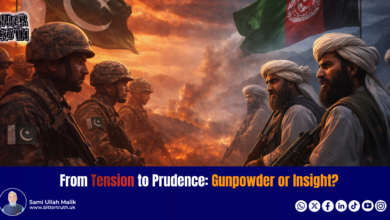
In May 2025, history once again turned its piercing gaze upon the subcontinent. A fierce military confrontation erupted between Pakistan and India. Under “Operation Sindoor,” India launched a series of missile and drone attacks. Pakistan responded with calculated fury. The Pakistani Falcons retaliated with precision, targeting Indian bases, and for the first time, the Chinese-built J-10C fighter jets demonstrated dominance over the much-celebrated French Rafale.
The myth of invincibility was shattered. Indian aircraft were downed, debris scattered across the land, images of wreckage shared across the globe. New Delhi awoke to the sobering reality of Pakistan’s resolute defence.
In desperation, both India and its close ally Israel appealed to Washington for a ceasefire. The same United States that had, in the early days of the conflict, worn a smirk of amused detachment, suddenly leapt to play peacemaker. President Trump claimed credit for the de-escalation—boasting, no less than thirty-five times, of his mediating role.
Indian authorities, humiliated, attempted to deny any foreign pressure. Yet none dared contradict Trump’s repeated declarations. The Indian media, along with sympathetic Western outlets, waged a war of words—but the brilliance of Pakistan’s defence had upended regional dynamics. Global analysts expressed astonishment at Pakistan’s military efficacy.
The crescendo of embarrassment came when the CEO of the Rafale-manufacturing firm confessed before international press that, “We sold aircrafts, but not courage to fly them.” The Modi administration insisted the operation was ongoing. But internally, a tremor of doubt coursed through New Delhi. Opposition leaders voiced concern over the growing threat of foreign military entanglements, particularly with China.
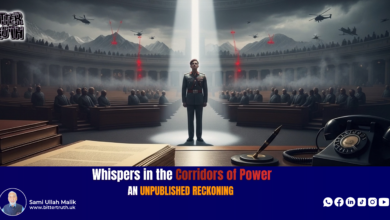
And so, the region remains uneasy. Whether this border confrontation has truly receded into history or lies dormant, ready to reignite, remains uncertain. What is certain is this: the resolve, resilience, and readiness of Pakistan has sent tremors through the corridors of power.
This, too, is independence. Not just the memory of 1947, but its living inheritance.
The Balance of Power and the New Geopolitical Order
A Strategic and Economic Analysis in the Wake of Victory
In the fiscal year 2024–25, Pakistan allocated PKR 2.55 trillion (approximately USD 9 billion) to defence—marking a significant 20% increase. Operating expenditures alone amounted to PKR 704 billion, reflecting a 29% rise, with personnel costs at PKR 846 billion and pensions at PKR 742 billion. In contrast, India boosted its defence budget by 5.9%, raising it to a staggering USD 78.7 billion—almost nine times greater than Pakistan’s allocation, and equivalent to 9.1% of its GDP. Yet, the recent Indo-Pak conflict left India humiliated on the global stage, its bloated budget unable to buy battlefield dignity.
Pakistan’s external debt now stands at approximately USD 87.4 billion, with nearly 1.9% of GDP servicing these obligations. China remains its principal creditor. In parallel, Pakistan has embarked on a USD 7 billion stabilisation programme with the IMF, aiming to anchor its economy amid turbulent waters. The nation’s economic growth target stands at 4.2%, though actual growth in 2024–25 was a modest 2.7%. Inflation is projected to settle at 4.7%.
Despite financial headwinds, global financial institutions have begun to view Pakistan’s reformist efforts with cautious optimism. Under the IMF programme, Pakistan has made strides towards fiscal prudence, trimming the overall federal budget to PKR 17.57 trillion (USD 2 billion), while nonetheless maintaining an upward trajectory in defence spending.
Recent improvements in Pakistan’s formal credit ratings signal a tentative return to stability. These are, by no means, the triumphal fanfares of prosperity, but rather the steady drumbeats of resilience and reform. Amid these developments, Pakistan’s time-tested military alliance with China continues to thrive, nurtured by the enduring ethos of an “all-weather friendship.” The China–Pakistan Economic Corridor (CPEC), joint defence production, modern weaponry, intelligence cooperation, and coordinated military drills reinforce this alliance. China remains Pakistan’s largest arms supplier, accounting for 81% of its total imports from 2019–24. The horizon holds further depth: Pakistan is reportedly moving to acquire fifth-generation stealth fighters, including the FC-31 and J-35, from China.
The bilateral military synergy now encompasses co-production of platforms such as the K-8 and JF-17 fighter jets, cooperation in nuclear infrastructure, and maritime, aerial, and land defence projects. China’s investment in Gwadar Port under CPEC is poised to transform it into a strategic deep-water hub. The Chinese Foreign Ministry has reiterated that this military partnership is “routine” and “not aimed at any third party.”
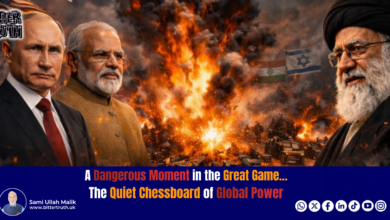
Following its battlefield success, Pakistan has seen the arc of diplomacy begin to bend in its favour. In Iran’s parliament, chants of “Long live Pakistan” echoed, while the Iranian President’s first official overseas visit was to Islamabad—a symbolic pivot away from New Delhi. Pakistan’s balanced stance in the Israel–Iran conflict resonated well with Tehran, altering the regional diplomatic calculus.
Iran has now adopted a more conciliatory posture toward Pakistan, opening fresh avenues in regional politics. The two nations recently signed twelve Memoranda of Understanding, spanning enhanced land connectivity, the Quetta–Zahedan railway line, trade corridors, and integration with Iran’s Silk Road projects at Gwadar and Chabahar ports.
This is not mere economic collaboration—it is the dawning of a new strategic partnership. A Free Trade Agreement has been finalised, and both nations have pledged full-spectrum cooperation in combating terrorism. For India, these developments represent a diplomatic body blow. Tehran is well aware of India’s alleged support for Israel with nearly a million personnel during the recent skirmishes. Iran’s distancing from India and warming relations with Pakistan deliver a clear message: the diplomatic winds have shifted.
Alongside the Iran pivot, a new chapter is unfolding with the United States. President Trump’s recent remarks—that India may one day rely on Pakistan to meet its oil needs—have not only underscored Pakistan’s growing significance but also delivered a political jolt to the Modi administration.
On 31 July 2025, Pakistan and the United States signed a landmark economic agreement. Under its terms, the U.S. will assist Pakistan in developing its extensive crude oil reserves located in Balochistan, Sindh, Punjab, and Khyber Pakhtunkhwa. President Trump confirmed that a U.S. oil company is being considered to partner in this venture, with the long-term vision that one day, Pakistan might even export oil to India.
Pakistan’s vertically integrated oil refining giant, Synargico, will oversee the import of the first shipment of American crude. Should the pilot phase succeed, monthly shipments are expected to follow. The agreement also entails tariff reductions, especially on Pakistani exports, expanding market access and stimulating investment.
But this accord extends far beyond energy. It encompasses cooperation in cryptocurrency, digital infrastructure, and IT. In March 2025, Pakistan established its own Cryptocurrency Council (PCC), led by Finance Minister Muhammad Aurangzeb, with Binance co-founder Changpeng Zhao appointed as strategic advisor. The PCC has since established a strategic Bitcoin reserve and allocated 2,000 MW of additional power for crypto mining and AI-powered data centres—positioning Pakistan as a hub for blockchain investment.
America’s interest in Pakistan now spans not only resource extraction but also technology and digital finance. Analysts view the combined access to oil reserves and preferential trade terms as a dual triumph—”two birds with one throne,” as one commentator remarked.
Meanwhile, under the CPEC umbrella, China continues to play an active financial and technological role. America’s resurgence in the region could herald a new strategic contest with Beijing—ushering in a dynamic equilibrium where Pakistan may emerge not merely as an ally, but as an arena of great power competition and cooperation alike.
The Turning of the Tide — A New Geopolitical Chapter for Pakistan and the West
The agreement marks the unveiling of a new economic pathway for Pakistan. With American partnership, Pakistan’s oil production is set to surge; trade corridors may reopen; and advancement in cryptocurrency and the IT sector appears not only plausible but promising. Admittedly, the road is fraught with diplomatic, political, and domestic perils — yet, with prudence and sagacity, this very path may shepherd Pakistan into a new epoch of economic awakening.
But a more compelling question looms: what lies beneath America’s sudden departure from India’s embrace and its overtures towards Pakistan? What secrets lie cloaked beneath this diplomatic volte-face?
In its 3rd August 2025 edition, The Economist features a seminal analysis suggesting that the pivotal meeting between Field Marshal General Asim Munir and US President Donald Trump in Washington on 18th June 2025 has heralded a significant recalibration of American regional policy. According to the piece, this summit marked the dawn of a new chapter in Pakistan–US relations, breaking through the glacial indifference of recent years and paving the way for a more temperate diplomatic stance.
Shortly after, Trump castigated India’s economy as a “wilted and lifeless system,” imposing a punishing 25% tariff — with more sanctions foreshadowed. In contrast, he declared a new trade framework with Pakistan, hinting at a reduction in the pre-existing 19% tariff. India, accused of circumventing Western sanctions by purchasing Russian oil, retorted that such decisions stemmed from economic exigency. New Delhi asserted it merely refined and re-exported the oil, functioning as a conduit rather than a consumer.
Meanwhile, Pakistan extended an olive branch by offering mineral access in Balochistan and voicing willingness to import more American oil and foster targeted investment incentives. Trump’s rhetoric was thus not mere populist flourish, but a calculated gesture aimed at strategic realignment. In response, American diplomatic circles moved swiftly to elevate Pakistan’s status to that of a major non-NATO ally, rekindling discussions on arms sales, defence cooperation, and counterterrorism — all of which had long remained dormant.
The Economist posits that General Munir’s summit was far from a perfunctory diplomatic gesture; rather, it re-centred Pakistan within the South Asian balance of power. The United States, having once tethered its strategic hopes almost exclusively to New Delhi, now appears to be unfastening that bond. A softer tone and economic engagement now characterise its posture toward Islamabad, whereas India finds itself burdened with punitive tariffs and a conspicuously cooler reception.
American interest has also begun to crystallise in sectors such as energy, mineral exploitation, and cryptocurrency within Pakistan. By contrast, India has found itself publicly censured for its oil dealings with Moscow. This divergence marks a significant strategic pivot. With this shift,
Pakistan emerges not just as a hopeful partner, but as a preferred strategic interlocutor.
According to The Economist, this reorientation reaches far beyond bilateral relations — extending to Kashmir, Iran, China, and the broader Middle East. In so doing, Washington has seemingly offered Pakistan not merely temporary favour, but an augmented role in shaping regional diplomacy and security. In the evolving theatre of South Asian geopolitics, Pakistan appears to have ascended from peripheral observer to pivotal player.
As the shadows of history part to reveal a new dawn, we find ourselves not in the mere march of time, but at the inflection point of human will. In this context, Russia’s formal withdrawal from the Intermediate-Range Nuclear Forces (INF) Treaty, coupled with its vow to deploy ballistic and cruise missiles across Europe, Asia, and the Pacific, is nothing short of a thunderclap across the diplomatic firmament. The tremors have reverberated far beyond the Kremlin — felt acutely in Washington, Beijing, Delhi, Islamabad, and Brussels alike.
This tectonic shift emerges at a moment when the world already finds itself mired in an unprecedented nexus of military, economic, and ideological turmoil. The INF Treaty, signed in 1987 by President Ronald Reagan and Soviet leader Mikhail Gorbachev, had prohibited land-based missiles with ranges between 500 and 5,500 km. This accords once shielded Europe from imminent nuclear peril. Its demise began with the US withdrawal in 2019 and is now sealed by Russia’s final renunciation.
Moscow’s unequivocal announcement — not merely withdrawing but committing to fresh missile deployments — is an ominous harbinger. The dream of a demilitarised Europe, tenuous at best, now lies in shards. NATO allies are awakening to echoes of the 1980s, when Soviet warheads cast a long shadow across the continent. Nations like Germany, Poland, and the Baltic states once again find themselves at the edge of a strategic precipice.
The undoing of the INF Treaty threatens to unravel the strategic balance painstakingly cultivated during the Cold War. It was a linchpin in curtailing the arms race. Its dissolution risks catalysing a renewed spiral of militarisation. Given that intermediate-range missiles can strike deep into European territory, their reintroduction has triggered palpable anxiety among NATO capitals — particularly those with a grim memory of being Soviet targets.
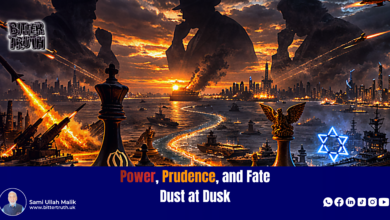
Thus, while Pakistan stands at the threshold of newfound opportunity, the broader global canvas is streaked with ominous hues. Diplomacy is no longer a chessboard of old alliances but a tempest of shifting allegiances and emergent threats. The winds of change are swift, but history belongs to those who learn to sail them.
The Winds of Irony: A Strategic Elegy in the Age of Missiles and Memory
As the shadow of Russian missile deployments looms ominously across the geostrategic theatres of Asia — encircling China, Japan, India, and Pakistan — the region teeters upon the precipice of peril and uncertainty. It is no longer a chessboard of diplomacy but a loaded cannon of consequences. Should these weapons of calibrated menace find stations in proximity to the subcontinent, the spectre of a new and unrelenting arms race becomes not a possibility, but a prologue.
In the theatre of the Pacific, this is not merely sabre-rattling; it is a clarion challenge to American supremacy. The island bastion of Guam, and the fortified flanks of South Korea — long cherished nodes of American military architecture — now rest within the crosshairs of Moscow’s recalibrated wrath.
For Pakistan, oft sandwiched between the burden of Indian militarism and the ambiguity of Western alignments, this moment may portend both risk and rare opportunity. Should Islamabad choose to court Moscow with calculated sobriety, a new corridor of strategic depth may be paved. Joint exercises, technological exchange, and cooperative missile defence could reshape the regional balance — not through rhetoric but resolve.
Though Russo-Chinese camaraderie remains officially congenial, this missile deployment sends Beijing a barbed whisper: stray not from the axis of Russian interest. Even allies must occasionally be reminded that in the grand theatre of geopolitics, loyalty is often provisional.
Across Asia, a new tremor stirs beneath the diplomatic crust. For Washington, self-styled guardian of the Pacific dominion, Moscow’s manoeuvre is more than provocation — it is a manifesto. Japan and South Korea, under America’s aegis for decades, now find themselves closer to the line of fire than at any time since the Cold War.
For Pakistan, this is a double-edged sword. On one side: tension, turbulence, and the spectre of escalation. On the other: a prospect for diversified strategic alliances — especially at a time when Islamabad balances delicately between Beijing’s patronage and Washington’s transactional engagement.
India, meanwhile, finds itself caught in an ironic bind. Having long enjoyed the patronage of Moscow in defence procurement and strategic cooperation, New Delhi’s recent flirtation with Washington has frayed the Russian trust. The missile deployments may thus be a subtle rebuke — a recalibration of Moscow’s regional favouritism.
In the domestic sphere, Prime Minister Modi’s star appears to be waning. The aftermath of the Pahalgam incident once again witnessed the predictable finger-pointing towards Pakistan — a well-worn diplomatic trope. Yet this time, the world did not rise to the bait. Even spokesmen of the Indian military, in a rare moment of retreat, appeared to distance themselves from the claim — revealing the fragility of New Delhi’s narrative.
Today, the world stands at an inflection point where even the subtlest shift in military calculus may rewrite the destinies of entire continents. Russia’s formal withdrawal from the Intermediate-Range Nuclear Forces Treaty, the nascent Pakistan-Iran détente, burgeoning US-Pak economic ententes, and India’s creeping global isolation — all these mark not disjointed events, but notes of a singular symphony: the emergence of a new world order.
Russia’s departure from the INF Treaty is more than a legal manoeuvre; it is a philosophical declaration. Power shall no longer be chained to treaties inked in the sepia-toned past. The strategic balance is no longer a matter of treaties, but of will.
O people of the homeland!
True independence lies not merely in the drawing of borders, but in the emancipation of thought, the assertion of economic dignity, and the revival of Islamic civilisation.
As the Qur’ān proclaims:
قُلْ إِنَّمَا أَدْعُو رَبِّي وَلَا أُشْرِكُ بِهِ أَحَدًا
Say: “I only call upon my Lord and I associate none with Him.” (Sūrat al-Jinn, 18)
In such grave and stirring times, the commemoration of Independence must be no hollow ritual of flags and fireworks. It must be a reaffirmation of national unity, Islamic creed, and moral coherence. Let our mosques resound with Qur’anic recitations; let our academies revive the soul of scholarship; let our military establishments embrace the divine word as the ultimate doctrine of defence.
Let this 14th of August be more than an anniversary — let it be an awakening. An awakening of hearts to the Qur’ān’s truth, of voices to patriotic poetry, and of institutions to the cause of collective dignity. Let our youth be mentored not merely in trade and technology but in the fire of character and the clarity of vision. Let our celebrations be shared with the neglected, the marginalised, and the forgotten.
It is through such remembrance that freedom acquires meaning — not in the unfurling of bunting, but in the rekindling of belief. Not merely in the survival of a state, but in the flourishing of a civilisation.
May God grant this nation everlasting peace, prosperity, and the awakening of the Islamic conscience. Āmīn.
And now, as we gaze into the mirror of our national past on the eve of independence, let us not rest in the comfort of rhetoric. Let us awaken the soul of Pakistan — for this land is not merely soil and sovereignty. It is the caravan of dreams, sacrifices, and prayers — each milestone watered by a mother’s tears, a father’s hopes, a martyr’s blood, and a scholar’s ink.
Let us remember — the realisation of Pakistan remains incomplete. The vision that birthed it finds fulfilment not in geography, but in the illumination of every citizen’s conscience. Freedom, in its highest sense, is not territorial — it is intellectual, economic, and spiritual. It is the justice of ʿUmar, the wisdom of the Qur’ān, and the law of Muḥammad ﷺ.
This is the hour to rise above political disarray, economic despair, and cultural dislocation. We are summoned not to battlefields, but to blackboards; not to slogans, but to sincerity. The new migration, the new Badr, the new Karbala — shall not be won with the sword, but with the pen, with discipline, and with taqwā.
As Quaid-e-Azam declared:
“Work, work, and work.”
And as Iqbal called out:
نہ تُو زمیں کیلئےہے، نہ آسماں کے لیے
جہاں ہے تیرے لیے، تُو نہیں جہاں کے لیے
“Thou art not made for the earth nor the sky;
The world is made for thee — not thou for the world.”
So, O people of Pakistan:
Let tonight’s illuminations be glorious —
but let tomorrow’s dawn be solemn, radiant with resolve.
Pakistan is not just a country —
It is a mission, a trust, a banner of belief.
And every Pakistani is its custodian, its torchbearer, and its pledged guardian.
Pakistan Zindabad.
Nazarīyah-e-Pakistan Pāyindah Bād.