Kashmir: The Conscience of the World on Trial
Echoes from a Silent Valley

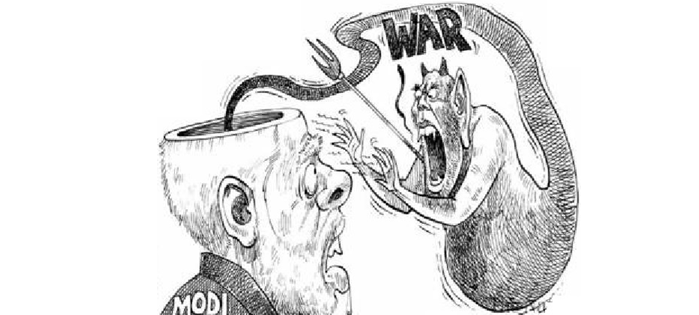
Once again, the ever-smouldering embers of hostility between India and Pakistan flared into open flame, thrusting South Asia perilously close to the precipice of nuclear conflict. India’s belligerent posturing was met with Pakistan’s calibrated yet resolute response—one that compelled the global community to reckon with the gravity of the situation. While the United States initially feigned indifference, the sheer volatility of the moment forced its hand. This article examines India’s strategic failure, the shift in American posture, the legal merits of the Kashmir dispute, and the diplomatic avenues available to Pakistan.
The crisis was triggered on the 14th of February 2019, when a deadly assault in Pulwama claimed the lives of 40 Indian paramilitary personnel. Without furnishing credible evidence, India swiftly pointed fingers at Pakistan and, in a theatrical display of might, carried out an airstrike in Balakot on 26 February. However, the reality proved less dramatic than the rhetoric: Indian jets dropped ordnance on barren hillsides, their targets no more than the silent sentinels of pine and stone.
In a calculated act of military poise, Pakistan retaliated on 27 February by downing two Indian aircraft and capturing one pilot—Wing Commander Abhinandan Varthaman. In a magnanimous gesture that echoed the spirit of peace and international responsibility, Pakistan repatriated the pilot, earning plaudits from capitals across the globe. In stark contrast, India’s chest-thumping bravado lay in tatters, its military capabilities called into question, its global image diminished.
Initially, both President Donald Trump and Secretary of State Mike Pompeo dismissed the hostilities as regional squabbling—longstanding and of no strategic concern to Washington. Yet, once India’s gambit was effectively neutralised, Washington pivoted with striking haste. The very same America that claimed disinterest scrambled to broker a ceasefire, issuing statements and leveraging diplomatic channels. Clearly, the American priority was not moral arbitration but the preservation of balance in a theatre of emerging powers—where its own interests, particularly vis-à-vis the China-Pakistan Economic Corridor (CPEC), were at stake.
President Trump, in an almost farcical remark, had initially quipped that the two nations had been “fighting forever”—a conflict, in his words, “none of our business.” But as Pakistan’s swift retaliation exposed India’s vulnerabilities, the White House adopted a markedly different tone. Diplomats were dispatched, tweets were launched, and in a flurry of backchannel activity, the United States declared its willingness to mediate—an offer that reeked less of altruism and more of strategic necessity.
This volte-face raises profound questions. Is America truly an impartial mediator, or merely a crutch upon which New Delhi leans in times of humiliation? Would the same urgency have been observed had India emerged victorious? The evidence suggests otherwise. The timing and tenor of Washington’s intervention betray a desire to afford India a diplomatic fig leaf, shielding its bruised pride from further scrutiny.
Nor is this an isolated miscalculation. In the summer of 2020, India once again found itself outmanoeuvred—this time by Chinese forces along the Line of Actual Control (LAC) in Ladakh. Despite its bombastic nationalism, the Indian government was forced to concede the loss of several thousand square kilometres, a fact reluctantly admitted by Defence Minister Rajnath Singh before the Indian parliament.
India’s designs to strangle CPEC by severing Gilgit-Baltistan via Ladakh met an ignominious end. The Sino-Pak alliance, underpinned by economic pragmatism and military coordination, thwarted this stratagem. In the broader canvas of Asian geopolitics, India finds itself a floundering actor—outflanked militarily, exposed diplomatically, and burdened with internal contradictions.
Washington, for its part, must now question whether Prime Minister Modi’s India is the reliable bulwark it had envisioned against China. The Indian debacle in Ladakh, coupled with its failure to assert dominance over Pakistan, has cast doubt upon its credibility as a cornerstone of the so-called Quad alliance. Behind the façade of alliance, murmurs of disillusionment are growing in American strategic circles.
Was, then, the American mediation offers nothing more than an elaborate performance—to provide Modi with “face-saving” rather than any genuine peacebuilding? There is ample reason to believe so. The Twitter-proclaimed ceasefire was not a triumph of diplomacy, but a tacit admission of failure—a hurried attempt to draw the curtains on a farcical episode before it unravelled further.
America, in framing its involvement as a bid to avert nuclear catastrophe, cloaks its real motives. Its primary interest lies not in justice for Kashmiris or parity for Pakistan, but in maintaining its geostrategic foothold in South Asia. Had India prevailed militarily, Washington’s tone would likely have been different—more congratulatory than conciliatory.
President Trump’s claim in 2019 that Prime Minister Modi had invited him to mediate the Kashmir issue was quickly denied by India. Yet the proposal lingered in the air like the smoke of distant artillery—neither confirmed nor wholly disavowed. His renewed call for neutral-ground negotiations must be seen in light of this earlier declaration. Symbolic, perhaps; sincere, unlikely.
India’s longstanding insistence that Kashmir is a “domestic matter” precludes any meaningful third-party intervention. This position has hardened since the unilateral revocation of Article 370 in August 2019. Conversely, Pakistan continues to welcome international mediation, pointing to UN resolutions that affirm the Kashmiris’ right to self-determination.
Yet, as matters stand, Trump’s offers ring hollow. The current American administration has shown little appetite for revisiting the Kashmir conundrum. Symbolism aside, the prospect of genuine mediation remains dim—overshadowed by the spectre of geopolitical interests and strategic alliances.
Is the United States Enabling India’s Military Rehabilitation? A Geopolitical Refrain in the Shadow of Kashmir
The pivotal question before us today is whether the United States is subtly affording India the latitude to recuperate its diminished military stature. To comprehend this, one must examine the intricate tapestry of regional geopolitics, woven ever more tightly by the strategic rivalry between Washington and Beijing. India’s recent misadventures — from its ignominious skirmishes with Pakistan to its humiliating standoff with China in Ladakh — have revealed uncomfortable truths about the state of its armed forces. For the United States, which envisions India as a keystone in the architecture of the Quadrilateral Security Dialogue (QUAD), such weaknesses are a cause for mounting concern.
Washington, desirous of preserving India’s posture as a bulwark against China’s ascendance, may well be extending both military succour and economic reinforcement — not out of benevolence, but from a calculated need to prevent New Delhi from becoming a lame sentinel. Yet, it remains equally evident that any overt military conflagration with Pakistan would prove catastrophic, not least because both nations are custodians of nuclear arsenals. In this context, the American endorsement of a ceasefire is portrayed not merely as a call for restraint, but rather as a strategic pause — a purchase of time under the pretext of peace.
Indeed, the deeper motive behind Washington’s mediation lies in preserving regional equilibrium and curtailing Beijing’s strategic reach. A nuclear confrontation in South Asia would not merely imperil two sovereign nations but would reverberate across global markets and fracture the fragile edifice of international security. The United States, keen on maintaining Pakistan as a partner in counterterrorism, simultaneously desires to marshal India against China — a diplomatic duality that belies its avowed neutrality.
Pakistan, for its part, remains China’s steadfast ally, and hence an indirect pillar of resistance to America’s Indo-Pacific strategy. Should India suffer further military or diplomatic erosion, it may cease to be the reliable counterweight the United States seeks. Furthermore, any armed engagement would jeopardise the strategic interests of Washington’s allies in the region, such as Saudi Arabia and the UAE — stakeholders whose economic entanglements in South Asia are far from trivial.
India’s failures — be it the rout in Ladakh, the international condemnation of its Kashmir policy, or its flagging diplomatic capital — have led some Western analysts to question New Delhi’s dependability. Within the QUAD alliance, India’s role, once heralded as decisive, now appears conditional upon its efficacy. The growing strategic convergence between China and Pakistan, exemplified by the success of the China-Pakistan Economic Corridor (CPEC), has palpably altered the region’s balance of power.
American media and policy circles are now furnishing varied justifications for their timely intervention. Among them, the spectre of nuclear escalation looms large. A decisive Indian victory or an unambiguous Pakistani defeat could have invited Chinese intervention — a development fraught with peril for Washington’s broader calculus. Moreover, a resurgent India may have diminished China’s influence, yet a destabilised Pakistan would unleash spectres of terrorism, insurgency, and strategic collapse — opening a Pandora’s box the West can ill afford, particularly as it remains entangled in the morass of Ukraine.
It is, therefore, not mere coincidence that President Trump, during his recent diplomatic forays through Saudi Arabia, Qatar, and the UAE, eagerly claimed credit for brokering the Indo-Pak ceasefire. He even ventured to suggest that the two countries might soon enter dialogue on neutral soil, touching upon matters as weighty as Kashmir. For Pakistan, this prospect necessitates careful diplomatic choreography. The government must marshal its full diplomatic arsenal and secure the confidence of its citizenry. Prior to any formal engagement, a joint session of Parliament, along with an address to the nation, ought to clarify the negotiating agenda — ensuring that no illusions are harboured, and no betrayals feared.
It must be remembered that India, consistent with its obdurate stance, may once again declare Kashmir an “internal matter” and thereby seek to remove it from the purview of talks altogether. Pakistan, in anticipation of such perfidy, must solidify its alliances — engaging China, Turkey, and key Islamic nations to apply collective pressure upon New Delhi.
Moreover, Pakistan must tread cautiously vis-à-vis the United States, whose duplicity is now all too familiar. Washington courts India as a strategic partner in QUAD, while simultaneously branding Pakistan an essential ally in its counterterrorism agenda — a precarious balancing act that demands Islamabad strengthen ties with both Beijing and Moscow to neutralise American leverage. Additionally, Pakistan must amplify the voice of the Kashmiri people on global platforms, leveraging the reach of social and international media to counter Indian disinformation.
As the Foreign Office refines its diplomatic posture, five core priorities must anchor Pakistan’s agenda:
1. Kashmir as the Cornerstone: The dialogue must revolve around the Kashmir dispute. Any deviation would be tantamount to a betrayal of history and principle. The legal bedrock of Pakistan’s claim remains the UN Security Council resolutions — particularly Resolutions 47 and 51 — which affirm the right of the Kashmiri people to self-determination.
2. Recognition of Dispute: Talks must not proceed unless India acknowledges the disputed status of Kashmir. Economic or trade matters can only follow; they cannot precede the question of sovereignty.
3. UN Supervised Referendum: A roadmap must be drawn for a UN-supervised plebiscite, with provisions for a permanent ceasefire monitored by international observers, and enforcement mechanisms for violations.
4. Repudiation of August 5, 2019: India’s unilateral abrogation of Article 370 and 35A stands in flagrant violation of international law. This act stripped Kashmiris of their autonomy and contravened not only UN resolutions but also the Fourth Geneva Convention.
5. Mobilising International Institutions: The Organisation of Islamic Cooperation (OIC), European Union, Human Rights Watch, and Amnesty International have all voiced concern. Pakistan must capitalise on this momentum — pushing for sustained international scrutiny through the UN General Assembly, the Human Rights Council, and relevant parliamentary forums in Europe and America.
Finally, it is imperative to expose India’s attempt to conflate the Kashmiri struggle for freedom with the spectre of terrorism — a wilful misrepresentation designed to obfuscate its own excesses. The world must be reminded that the Kashmiri resistance is not born of malice, but of a noble yearning for justice — a cause
The Final Reckoning: Diplomacy, Justice, and the Voice of Kashmir
It is both a moral imperative and a strategic necessity that Pakistan revives and energises a dedicated Kashmir Media Cell, charged not merely with reactive messaging, but with proactive narrative-building on the global stage. The international media, when aligned with documentary evidence and principled argument, becomes an instrument of both justice and persuasion. With our brethren in the Islamic world, a concerted diplomatic and economic pressure campaign against India must be mounted — one grounded in shared values and a commitment to the dignity of the Kashmiri people.
The Organisation of Islamic Cooperation, together with other Muslim alliances, must be mobilised to issue a unified, unambiguous condemnation of the brutalities being perpetrated in the occupied valley. Parallel to this, a consumer-level campaign — particularly among the Pakistani diaspora and the broader Muslim ummah — should be initiated to boycott products of nations complicit in, or indifferent to, such oppression. This is not merely an act of economic protest, but a symbolic gesture against complicity and moral silence.
In tandem with these efforts, the full arsenal of modern media must be brought to bear: from meticulously crafted documentaries and international press campaigns to coordinated social media initiatives that engage global influencers. The goal is not propaganda but awakening — to arouse the conscience of the world and to resurrect the forgotten promises of the United Nations, to which India itself is signatory.
International bodies — from the UN Secretary-General to global human rights organisations — have already expressed grave concern. Their words must now be transformed into action through sustained diplomatic engagement, relentless advocacy, and the presentation of irrefutable evidence. The world must be made to confront the harrowing truth: over a hundred thousand lives lost; mass graves unearthed by even Indian journalists; families silenced by fear, youth abducted, and a population traumatised under the jackboot of military occupation.
A Kashmir Advocacy Desk within the Foreign Office must operate as a permanent clearing house for intelligence, media material, and coordinated diplomatic briefings. A masterfully executed international documentary, dispatched to key multilateral organisations, could serve as a clarion call. Simultaneously, a public awareness campaign within the Islamic world must awaken the moral force of the ummah against India’s unrelenting barbarities.
Another axis of concern lies in the systematic violation of the Indus Waters Treaty. Brokered under the auspices of the World Bank in 1960, the treaty delineated sovereign rights over eastern and western rivers between India and Pakistan. Any attempt to tamper with this fragile equilibrium jeopardises Pakistan’s agricultural lifeline and thus, national security. India’s dam-building ventures — Kishanganga, Baglihar, Ratle — stand not only as engineering feats but as instruments of water hegemony and ecological sabotage.
Rather than revisiting the treaty itself, Pakistan must take recourse to international arbitration — appealing to the International Court of Justice and appropriate mediatory forums. With methodical documentation, Pakistan must illustrate how India’s hydrological adventurism disrupts not only its own riparian obligations but also the very sustainability of downstream communities. The world must be shown how this silent aggression may lead to ecological collapse and, potentially, a humanitarian catastrophe.
Furthermore, Pakistan must demand the reinstatement of the UN Military Observer Group in India and Pakistan (UNMOGIP), particularly along the Line of Control. India’s resistance to their presence is itself a tacit admission of ongoing violations. The presence of international observers is not merely symbolic — it is a buffer against escalation and a witness against impunity.
True peace, as history has unfailingly demonstrated, cannot germinate on barren soil; it requires the rich loam of justice. Should Pakistan pursue diplomacy with determination, clarity, and constancy, it can indeed awaken the slumbering conscience of the international community. With the weight of UN resolutions, and the moral ascendancy earned through patience and principle, Pakistan stands on solid legal and ethical ground.
Yet let us not delude ourselves — the duplicity of global powers, cloaked beneath the mantle of strategic interests, remains the principal obstacle. Pakistan must thus proceed with a judicious blend of resolve and restraint: a diplomacy not of meek submission, but of principled courage.
An equally critical matter is the plight of prisoners of war and the frequent bombardments along the Line of Control. Pakistan must propose a new bilateral or multilateral framework rooted in the Geneva Conventions — complete with enforcement mechanisms, verification procedures, and international sanctions against violators. Let impunity end where transparency begins.
The China–Pakistan Economic Corridor (CPEC), a harbinger of regional prosperity, must be shielded against India’s subversive attempts to derail it. Just as the Indus Waters Treaty undergirds our agrarian security, so too does CPEC represent the artery of our economic future. On this, there must be no compromise.
President Trump’s overtures toward mediation — often theatrical and performative — must not lull us into complacency. Instead, let us use this moment to reopen the Kashmir dossier on the international agenda, supported by the strategic solidarity of China, Turkey, and the Islamic world.
If and when negotiations do resume, Pakistan must not relegate the voice of the Kashmiri people to a footnote. Their struggle — their dream — is our strongest argument. In it lies our moral legitimacy.
American intervention, thinly veiled as peace-making, is but a function of its own geopolitical calculus. Let us then come to the table neither as supplicants nor as saboteurs — but as a state of dignity, of law, and of unyielding conviction. History teaches us this hard truth: negotiations born of weakness yield treaties marked by surrender.
Let Pakistan’s case be carried by the force of law, the power of public opinion, the clarity of media advocacy, and the unity of the Islamic world. Let us draw strength from past triumphs — for He who granted us Victory in Operation Baniyan al-Marsous, shall grant us victory again.
Insha’Allah.