Diplomacy, Power, and the Conscience of Nations
The Long Shadow of War, the First Light of Peace

When the heavy hand of history drew the fateful line of partition upon the brow of the Subcontinent, it inscribed upon the tablets of destiny not merely new borders, but an unending contest of memory and meaning. Scattered across those hastily fashioned frontiers lay abandoned dreams, unfinished tales and blood-stained remembrances which still sigh through the corridors of collective memory, echoing from generation to generation. The relationship between Pakistan and India is not merely an affair between two nation-states; it is that epic chapter of the shared Indo-Pak past in which grief and pride, lament and hope, all jostle for expression in equal measure.
Today, as new moves are played upon the chequerboard of global politics — now upon the carpeted rooms of Washington, now within the echoing halls of Beijing — one has the uneasy sense that the wounds of the Subcontinent have not yet healed; it is merely the dressing that is changed from time to time. Voices raised in the name of arbitration arrive at times clad in the garb of sympathy, at times bearing the mien of hegemony, and at times speaking in the harsh accents of power.
Yet the question stands, stubborn and undismissed:
Is the destiny of nations written upon the plush carpets of conferences,
or does it rather spring from the fortitude of those hearts that are alive to the burden of their history and the gravity of their responsibilities?
This essay is a modest attempt to untie the knots of that long and tangled narrative—
where words are not mere descriptions but the very pulse of an age;
where the dry analysis of politics is not devoid of emotional moisture;
and where history is not only a chronicle of what has been, but a hand knocking upon the door of the future.
The politics of South Asia has ever been a compound of strategic rivalries, national narratives, historical disputes and the pervasive influence of global powers. The contest between Pakistan and India—above all the question of Kashmir—has remained not merely the axis of their foreign policies, but also a point of abiding fascination for the world’s great powers. Thus, when the President of the United States, Donald Trump, laid claim to a mediatory role, and thereafter China voiced sentiments of a similar nature, the matter ceased to be a mere play of diplomatic vocabulary and struck instead at the very nerve of regional equilibrium and national sovereignty.
This study seeks to explore the political and diplomatic ramifications of such pronouncements, and to underscore that the present wave of “mediation” is not solely an expression of goodwill; it is likewise a symptom of new alignments that are silently re-drawing the global map of power.
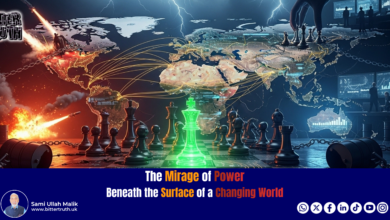
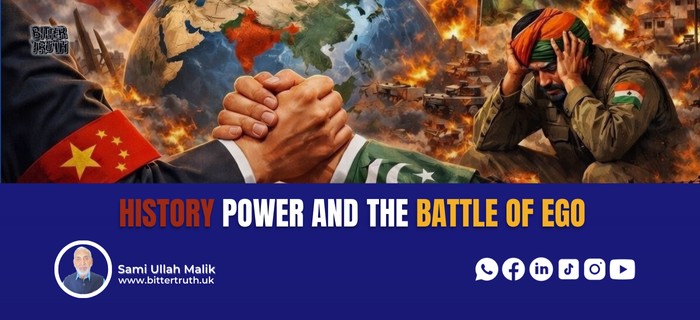
If President Trump’s earlier assertions of brokering peace between India and Pakistan had already tied a knot upon the political chessboard for Prime Minister Narendra Modi, then the echo of a similar claim issuing from the tranquil valleys of China served only to tighten that knot. The Chinese Foreign Minister’s remark—that Beijing had played a mediatory role in easing tensions between the two neighbours in May—sent a fresh tremor through the diplomatic atmosphere. History once again whispered in the corridors of power that South Asian politics is not merely the demarcation of boundaries on a map, but a chess-game of interests in which every move harbours multiple meanings.
Trump’s claim of mediation was in effect a declaration that the United States wished to retain its relevance in the South Asian dispute. It is equally true that although India has officially rejected such claims, the silence of Prime Minister Modi was widely read—both internationally and within India itself—as a tacit acknowledgement rather than outright denial.
China’s subsequent assertion has now placed the Modi government upon another uncomfortable perch. It makes plain that a new axis of power is gradually crystallising in the region. The statement that China had helped lower tensions between Pakistan and India did not merely ignite a fresh debate at the diplomatic level; it also stirred the still waters of India’s domestic politics.
South Asia has thus moved beyond the narrow confines of “bilateralism”. India has repeatedly maintained that all issues relating to Pakistan and Kashmir are bilateral and that third-party intervention is unacceptable. The great powers, however, weave their webs of interest beneath the veil of mediation. China’s claim challenges this long-standing position and becomes a domestic political liability for New Delhi, for it furnishes the opposition with an arsenal of questions, sows doubt about governmental policy and invites scrutiny of diplomatic transparency.
For India the challenge is stark: how to preserve the rhetoric of bilateralism when the world refuses to speak its language? Hence China’s statement triggered not only international conversation, but internal tremors as well.
No sooner had Beijing’s claim surfaced than voices in India’s opposition grew louder. The Congress Party demanded clarification; the Ministry of External Affairs maintained a telling silence; and thereby three concurrent moves were made upon the political chessboard at once: mounting calls for transparency, a testing of the national security narrative, and public debate over the direction of foreign policy. Thus, is demonstrated a larger truth of democratic life: foreign policy is not forged only in sealed diplomatic chambers; it is also answerable before the court of public opinion.
In the wake of China’s assertion, questions multiplied within India’s political forums. The Congress Party sought explanation, and the silence of the Ministry deepened the matter, transforming it from a mere political point-scoring exercise into a question of national strategy. Upon the lips of the opposition trembled the sentiment that silence, too, on occasion, becomes a form of admission.
Two matters emerge with clarity: the opposition raises questions, and the Foreign Office remains silent. The reasons for such reticence may be many—perhaps the government does not wish to prolong the controversy; perhaps an outright denial may strain relations with China; perhaps an admission would undermine its own professed policy. Hence the moment affords the opposition a fertile political opportunity: to demand transparent answers, to invoke national security, and to subject foreign policy to critical light.
The objection raised by Congress leader Jairam Ramesh is, at its heart, a question of principle. He rightly suggested that if China’s claim of mediation is indeed correct, it constitutes not merely a repudiation of previous official positions but risks turning a profoundly sensitive chapter of national security into a faint, ironic smile—and in the realm of national security one does not permit the luxury of careless laughter; there every word is placed upon the razor’s edge.
Where the currents of history appear to turn upon unseen tides, one is reminded of the Qur’anic
declaration:
﴾وَتِلْكَ الْأَيَّامُ نُدَاوِلُهَا بَيْنَ النَّاسِ﴿
“And such are the days: We alternate them among mankind.”(Qur’an 3:140)
And when questions of national resolve arise, another verse seems to speak with solemn pertinence:
﴾إِنَّ اللَّهَ لَا يُغَيِّرُ مَا بِقَوْمٍ حَتَّىٰ يُغَيِّرُوا مَا بِأَنْفُسِهِمْ﴿
Indeed, God does not change the condition of a people until they change what is within themselves.” (Qur’an 13:11)
These verses capture the inner moral dimension of statecraft, reminding nations that diplomacy, however intricate, ultimately rests upon the character, courage and conscience of peoples.
Within the remarks of Jairam Ramesh lie three unspoken propositions. First, that the Chinese assertion stands at variance with India’s avowed official position; second, that the public has not been taken fully into confidence; and third, that matters of national security ought never to be converted into mere counters upon the board of partisan politics. His central contention may be stated thus: if mediation has indeed taken place, what remains of India’s long-proclaimed doctrine of strict bilateralism? Let the people be told. And if mediation has not taken place, why then does China advance such a claim? If it has not, let there be categorical denial. To allow the Chinese assertion to linger uncontradicted is to imperil the credibility of the State’s own position. Here the issue of sovereignty stands at the very heart of the debate. For any nation, acceptance or rejection of mediation is not a trifling diplomatic gesture; it is inseparably bound to national dignity. China’s declaration is thus perceived as a test of that dignity.
In the same vein, Asaduddin Owaisi, President of the All India Majlis-e-Ittehad-ul-Muslimeen, raised—with his characteristic candour—a pointed question: how can China, on the one hand, pour weapons into Pakistan and thereby tilt the scales of military balance, and on the other, appear upon the stage as an impartial arbiter? Such conduct, he suggested, is akin to the traveller who sets the forest ablaze and then proclaims himself the herald of life-giving rain. Both roles cannot be worn by the same actor.
Owaisi’s argument may be framed thus: he queries China’s double posture of partner and mediator, reminding Prime Minister Modi that Beijing is one of Pakistan’s principal arms suppliers and a party to sensitive defence cooperation. A power that equips one disputant, strengthens its military sinews, and collaborates in strategic operations cannot plausibly claim the mantle of neutrality. Moreover, in several border disputes, China itself stands as an interested party vis-à-vis India. The claim of mediation by such a state inevitably casts shadows upon its alleged impartiality. Can a disputant simultaneously act as “disinterested mediator”? It is at this very juncture that politics, ethics and strategic interest intermingle in so intricate a braid.
The broader question arises: does China’s present narrative foreshadow the emergence of a global mediator? In its address, Beijing underscored its involvement in issues ranging from the Iranian nuclear file and the Myanmar crisis to the Palestinian–Israeli conflict and the Cambodia–Thailand tension. This was not mere information; it was a declaration of power. China evidently seeks recognition not only as an economic colossus and military force, but as a diplomatic arbiter as well.
At an international symposium, Foreign Minister Wang Yi listed the India–Pakistan tension among the world’s “hotspot” conflicts, stressing that China is already engaged across multiple theatres of dispute and that South Asia is part of that expanding remit. The implication was unmistakable: Beijing aspires to shape outcomes, not merely to observe them. The message resonated beyond the region—that China no longer contentedly answers to the title of “regional power” but claims a seat at the high table of global statecraft. In the great assembly of nations, the signal was clear: the axis of Asian politics is shifting, and Beijing is no longer a spectator but a protagonist.
Wang Yi’s remarks suggested a world traversing fresh tempests—regional wars multiplying, balances of power in a state of ceaseless flux. He proposed “fairness and balance” as the balm for these wounds. The words are elegant; yet history, stern tutor that she is, reminds us that between the deserts of rhetoric and the oasis of meaning there must fall the rain of action. His portrait of China as a force for equilibrium and a solver of root causes invites, inevitably, scrutiny: critics argue that in certain theatres Beijing has been itself a party to disputes and elsewhere has not hesitated to wield economic pressure.
Indian columnist Sushant Singh has observed that China’s statement achieves several objectives at once. It places Pakistan and India together in the same dock, installs China as the region’s new “supreme mediator”, and simultaneously lends retrospective heft to President Trump’s earlier claim. Beneath the apparently temperate tone lies the steely reminder that the lamp of sovereignty burns brightest when fed by its own oil; it flickers when made dependent on the breath of others.
Meanwhile, Indian journalism and intellectual circles have reacted with alacrity. Analysts highlight that China is aligning Pakistan and India upon one plane, reinforcing American claims, and drawing India’s sovereignty into question. The response itself is proof that mediation is not a mere diplomatic posture; it reaches into the foundations of national narrative. These are not idle words; behind statements lie signals, and behind signals strategic consequences — often of formidable gravity.
Owaisi has also contended that by placing both nations upon a single line, China seeks acknowledgment as the region’s paramount power. The question is thus posed: was this tacit understanding reached when the Prime Minister visited China? The query is not solely of diplomatic complexion; it invites a glance into the mirror of intention.
His second question cuts deeper still: does China now intend to prove itself a great power? The point is weighty. Beijing is enlarging its influence across South Asia; it enjoys intimate ties with Pakistan; it confronts continuing border disputes with India. In such a context, any declaration of mediation may itself constitute an assertion of power, a signal that decisions in the region will be taken beneath Beijing’s shadow. Owaisi’s concern is plain: has the Modi government, at any level, consented to such a role? If not, why then this persistent silence?
In such moments, when sovereignty, intention and responsibility converge, the Qur’ān’s admonition sounds with grave clarity:
﴾وَلَا تَهِنُوا وَلَا تَحْزَنُوا وَأَنْتُمُ الْأَعْلَوْنَ إِنْ كُنْتُمْ مُؤْمِنِينَ﴿
“Do not lose heart and do not grieve; you shall be uppermost, if you are true in faith.” (Qur’an 3:139)
And concerning neutrality and justice, one recalls:
﴾كُونُوا قَوَّامِينَ بِالْقِسْطِ شُهَدَاءَ لِلَّهِ وَلَوْ عَلَى أَنْفُسِكُمْ﴿
“Be steadfast in justice, bearing witness for God, even if it be against yourselves.” (Qur’an 4:135)
These verses do not merely adorn the page; they summon states and statesmen alike to weigh power in the scales of conscience.
Although no formal repudiation was issued, official “sources” intimated that China had played no role; and thus, by the alchemy of attribution, the media conveyed that Beijing’s claim to mediation was to be rejected. No mediation occurred, they maintained; the issue was resolved bilaterally, through direct communication between the Directors-General of Military Operations. This, they added, was wholly consistent with India’s long-standing policy—there is no room for a third party. Two points therefore stand out: India does not intend to abandon the doctrine of bilateralism, and the inclusion of an external actor is perceived, at the level of policy, as a palpable threat.
According to India Today, government sources clarified that the resolution of the May crisis owed nothing to the intercession of any foreign power. The same statement underlined that the two DGMO offices conducted direct talks, agreed themselves upon a ceasefire, and brought matters to a decisive close. The implication was unmistakable: while the world may adorn itself with the jewels of mediation, the definitive verdict is delivered at the table where hard realities sit. Three conclusions emerge: military-to-military channels remain effective; confidence-building at the operational level precedes diplomacy in the abstract; and the need for external actors correspondingly diminishes.
In those days tensions rose, appeals for restraint were voiced, a ceasefire ensued, mediation was claimed; and the net effect was that, owing to Prime Minister Modi’s culpable silence, the diplomatic advantage slid towards China, India found itself on the defensive, and the Opposition sharpened its questions.
At the press briefing of 13 May it was again affirmed that the date, hour and terms of the ceasefire had all been agreed through direct military contact. The conclusion was clear: the ceasefire was not the product of external pressure; neither China nor the United States could claim a determinative role; India had adhered to its position. Once more it became evident that in South Asia the hinge of conflict resolution is mutual confidence between the two principals—sometimes turbulent as a stormed river, sometimes gentle as a murmuring brook.
Events between 7 and 10 May cast fresh queries upon China’s role. On the 7th, Beijing called for restraint. Restraint was urged; a ceasefire followed; a claim of mediation was made—small wonder that observers linked these strands. The Opposition pressed the issue; China reaped diplomatic advantage. History’s lesson is constant: when calls for restraint are wrapped in the silk of interest, their meanings subtly change.
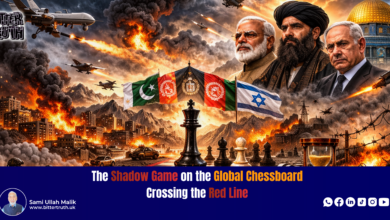
Thus the sum of these events is clear. South Asian politics is no longer a mere cartographer’s exercise; it is a chessboard upon which great powers play move upon insinuating move. The dispute between Pakistan and India is not only a quarrel of neighbours; it is an examination in history, identity, sovereignty and political maturity. The central question is not mediation as such; it is this: when do nations learn to rely, not upon borrowed crutches, but upon the inner strength of their own wisdom and judgement? That is the call of time, the demand of history, and the high road to national dignity.
By asserting its role as mediator, China sought to augment its diplomatic weight; India reiterated its doctrine of bilateralism; the Opposition pressed the government; Pakistan remained, though in the background, a principal party; and the global balance of power turned upon a new hinge. The essential question remains: shall the problems of South Asia be solved by outside intermediaries, or is the true path that of dialogue, confidence-building, and political maturity? The question remains open; time, history and the insight of nations will answer it.
The entire episode is emblematic of a deeper truth: South Asia has become a strategic laboratory for global powers. The conflicts of Pakistan and India are enlisted in the narratives of others. Mediation is seldom pure benevolence; it is often the strategy of power. The real issue is not who mediates; the real question is whether the peoples of the region will find the courage to solve their problems themselves. When inner wisdom awakes and political maturity is born, the need for external mediation, like a spent echo, dies of itself.
It is therefore imperative that a just order of peace and security be fashioned—one capable of lifting millions from the grip of poverty. This is possible only when the world’s peace-loving forces are made aware of the dangers implicit in the aggressive designs of the RSS-inspired Hindutva project in India: how, in pursuit of power, such a project may become a grave threat to global peace. To avert that danger, there must be an enduring and purposeful mechanism of dialogue between Pakistan and India; the principles of ceasefire must be transparently monitored; parliamentary trust must replace megaphone diplomacy; and instead of global mediation, a regional model of conversation must be built.
In the end, one truth stands before us with head unbowed: the peoples who dwell on either side of the Subcontinent’s divide are separated by borders, not by the intimacies of feeling. The palaces of power change; mediation claims rise and fall; but the true test of nations lies not in who speaks for them, but in when they learn to speak for themselves. China or America—every great power brings its own interest with it, and history attests that in the marketplace of power, the coin of pity seldom circulates. The truest power is that which awakens in the hearts of peoples, handing them the lamps of dignity, wisdom and prudence. The soil of the Subcontinent has witnessed much blood, but it has also seen lamps of patience, forgiveness and courage that refuse to be extinguished.
Should Pakistan and India resolve their differences in the fragrance of dialogue, future generations may hear not the drums of war but the flute of peace. In the long night of history, the first line of dawn appears for those who find the courage to stand upon their own feet rather than upon the borrowed strength of others.
This, then, is the burden and the music of the present essay: that amid the clamour of mediation, the inner voice of conscience be recognised; that beyond borders, the common heartbeat of humanity be heard; and that perhaps—just perhaps—upon the courtyard of history the first bud of peace may open, and the morning of the Subcontinent become in truth a morning of hope.
In such reflections one is reminded of the Qur’ānic counsel:
﴾إِنَّ اللَّهَ لَا يُغَيِّرُ مَا بِقَوْمٍ حَتّىٰ يُغَيِّرُوا مَا بِأَنْفُسِهِمْ﴿
“Indeed, God does not change the condition of a people until they change what is within themselves.” (Qur’an 13:11)
And concerning reconciliation:
﴾وَإِنْ جَنَحُوا لِلسِّلْمِ فَاجْنَحْ لَهَا﴿
“And if they incline to peace, then you too incline towards it.” (Qur’an 8:61)