Deception, Delhi, and the World: A Lament for Lost Greatness
India's Silent Retreat: Facing Destiny Without Strategy

When nations surrender the helm of their destiny to the currents of time, any wave—no matter how faint—may capsize their vessel. And when thunder accompanies the gathering clouds on a nation’s horizon, it is no longer the hour for sleepwalkers; it is the call for the wise to awaken.
The subcontinent we inhabit is not merely a cartographic fact—it is a confluence of civilizations. Here, history teaches even adversaries the art of reconciliation, yet a handful of political missteps may transmute fraternity into enmity. The rising ramparts of peril that now surround India from the East, the West, and the North are not sudden portents of doom, but the cumulative wages of strategic imprudence sustained over decades.
Those nations that inscribe their legacy in golden script are not those who abandon themselves to fate, but those who master the art of navigating its storms with foresight and deliberation. While fate may well be a divine decree, prudence remains the sovereign exercise of human will. Faith in destiny may offer solace to the spirit—but if invoked as an excuse for inertia, a pretext for inaction, or a cloak for abdicated responsibility, it becomes not salvation, but surrender.
The chronicles of the subcontinent are strewn with the ruins of Muslim principalities that perished—not because their stars dimmed, but because their sovereigns mistook passivity for piety, and resignation for wisdom. Destiny becomes luminous only when it is read by the light of conscious deliberation.
Prudence is no mere word—it is the compass by which nations chart their course through tempests. It is that subtle skill that detects the storm in the whisper of the wind, that spies danger in the shifting tides of diplomacy, and that carves out paths upon which a people may not only survive—but ascend.
Today, the consternation of General Anil Chauhan, the unease couched within Rahul Bedi’s dispatches, and the emerging strategic convergence between Bangladesh and China—these are not auguries from the stars; they are the cries for immediate and rational recalibration. The choice before Indian policymakers is stark: shall they dismiss these signals as mere “acts of fate,” or shall they convert them into the architecture of a renewed future?
Prudence transcends the clang of sabres and the thunder of cannons. It is the aggregate of internal cohesion, political maturity, diplomatic dexterity, educational enlightenment, and the civic consciousness of a people. Until a nation aligns its inner compass, it cannot hope to erect bulwarks against external storms. History teaches that in the contest of empires; the might of arms alone does not suffice—it is the integrity of character that determines endurance. A nation that suffers from intellectual atrophy cannot hope for triumph on any front.
When destiny becomes a euphemism for lethargy, prudence veils her face, and nations, instead of crafting their fate, begin to mourn it. India now stands at a decisive crossroad: to passively observe the unravelling of its strategic fabric under the guise of fatalism, or to raise the torch of wisdom and forge a renewed national doctrine. Let it be remembered: when nations turn their backs on deliberation, fate snatches the reins of time from their hands. It is not lamentation that time demands, but illumination—for those who dare to seek the path through darkness, even the stars begin to stir.
India’s present predicament is not merely geographical—it is a siege of thought, of culture, of arms, and of spirit. It is a tale unfolding not only along the fault-lines of military engagement, but in the quiet desperation of diplomatic inertia, political immaturity, regional neglect, and the disarray within. The conspiracy unfolding is not confined to border trenches; it dances in the corridors of embassies, orbits in satellites, and whispers through the ranks of regiments.
General Anil Chauhan’s alarm is not the fleeting anxiety of a soldier—it is the echo of history’s warning, long ignored. When nations fail to see peril with the eyes of the soul, defeat becomes inevitable. The triangulated alliance now emerging between China, Pakistan, and Bangladesh resembles the fabled Chakravyuha—a deadly formation in which young Abhimanyu was ensnared, with no path of retreat. So too is India now encircled: to the north by China, to the west by Pakistan, and now, astonishingly, to the east by Bangladesh—its former protégé.
When those whom one once called kin rise with daggers drawn, the wound inflicted is not upon the body, but upon the soul. Bangladesh, landlocked save for India, sharing a staggering 94% of its border with her benefactor, now appears to stand in alignment with India’s foes. This is not a mere geopolitical pivot—it is a cultural tragedy.
Should 4,367 kilometres of shared border now be repurposed for strategic hostility, it is not only the guns that tremble—but the villages and towns that lie within range. Frontiers once symbolic of fraternity are now transmogrifying into barbed barricades of mistrust. A nation that once stood as the jewel of India’s strategic foresight now extends its hand in alliance with China and Pakistan.
Is this drift a product of economic necessity? Or has India’s own hubris, its lapses in diplomacy and neglect in sustaining fraternal bonds, driven Bangladesh into foreign arms?
That Bangladesh, despite its intimate geographic embrace with India, now echoes a counter-narrative, is not a diplomatic misstep—it is a civilizational breach. For when trust evaporates, borders become not just lines on maps, but chasms in the human heart.
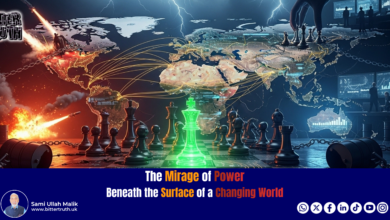
We now stand upon a geopolitical chessboard unlike any witnessed in living memory. The rising entente between China, Pakistan, and Bangladesh is not merely a military syndicate; it is an emergent game of power—economic, cultural, and political—poised to reshape the Asian order. Should India remain blind to this reality, it may not only forfeit its territorial integrity, but its place in the annals of history.
Encircled by Strategy: India’s Geopolitical Trial in a Shifting Asian Chessboard
The border skirmishes with China, it must be said, are not isolated tempests but the visible ripples of a long and meticulously orchestrated strategy. China is no longer merely ensconced in the icy altitudes of Ladakh; it is weaving a strategic web that binds Bangladesh, Nepal, Sri Lanka, and Pakistan into a calculated geopolitical lattice. What India once lauded as her geographic ascendancy has begun to metamorphose into a tightening noose — a cartographic crown now turned collar.
This encirclement is not only military in nature, but economic and diplomatic in tone. China’s economic leverage, coupled with its military dominance and alignment with regional players such as Pakistan and Bangladesh, has heralded a new Cold War in Asia — one in which India, despite its military might, finds itself curiously isolated. The Modi administration, ever ready to strike the drum of conflict for electoral dividends, seems poised once more to summon the spectre of war — a gambit that may well hand the United States a convenient lever to manipulate Delhi’s desperation, nudging Modi toward a political precipice.
The Vice Chief of the Indian Army’s lament — that Pakistan allegedly accessed “live” operational data via Chinese intelligence — tears through the drapes of military decorum. Should a foe possess such minute awareness of troop movements, it signifies not just an operational breach, but a diplomatic exposure that leaves India vulnerable and friendless in high places.
While Pakistan has summarily dismissed such accusations, international defence analysts concede that Chinese technical assistance is plausible. Yet they also marvel at Pakistan’s demonstrable military deftness. The unspoken question lingers still: How did the adversary obtain such deep penetration of India’s strategic pulse? Is this the result of internal fissures or a yawning technological deficit? The credit, however controversial, is attributed by some to Pakistan’s relentless innovation — whose culmination, during recent hostilities, rendered over 70% of India’s power grid inoperative, plunging the façade of “Shining India” into sudden darkness.
Why then did General Anil Chauhan, custodian of India’s highest security mandate, resort to a tone of defeat in public discourse? If the allegations were indeed baseless, why allow them to echo unchecked across global media? As Rahul Bedi has observed, the confluence of Chinese-supplied weaponry, satellite imagery, and real-time intelligence feeds to Pakistan have coalesced into a strategic storm now casting its shadow across India’s northern, western, and eastern flanks. That such revelations are surfacing belatedly raises its own troubling spectre — are they the by-product of a demoralised command seeking to mask its wounds?
The downing of Israel’s vaunted Harop drone by the Pakistani Air Force was not merely a tactical strike — it was a checkmate on the technological chessboard. These stealth drones once hailed as invincible by their Israeli architects — capable of evading detection and delivering lethal payloads — were believed to be virtually immune to modern interception. India, emboldened by this technological promise, enlisted Israeli operators to deploy them in active combat. Yet when Indian radar failed even to recognise their presence, it exposed not just a vulnerability, but a strategic alarm bell tolling in the heart of Indian defence.
The so-called “Demonic Triangle” — the covert technological axis of the United States, Israel, and India — had long boasted that a mere handful of Harops could disable Pakistan’s defences in minutes. And yet, not only were 79 such drones obliterated, but several were captured intact, decrypted, and safely landed — an unthinkable blow to Israeli prestige. These drones, pre-programmed for self-destruction to prevent reverse engineering, failed to accomplish even that. The myth of Harop’s invincibility has been shattered and the blueprints, once guarded as state secrets, are now part of a new technological calculus.
Pakistan has tested India’s military patience for decades, but today, there is a paradigm shift. It lies in the quiet, methodical coordination with China — in shared algorithms, electronic warfare tactics, and a strategic unison that goes beyond mere firepower. Whether responding to BrahMos missiles or neutralising drone incursions, Pakistan is no longer reacting; it is orchestrating.
Herein lies the strategic tragedy of contemporary India: a fractured internal polity eroding the spine of its foreign policy. Without national cohesion, no foe is vanquished; indeed, it grows stronger.
One must also ask: Why were India’s BrahMos missiles — allegedly misfired — not intercepted by Pakistan’s air defence grid? Though they veered off course, their trajectory left behind disconcerting questions. Did Pakistan’s technological interference truly divert them, or was it a convenient post hoc claim? The notion of blinding hypersonic projectiles may exist in theory, but warfare ultimately tests all theories in its unforgiving crucible.
This chain of events compels us to re-evaluate: Is conventional defence now obsolete?
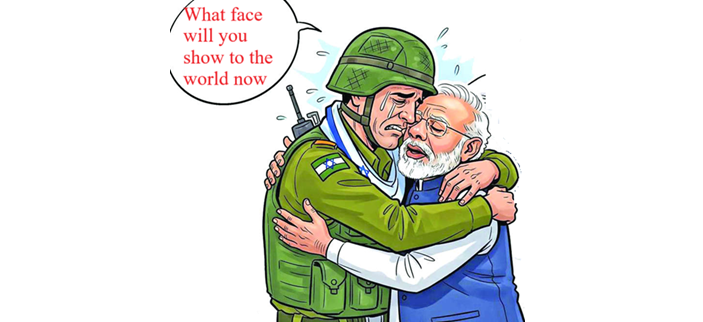
Moreover, if even with the backing of Western nuclear pacts and U.S. defence assurances, India could not shield herself from aerial intrusions by Pakistan’s stealth systems, what then is the value of that grand strategic alliance? The Israeli-operated Harops, launched from the Adampur airbase, aimed to cripple Pakistani infrastructure. But when Pakistan retaliated under intense pressure, Adampur itself became a cratered memory. When eighteen coffins wrapped in silence landed in Tel Aviv under the cover of night, Israel too awoke to a reality that no amount of technological bravado could mask.
And yet, Prime Minister Modi — resolute in defiance — continues to issue threats under the garb of “Operation Sindoor,” eschewing humility in favour of hubris.
The Glass Battlefield: Truth, Thunder, and the Twilight of Illusions
Allegations now gather, not as whispers in the wind but as thunder over Delhi’s ramparts: that the Modi government has sought, with deliberate cunning, to obscure the true extent of national loss. The Indian defence attaché’s reluctant concession — that “a few aircraft were lost” — is not merely a statistical footnote; it is a candid, if inadvertent, disrobing of political pretence. If truth can find utterance on Bloomberg’s global stage, why then must it be muzzled in the echoing halls of New Delhi? The question resounds not from foreign observers alone but from within India’s own civic soul: why is candour abroad possible, but at home forbidden?
Where wisdom prevails over politics, and where leadership ought to be more than the narcotic of pride, it becomes incumbent to reflect the mirror of reality. For a rampart of glass cannot be defended with a shield of wood. Herein lies the crux: when the edifice of propaganda begins to outshine the substance of truth, the nation risks not only defeat, but delusion. Nations are forged in the crucible of candour, not in the furnace of fantasy.
The much-anticipated dogfight between the Indian Rafale and Pakistan’s J-10C was more than a clash of steel wings — it was a collision of doctrines, a trial of strategic philosophies, and a litmus test of national poise. It was not merely two aircraft vying for dominion of the skies; it was two ideological constructs, two geopolitical imaginations, two conceptions of war, pitted against one another in the theatre of air and perception. The world watched — not to marvel at aerobatics, but to divine the future: for whoever triumphed here would not merely win a battle, but lay the grammar of the next military epoch.
Rafale — sleek, extravagant, and technologically ornate — met the austere but surgically effective J-10C, the product of Sino-Pakistani synergy. This was not a clash between giants and upstarts, but a reckoning between confidence and calibration. The skies bore witness, yes — but so too did the earth beneath, where consequences were not theoretical, but strategic and immediate.
India’s External Affairs Minister’s revelation — that the US Vice President had warned of potential escalation should India refuse to concede on certain fronts — was not merely a diplomatic aside. It was a crack in the façade of New Delhi’s global posture. For when the eagle begins to counsel restraint, it is not weakness — but recalibrated allegiance. Does this point to a new strategic architecture in South Asia? Or perhaps a subtle but growing acknowledgement of India’s limitations amidst the shifting tectonics of global power?
The recent 88-hour episode of tension between India and Pakistan was no ordinary standoff. It was a high-stakes chess game played across diplomatic corridors, military frontiers, and media screens. It was a contest not only of firepower, but of perception, stamina, and the ability to manoeuvre within a shrinking space of ambiguity. The confrontation did not merely raise alarms; it raised questions about the very scaffolding of South Asia’s geopolitical balance.
Indeed, the subcontinent’s history is not a relic buried in textbooks. It is a living chronicle, inked with sacrifice and siege, with blood and borders. These 88 hours — compressed in time, but expansive in consequence — were not isolated incidents, but rather the prelude to a larger, more consequential chapter yet to be written.
It is often said that those clouds which thunder do not rain — but sometimes, the storm that announces itself with lightning brings not only rain, but revelations. This is such a moment. A moment not of jingoism, but of judgement. A time not for recklessness but reckoning.
If India continues to substitute domestic political theatrics for strategic clarity, it may find itself blindsided — not by external foes, but by its own illusions. History does not suffer pride lightly; it has always been unsparing in its verdicts against the hubris of nations.
This is no mere prologue; it is a tolling bell. A bell that may herald either awakening or decline. Civilisations do not perish from error — they perish from arrogance. And if India must learn one lesson from this turning tide, it is this: when nations await destiny without preparing their design, they walk willingly into the abyss.
History, if ignored, does not forgive. It simply forgets.