Courts of the Heart and the Tribunal of Time
Shadows of Tension, the Call of Brotherhood

When restlessness takes up residence in the inner chambers of the heart, when the streets of our cities reverberate with the cry of lamentation, and when furrows of care deepen upon the brow of the Muslim ummah, history does not sit silent; it finds a voice and speaks, at times as a whisper of conscience, at times as a clarion call. Today, the rising tension between Bangladesh and India is not merely another chapter in the ledger of international politics; it is a tale woven of wounded hearts, searing memories, and treaties that lie scattered like torn leaves in the wind.
This is the very soil that once hummed with songs of fraternity and common cause; yet now the dust of rancour has dulled the music of that fellowship. The innocent blood unjustly spilt, the disquiet that hangs heavy in diplomatic corridors, the trembling hearts of minorities, and the sleight of hand of political conjurors—all impress upon us the inescapable truth that when justice departs, it is not the earth that trembles first, but the human heart that quakes.
The Qur’ān reminds us:
﴿وَاعْتَصِمُوا بِحَبْلِ اللّٰهِ جَمِيعًا وَلَا تَفَرَّقُوا﴾
“And hold fast, all of you together, to the rope of God, and be not divided.”
Yet alas, the politics of our age has loosened its grip upon that saving cord, choosing instead to clutch the thorny thickets of discord.
The purpose of this report is not to fan the embers of hatred, but to knock gently—indeed insistently—upon the doors of the collective conscience:
Where did we stumble? When did we lose our way? And when shall we once again seek the shade of the Qur’ān and the Sunnah, and return to the fashioning of just and equitable societies?
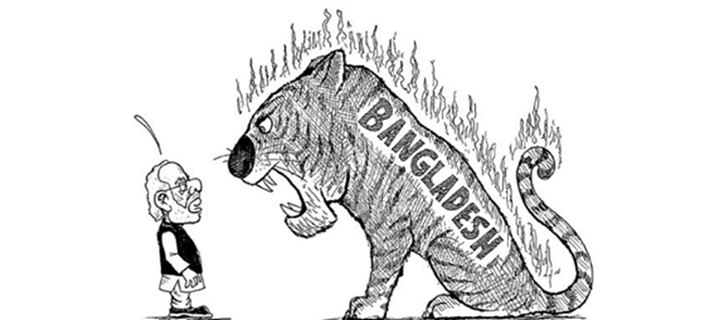
The recent unrest in Bangladesh is not an isolated episode; it is the outgrowth of grievances long incubated, of mutual suspicions carefully tended, and of apprehensions that have matured over years. Protests, disturbances, diplomatic remonstrations and reciprocal accusations have rendered the already fragile thread of relations between the two countries more delicate still. It would seem that the caravan of past companionship has wearied upon the road, and that a new political wind has set the lamp of friendship flickering. The question inevitably presents itself: is this but a passing mist, or shall it harden into a permanent gulf?
It is for this reason that the recent violent demonstrations in Bangladesh have deepened the pre-existing tension between the two states. This exchange of accusations did not begin at the dawn of time yet today matters have reached such a pitch that both neighbours summon each other’s diplomats to register protest and issue stern public statements. One cannot help but ask: those who once walked shoulder to shoulder in the shade of comradeship—will they ever again stand side by side at some decisive turning of history?
The death of Depo Chandra not only shocked human sensibility but shook to the core an already fragile sectarian equilibrium. His killing poured yet more powder into the air, and its echo could be heard in the strident reactions of hard-line Hindu quarters. Conversely, the murder of Usman Hadi arrived laden with political symbolism and layered questions. The violent demonstrations that followed his death had already spread a feverish unease from city to city. Whether the reports of the alleged assassin’s flight abroad be true or unfounded, they sowed seeds of anger and distrust within the public mind. At that very moment, the social pulse betrayed that emotional turbulence had outstripped the measured cadence of the state’s official narrative. Allegations surfaced that the supposed assailant was linked to the Awami League and had fled to India; the police may deny it, but when the river of emotion rises in spate, the boat of reason grows perilously light.
In this bitter atmosphere, the suspension of visa services became, as it were, a new wall raised between two hearts. Objections were voiced regarding the security of diplomatic missions on both sides, and the summoning of high commissioners became emblematic of the prevailing unease. The suspension of visas is never a mere administrative decision; it breaks the bridges that allow people to meet and lives to intertwine. For students, traders, patients and families, it erects a psychological barrier more formidable than any physical fence. The calling in of diplomats is no longer a matter of formal phrase-making; it signifies a bitterness that now weighs heavily upon the nerves of both governments. One senses that on the chessboard of diplomacy the soft pieces are being withdrawn, and the hard moves now dominate the game.
Anti-Indian sentiment in Bangladesh is no new sapling; it is an old tree putting forth new branches. During Sheikh Hasina’s extended tenure in power, allegations of Indian overreach had already been quietly gathering in certain circles. Such sentiments are not a momentary spasm but the product of a long historical continuum. The politics of the post-1971 era, questions of borders and river waters, the balance of trade, and suspicions of political interference have kept the emotional climate damp with resentment. Her period in office was, by some, portrayed as overly inclined towards India, and thus the impression took root that the passion for national sovereignty had been muffled.
Her subsequent removal from office and refuge in India further fanned these emotions. The failure to secure her return, despite repeated requests from Dhaka, left troubling questions in the public mind and added fresh fuel to the fire of suspicion. The matter may well reside within the legal and diplomatic domain, yet in the court of public sentiment verdicts are often written in a different ink.
The voice of youth is the heartbeat of a nation’s inner life. When the tongue becomes flame and the heart a live ember, political moderation retires from the field. Anti-Indian speeches and slogans are but the outward form of a resentment long suppressed beneath the courtesies of political discourse. After the killing of Usman Hadi, the heated rhetoric of certain young leaders further inflamed the atmosphere. When language becomes fire, ears burn and reason withdraws to the shadows.
Here the Qur’ān once again counsels balance and justice:
﴿يَا أَيُّهَا الَّذِينَ آمَنُوا كُونُوا قَوَّامِينَ بِالْقِسْطِ شُهَدَاءَ لِلَّهِ﴾
“O you who believe, be steadfast in upholding justice, bearing witness for Allah SWT.”
For it is only when justice stands firm that nations are steadied, hearts are reconciled, and history turns its face from tumult towards tranquillity.
The crowds gathering outside the High Commissions are not mere congregations of bodies; they are emotion given collective form. From Dhaka to Chittagong, protests and incidents of stone-throwing have been reported in the vicinity of Indian missions. The cycle of pelting stones followed by arrests and subsequent releases bears witness to the fact that state institutions themselves appear, to some extent, on the defensive before this tidal swell of sentiment. The rallies on both sides of the border have become a mirror of something deeper—the clash of narratives now waged in the open.
From Dhaka to Chittagong the pattern was repeated: protest, confrontation, arrest, release; and the phrase “unjust demonstrations” crept into statements on both sides. Processions emerged across the frontier, while in the air the dark birds of mistrust circled ominously.
Mistrust is that silent termite which hollows out even the strongest of bonds from within. The analyses of former diplomats point unerringly to this inner decay. International norms demand that diplomatic missions be treated as sacred trusts; yet when passions gain the upper hand, even sacred trusts appear imperilled.
According to one former diplomat, such mutual suspicion has scarcely been witnessed before. The golden principle of international relations is plain: the protection of diplomatic missions is a foremost responsibility—and it is this very principle that now stands in the crucible of trial.
“To bind a man to a tree and set him alight”—the phrase alone chills the human soul. The incident not only heightened anxiety among Hindu communities, but raised grave questions about state authority, the rule of law, and the security of minority rights. Social media, heedless of borders, carried the tragedy in moments to the doors of the world’s conscience.
The tragic death of the Hindu employee, Das, the harrowing spectacle of his being tied to a tree and burned, and the widespread circulation of the video—all of this fanned the flames of anger higher and higher. The incident has posed anew the question of minority protection. At the same time, various claims and counter-claims surfaced, pointing in different directions—claims which must be tested upon the touchstone of responsible investigation and proper judicial process.
The statement of the head of the interim government may well be a candle of hope, yet history’s chronicler reminds us that statements alone do not suffice. Law derives its dignity not from force, but from justice. Eyes now watch to see how this promise is translated from word into deed. The interim head, Muhammad Yunus, stated unequivocally that in the “new Bangladesh” there is no room for such violence. The pledge of the supremacy of law will carry weight only when the scales of justice are seen to balance equally on both sides.
Arrests, no doubt, have been made; yet the central question lingers still—do minorities feel secure? The true ornament of a democratic society lies in this: that its weakest are the safest. When they tremble, the prestige of the state itself is wounded. Despite the arrest of several suspects in the killing of Das, the enduring question remains whether the dread in the hearts of minorities has eased. Is this violence but a passing frenzy, or does it speak of a deeper social disquiet?
According to certain narratives, suspicions have been voiced of the involvement of religiously extremist elements, with reports of attacks upon newspapers and cultural institutions. This brings once more to life the question: which facet of society is represented by those who strike at pen and culture? Attacks upon the press and cultural bodies signify that there exists within society a faction that would answer difference not with dialogue, but with force. It is here that the great heritage of civility, tolerance and urbanity is placed upon trial.
Civil society is the social soul of the state. That soul has declared, in tones impossible to ignore, that the interim administration appears to have faltered in restoring order. This voice of society is not merely a complaint; it is an invitation towards reform. The protests of civil society grew into a dignified reproach: that the interim authorities failed to secure peace and order. The torch held in the hand of the state seemed to flicker in an uncertain wind.
International observers have rightly noted that the media may either fan the flames or pour water upon them. When a report clothes itself in prejudice, it fills the eyes of society with smoke. Responsible reporting is therefore now not merely desirable; it is imperative. Some researchers further drew attention to the fact that certain Indian media outlets have presented Bangladesh’s situation in a manner likely to deepen sectarian perceptions. At the same time it has become abundantly clear that the stability of Bangladesh is intimately interwoven with the security of the entire region.
Elections can be creative; they can also be destructive. The approach of the 12 February polls has imparted a new gravity to the political atmosphere. The challenge before the interim leadership is to prepare a climate of tranquillity before the nation proceeds to the ballot. The election of 12 February may thus prove not merely a transfer of power, but a decisive line between stability and unrest. The true test of the interim government will be to quench the fires of violence and secure a peaceful environment for the exercise of the franchise.
Here, one is reminded of the Qur’ānic admonition:
﴿وَلَا يَجْرِمَنَّكُمْ شَنَآنُ قَوْمٍ عَلَىٰ أَلَّا تَعْدِلُوا ۚ اعْدِلُوا هُوَ أَقْرَبُ لِلتَّقْوَى﴾
“Let not the hatred of a people incite you to depart from justice. Be just; that is nearer to piety.”
For nations, like men, are judged in the end not by the loudness of their passions, but by the firmness of their justice.
The absence of the Awami League has rearranged the political chessboard in an altogether new fashion. With its withdrawal from participation, the prospects of the Bangladesh Nationalist Party appear comparatively bright; yet religious political forces, too, may emerge as a formidable challenge, rendering the political equation more intricate still. Politics, after all, does not flow like a straight river; it meanders, it coils. The chess game of statecraft seldom lays all its cards upon the table at once.
Policy-makers in India do not regard this situation as a matter merely external to themselves; they see it as inextricably bound to their own internal security. The wise remind us that when a neighbour’s house is ablaze, one does not sit as a bystander; one seeks water. Within India’s political and strategic circles, the present state of affairs is being weighed as a major strategic challenge. Former diplomats concur that the time has come to acknowledge ground realities and build anew the foundations of trust—for neighbours are meant not to be walls but sheltering trees.
Whatever the electoral outcome, the destination ought to be one and the same: peace, respect and mutual confidence. The soil of politics is rendered barren by accusation and counter-accusation; through dialogue it becomes fertile again. What is needed today is that the region’s leaders descend from the lofty towers of ego to sit upon the plain floor of reason and justice. Voices from India speak of a readiness to engage in dialogue with whichever government emerges from the polls; yet a sober note is also heard—that the blaze of mistrust will not be extinguished by a single statement or decision. What is most urgently required is not a barrage of allegations, but the lighting of lamps of prudence, patience, justice and moderation.
History teaches us that whether borders are drawn upon the earth or upon the human heart, they may be crossed only by dialogue, justice and mutual respect. The chapter of relations between Bangladesh and India has not yet been closed; the pen is still in motion, and the ink is still wet. It remains to be seen whether the coming lines shall be scented with reconciliation or
darkened by the dust of suspicion.
These events are not mere news items; they are lines being written upon the pages of history. The days ahead will decide whether those lines are inscribed in tears or in smiles. Choice lies with humankind—judgement rests with the tribunal of time.
History stands with tears in its eyes, and time clasps in its palm a single question: will man once again become truly human? Whether Bangladesh or India—these fragments of earth are but a trial for us; the real frontiers are built and broken within the heart. The innocent Usman Hadi—every drop of his blood has, as it were, reached the heavens and summoned the balance of justice.
Islam teaches us:
﴿إِنَّمَا الْمُؤْمِنُونَ إِخْوَةٌ﴾
“Indeed, the believers are but brothers.”
Yet we have let this brotherhood be lost somewhere amid the clamour of political slogans. The need of the hour is that rulers and ruled alike, intellectuals and leaders together, look within their own consciences and renew this covenant—that whatever the form of injustice, whatever its colour, and within whichever frontier it occurs, we shall stand against it. Hand upon heart, we must ask: did we truly regard Usman Hadi as our brother, as a part of our own being; and if so, how fully did we, as a state, raise our voice against his unjust killing?
We must recognise that before diplomatic relations are repaired, the hearts must first be mended. The tents of hatred must be uprooted and those of justice pitched in their place. Politics must exchange the cloak of vengeance for the mantle of service. Yet so long as, across the border, a government is guided by an exclusivist Hindutva ideology, represented by the RSS and led by Mr Modi, the attainment of peace in this region risks becoming little more than a dream. It is therefore essential that the Muslim world, across all its platforms, unitedly identify this peril and seek to bridle such sectarian extremism.
Our prayer is simple yet profound:
O Lord of the worlds,
Where hatred has taken up residence, install love;
Where injustice has camped, cause the sun of equity to rise;
And grant to the Muslims of this region the insight
To leave the thorny paths of division and walk the highway of brotherhood and faith.
In the final reckoning, the decision does not belong to politicians alone—
it belongs to conscience and to the court of Allah SWT.