Conspiracies in the Skies, Destinies on the Earth
Flights of Power, Decrees of Fate

When one turns the brittle pages of history, it becomes abundantly clear that the heavens do not always pour down rain alone; at times, they cast down leadership itself. Whenever those aircraft that once bestrode the skies are brought to ruin, it is not merely metal that is shattered; the sinews of nations, too, are broken in spirit. Amidst the mangled wreckage, it is not only bodies that are discovered; unfinished dreams, abandoned designs, and hopes reduced to shards lie scattered like silent witnesses.
One bitter verity of contemporary politics is this: the great powers and the modern empires of influence, in the relentless pursuit of their own interests, often tread paths upon which morality, humanity, and law refuse to accompany them. The record of history bears eloquent testimony that whenever the leadership of the so-called Third World has dared to speak of sovereignty, economic emancipation, or national dignity, the clouds of conspiracy have gathered thick and low upon their horizons. Somewhere the event is designated an “accident”, elsewhere a “technical malfunction” is invoked as explanation; yet the question refuses burial: are these happenings mere coincidence, or are they the silent moves upon the global chessboard of power—moves committed to files but never entrusted to tongues?
These aerial tragedies have, with startling regularity, singled out the political and military leadership of Asia, Africa, and the Muslim world. Time and again, the nations of the Global South have walked through the valley of this grief—now a president, now a commander-in-chief, now an entire cohort of leadership departing together. The consequence, alas, has been drearily familiar: disorder, uncertainty, enfeebled governments, and a people bowed beneath the weight of broken backs.
The contemporary Third World lives on, scarred yet unvanquished by these wounds. It knows full well that its fragile economies, its debt-laden structures, and its fractured politics are made the laboratories in which global powers test their designs. And yet, within this very world, a tremor of awakening is rising. Nations have begun to ask questions; they are rereading history with new eyes and striving to take their destinies into their own hands rather than leaving them to the bases and chancelleries of others.
This study is, therefore, not merely an anthology of disasters; it is a chronicle of those moments when what fell from the sky was not only aircraft but sometimes history itself.
Throughout the long chronicle of mankind, the triangular relationship between power, leadership, and death has stirred an abiding fascination. Leadership is ordinarily nurtured upon the earth; yet, in striking numbers, its end has been consigned to the winds above. Air travel—emblem of modern civilisation—has, on occasion, become the theatre of history’s most lethal turns. The present dissertation examines those tragedies in which heads of state, commanders of armies, eminent rulers, and senior public leaders perished in the wake of aviation disasters.
This inquiry is not a mere catalogue of wrecks; it seeks rather to present a comparative analysis of their historical contexts, the technical and meteorological dimensions, the political repercussions they unleashed, and the conspiracy narratives they inevitably engendered.
On the cold morning of 23 December 2025, the skies over Türkiye witnessed a calamity that startled the discerning mind and struck the hearts of the Muslim world and the people of Libya alike. General Muhammad al-Haddad, Chief of the General Staff of the Government of National Unity, lost his life in an air crash. Fate overtook him in mid-flight; the journey ceased to be earthly and became one of eternity. The wind of destiny turned his passage into a final voyage. At such moments one is reminded of the Qur’ānic truth:
﴿كُلُّ نَفْسٍ ذَائِقَةُ الْمَوْتِ﴾
“Every soul shall taste death.”
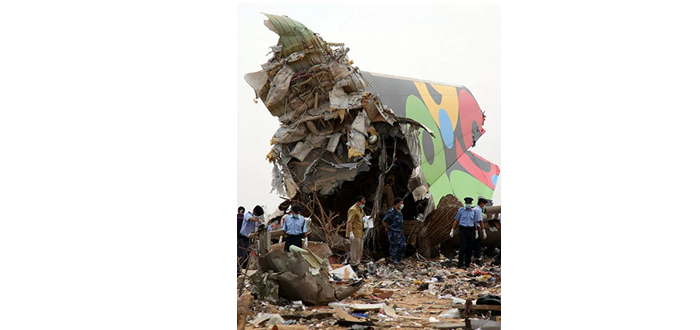
The aircraft, bound from Ankara to Tripoli, had scarcely begun its colloquy with the heavens when communication lines were severed. Moments later, some 105 kilometres from Ankara, the mute soil of a quiet village gathered the scattered debris into its bosom as though bearing witness that those who had departed would not return to this world again.
This was not the passing of a solitary man; it was the departure of a caravan of leadership. A single commander was not alone aboard that fateful flight; several lamps of guidance burned together there. Lieutenant-General al-Fitori, Chief of Staff of Libya’s land forces; Brigadier-General Mahmoud al-Qatawi, head of the Military Manufacturing Authority; and Muhammad al-Aswi Diab, adviser to the Chief of the General Staff—all were passengers upon that doomed aircraft, and all answered the summons of death with steadfastness.
The tragedy did not stand in isolation; it rapped upon the windows of memory and awakened the sorrowful chronicles of the past—those moments when eminent political and military figures were handed to fate amidst the clouds. The abrupt loss of communication after take-off, the crash site scarcely over a hundred kilometres distant from Ankara, the widespread debris indicating catastrophic explosion, the simultaneous demise of key civil-military leadership—these elements combined to further unsettle Libya’s already fragile political equilibrium, disrupt its chains of decision-making, and draw intensified international scrutiny.
In May 2024, Iran’s President, Ebrahim Raisi, too, departed this transient world in the aftermath of an aviation disaster. His helicopter crashed in mountainous terrain near the border with Azerbaijan, claiming also the lives of the Foreign Minister and accompanying officials. They were returning from the inauguration of a joint dam. National mourning spread across the land; the continuity of leadership suffered a jolt; elements of conspiracy infiltrated public discourse; the region responded with alacrity. The episode rekindled debates on the inherent precariousness of political leadership.
Their intended destination was Tabriz; Providence had ordained another. Though official inquiries attributed the crash to dense fog, discerning observers and senior officials spoke of clear skies—leaving, as so often in history, a question suspended in the air.
And, above all, there echoes the Qur’ānic reminder which history itself seems to utter:
﴿إِنَّا لِلَّهِ وَإِنَّا إِلَيْهِ رَاجِعُونَ﴾
“Indeed, we belong to God, and to Him is our return.”
Critics, peering through the rubble of fact and conjecture alike, pointed towards technical failings and lifted the curtain upon the darker alcoves of global politics. In the agora of public discourse, lamps of suspicion were lit; rumours walked with unhurried confidence. Accusations arose that truths had been muffled, that realities had been discreetly swept beneath official carpets. The event ceased to be mere “news”; it hardened into an enigma.
In August 2023, near Moscow, an aircraft fell from the sky, taking with it Yevgeny Prigozhin and ten of his companions. The very man who had commanded a formidable host of mercenaries in the war in Ukraine, and who—only months before—had startled the world by raising the banner of rebellion against President Putin, now vanished into the smoking wreckage. Ten companions, a single catastrophic end; accident or deliberate downing—who was to say? The sphinx-like silence of the state invited a global debate on power, its uses, and its inescapable consequences.
The annals of Pakistan, too, bear witness beneath the skies of Bahawalpur. In 1988, the military president, General Muhammad Zia-ul-Haq, perished in an air crash. Alongside him were the United States Ambassador, Arnold Raphael, and several of Pakistan’s most senior military officers. The sky of Bahawalpur, once tranquil, now became custodian of a grievous testimony.
International media outlets offered a profusion of theories; the gates of conjecture were flung wide. A hint of missile attack, the suggestion of foreign hands, the whisper of a global conspiracy—such interpretations abounded. Yet the pen of history wrote no definitive conclusion; the veil of truth has never been entirely lifted.
Ijaz-ul-Haq spoke of explosive materials secreted in crates of mangoes; yet this allegation never passed from suspicion into certainty, and history refused to confer upon it the dignity of established fact.
General Mirza Aslam Beg, in his memoirs Iqtidar ki Majbooriyan (“Constraints of Power”), recounted that day’s chilling narrative: an inspection from the air, smoke rising from below, the aircraft descending, and then the resolute decision not to proceed to the crash site but to return directly to Rawalpindi. For there are decisions, he implied, that are not scripted upon the ground but written in the grand ledger of destiny.
On 17 August 1988, upon the plains of Bahawalpur, there occurred that tragic moment which became simultaneously a political, military, and national turning point. In a purported air crash, Pakistan’s President, General Muhammad Zia-ul-Haq, the Chairman Joint Chiefs of Staff Committee, General Akhtar Abdul Rahman, and the American Ambassador, Arnold Lewis Raphael—together with nearly thirty souls—passed from time into eternity. This was not merely the death of individuals; it signified the closing of an entire chapter. Layers of inquiry, the subsequent stages of investigation, the story of the Al-Khalid tank trials, the background of military decision-making, the demands of constitutional propriety, and the inscrutable aura surrounding the tragedy—all seem etched upon the tablets of history.
The calamity befell Pakistan at a moment when its military trajectory stood at a crossroads and the map of regional politics was being redrawn. The echo of the crash travelled beyond its borders; the entire country was swathed in mourning, and the chessboard of power was rearranged anew.
Despite investigations, questions clung like shadows: accident or design? Was there an unseen hand behind the curtain? The knot has never been fully untied. State institutions sought the causes; reports were written with admirable diligence—yet, like a persistent tremor beneath the earth, the anxiety remained. International media, too, mulled various possibilities: mechanical failure here, tangled webs of conspiracy there. But history chose silence over verdict; it preserved the questions and withheld the answers.
The tragedy unfolded at a time when the trials of the Al-Khalid tank were underway, and the military
leadership had gathered in Bahawalpur against that backdrop. The journey, undertaken in that context, metamorphosed into an eternal voyage. The Al-Khalid tank represented a joint endeavour of China and Pakistan, with the American M1 Abrams commonly perceived as its rival. Threads of power, technology, and geopolitics were entwined in intricate knots.
India, too, dreamt of forging its own armour, yet its endeavours faltered; the lesson emerged that isolation yields only sterility, while collaboration and prudence serve as the true rungs to success. Industry does not stand alone; wisdom, experience, and partnership are its pillars.
Pakistani and Chinese experts, weaving together diverse strands of technology from multiple nations, produced a tank that was more than a machine—it was the emblem of a nation’s resolve.
At such crossroads of fate and power, one is reminded of the Qur’ānic admonition:
﴿وَمَا تَدْرِي نَفْسٌ مَّاذَا تَكْسِبُ غَدًا ۖ وَمَا تَدْرِي نَفْسٌ بِأَيِّ أَرْضٍ تَمُوتُ﴾
“No soul knows what it will earn tomorrow, nor does any soul know in which land it shall die.”
Pakistani engineers, with patience, craft, and an almost monastic deliberation, gathered diverse strands of foreign technology and, through prudent adaptation, fashioned the Al-Khalid tank. It was not merely a contrivance of iron and steel; it was a living testament to national resolve. It carved its own path through difficulty; it stood, not as a machine alone, but as the emblem of a people’s steadfast will.
General Akhtar Abdul Rahman protested that he had not been included in the first group of passengers. The answer returned with bureaucratic composure: it is a principle of prudence that all senior officials do not travel upon the same aircraft. Yet destiny is seldom impressed by human protocols; its own statutes operate at loftier levels. In the end, he too boarded the very flight from which none would return.
On 17 August, when General Zia-ul-Haq arrived in Bahawalpur, General Aslam Beg was already awaiting him. Military commanders and foreign dignitaries formed part of the retinue. None realised that what appeared to be a reception was, in truth, the prelude to a farewell—an unwritten valediction upon which eternity had already inscribed its seal. The author himself, in an extended interview with General Beg—still available in the modern marketplace of social media—posed many of the questions that had fermented in public minds; their answers may yet be heard there.
At the Tamewali Firing Range, the Al-Khalid and the M1 tanks were brought into direct comparison. The Al-Khalid prevailed, as if the labours of the nation had been vindicated. The joy of success had scarcely settled in the mind when a dark monsoon of tragedy rolled in; the voices of triumph were stilled. After the trials, the party set out once more for Bahawalpur. Prayers were said; routine engagements continued; the airport beckoned; life moved with the nonchalance of habit—yet somewhere, at the unseen margin of time, destiny had already written its decree.
Before departure, Zia-ul-Haq smiled and uttered his final words: “Why do you not come along as well?” Only later did the profundity of that simple invitation reveal itself as a silent farewell. It proved the last summons to earthly travel. He boarded the aircraft—and the narrative of history changed direction. Moments later, communication with “Pakistan One” fell abruptly silent. Radios died; a nameless fear rose like mist within the heart—fear that precedes the echo of catastrophe.
Smoke was seen rising at a distance. On approaching, the truth revealed itself: the C-130 lay destroyed; flames conversed with the very sky. There was wreckage—then fire—then silence. Human forms had become ash; and a chapter of history quietly closed.
General Aslam Beg resolved that power must pass in accordance with the Constitution. Conscience spoke; his steps obeyed. It was the decisive hour: to grasp authority, or to surrender it to lawful order? He remembered a father’s counsel and concluded that sovereignty is a trust of the people. Thus, in his own words, he chose fidelity over ambition.
Accordingly, in obedience to constitutional requirement, authority was transferred to the Chairman of the Senate, Ghulam Ishaq Khan. At ten that night, the nation was addressed; within mere hours the machinery of state refashioned itself, and constitutional process was revived.
The violence of the crash rendered identification agonisingly difficult. Whatever fragments of mortal remains could be gathered were laid to rest with reverence as sacred trust. Subsequent medical reports failed to establish the presence of any definitive chemical agent. Yet doubts lingered like embers beneath ash—at times cold, at times glowing faintly into life.
Military Intelligence, the Inter-Services Intelligence, and the Air Force each conducted inquiries; reports were duly submitted within three weeks. Yet truth never showed its entire face; it glanced from behind the curtain and withdrew. After that, history closed the docket; politics opened its next chapter. The C-130, as an Air Force asset, fell under its responsibility; protocols were strict and security thorough—yet accidents bow neither to rule nor routine; they merely await their moment.
The inquiries yielded no conclusive evidence of gas or toxic chemicals. The silence of the pilot, the absence of any SOS signal, the sudden loss of control—these sustained the spectre of conspiracy, while proof remained stubbornly out of reach. At times, silence itself becomes the most troubling question, and so suspicion never wholly died.
Commissions were constituted under both Benazir Bhutto and Nawaz Sharif—the Bandyal Commission and later the Shafi-ur-Rahman Commission—yet every road circled back to the same verdict: accident. Perhaps history deemed it fit that the final judgment be deferred to another tribunal altogether. For the Qur’ān reminds us:
﴿فَيَوْمَئِذٍ لَا يُسْأَلُ عَنْ ذَنْبِهِ إِنسٌ وَلَا جَانٌّ﴾
“On that Day, neither man nor jinn shall need to be questioned about his sin.”
The narrative now turns towards Jordan. In February 1977, Queen Alia Al-Hussein—the consort of King Hussein—perished in a helicopter crash. The tragedy shook not only the royal household but several pillars of the state; the Minister of Health and other dignitaries were also lost—a whole caravan extinguished. Fate seemed to proclaim that calamity does not halt at palace gates; royal walls are no rampart against decree. Forty days later, the airport at Amman was named in her honour—an emblem of national remembrance, a covenant to remember, a tribute cast in stone and iron.
And over all these episodes there hovers the eternal declaration:
﴿مَا أَصَابَ مِن مُّصِيبَةٍ إِلَّا بِإِذْنِ اللَّهِ﴾
“No calamity befalls save by the leave of Allah.”
In April 1966, Iraq’s President ʿAbd al-Salām ʿĀrif likewise met his end in a helicopter crash near Basra. In the immediate aftermath his brother, ʿAbd al-Raḥmān ʿĀrif, assumed the reins of office—his tenure brief, his shadow soon receding. Many a thoughtful observer deemed the tragedy mysterious, and history, once again, left its questions suspended in the air, knocking still upon the door of inquiry. Such episodes have shaped, directly and decisively, the political temper of the region.
These are not mere references in a chronicle; they are the ill-fated lamps of history—burning dimly, half-veiled, their truths elusive, perhaps destined to remain forever beyond the full gaze of the world. Each lamp teaches us that power is transitory, flight is finite, and the end is certain; that even those who soar in the boundless skies remain beholden to a single gesture of destiny. Power, pomp, and princely splendour can be scattered to the winds in the twinkling of an eye.
Here the timeless proclamation resounds:
﴿كُلُّ مَنْ عَلَيْهَا فَانٍ﴾
“All that is upon it shall perish.”
In most air disasters, certain elements are habitually at work: inclement weather—fog, dust-storms, blizzards; mechanical failure—engines giving way, hydraulic collapse, electronic malfunction; human error—want of training or want of vigilance. Yet, when the manifest includes heads of state, intelligence chiefs, or military commanders, another factor insinuates itself: political interest. Hence investigators, in prudence, seldom close the door between accident and design.
Where the leader of a nation, the custodian of its security, or the commander of its arms falls from the sky, the event refuses to remain a mere mishap. Questions arise and abide. Who stood to gain? Did the safety cordons fail? Was this nature’s blind strike, or a deliberate move upon the chequered board of power? History reminds us that truth is not always preserved upon official parchment; sometimes it lies interred with the dead.
From such inquiries a few sober verities emerge. The death of leadership can bend the arc of national destiny; air disasters have marked turning-points in modern politics; and despite the advance of science, certain riddles remain unresolved. At the zenith of power, human frailty whispers its limits, and the great judgments of history seem to be written, as it were, also in the heavens.
From the skies over Bahawalpur to the runways of Amman—from Queen Alia of Jordan to President ʿAbd al-Salām ʿĀrif of Iraq—each catastrophe reiterates the same austere lesson: that authority, might and magnificence are but like flight itself—glorious yet fragile; a single gust, and the splendour is in shards. Whether the subject be military strategy, the diadems of politics, or that immutable law of human fate, the record stands preserved in the very sequence you provided.
Surveyed together, these episodes compose a sombre tableau: twisted wreckage of aircraft, plumes of black smoke, mothers in lament, silent sentry-posts, and the chill of dread drifting through the corridors of power. These are not merely doleful accidents; they are the very bends in the river of history that altered national destinies, redrew political maps, and diverted the current of time itself.
It is equally true that global hegemonies have long sought to keep the balance of power within their grasp—by open war, by economic strangulation, by the re-ordering of governments, and at times by those enigmatic “accidents” whose truth has never fully stepped into the light. Leaders across the developing world who spoke of sovereignty, ownership of resources, or independence from the world’s economic regimes have too often paid in isolation, in tragedy—or in what the record calls an accident.
These are not fanciful tales; they are the painful truths that lie buried—and yet alive—in the breast of history. But the reverse of the picture must also be seen: shattered nations do not always perish; they rise as well. The so-called Third World now stands with its wounds uncovered; after long ages of servitude, the whirlpools of intrigue and the tempests of disaster, its youth are awakening, its thinkers are taking up the pen, and its people proclaiming their right to self-determination. The road is perilous; nevertheless, history bears witness that nations which wept—and walked on—arrived at last.
If on one side these air catastrophes bereft nations of their leaders, on the other they taught a sterner lesson: that freedom exacts a price; that the road to sovereignty is strewn with dangers; and that to confront imperial power is often to have one’s fate inscribed as “an accident”. Yet history does not halt at disaster—it merely turns the page.
Today, the peoples of the developing world mourn their fallen leaders, and from that very remembrance draw their courage. Perhaps the dawn that is to come shall be born of these tears; and when flights once again trace their arcs across the sky, they may become not omens of fear but heralds of freedom.
The unifying spirit of these singular tragedies reminds us that history is not a bare sequence of events but also a ledger of admonitions. Leaders depart, but leave behind their questions: Whose power? Whose mandate? And to what end?
The tale of these air disasters gently but insistently teaches that the aircraft of national destiny does not only fly through the clouds; it travels also across the firmament of principles and of hearts. This essay is, in essence, the chronicle of the tenuous bond between human destiny and temporal power. The flights may be long, but they are never eternal; authority may be exalted, but it is never imperishable.
By the waning days of the second decade of November, the reflective sessions of the Global Iqbal Conference were still in full sway in Quetta Baluchistan. The halls hummed with dialogue, the minds of scholars and thinkers pressed forward, alive with ideas. Amidst this fervour, the honourable Hafiz Tahir—former Secretary, recently designated OSD—insisted, with unyielding warmth and hospitality, that I visit his official residence. That very residence where today he spends, in quiet dignity, the remaining days of the sentence that his unwavering integrity has earned. There was a solemnity there, an almost palpable silence, a muted protest; it seemed as though the walls themselves bore witness that, at times, the gravest cost of truth is solitude, and the heaviest burden, a moral sentence imposed by conscience.
Yet it was a humble plaque, fastened to the outer door, that truly seized my heart. Upon it, a Qur’anic verse shone with stark simplicity:
﴿وَما الْحَياةُ الدُّنيا إِلّا مَتاعُ الْغُرورِ﴾
“And the life of this world is nothing but the merchandise of delusion.”
I lingered before it, as though the words were not etched upon stone but upon the very fibres of my soul. How I longed, in that moment, for us to do more than merely read—to immerse ourselves within its depths, to hold our lives to its mirror, and to discern what constitutes true recompense, and what the ultimate reward might be. A shiver ran through me as I realised, perhaps for the first time, the profound truth that only by such reckoning could we understand the true measure of loss—and of success.
Aerial disasters, shattered leadership, fractured kingdoms, toppled thrones—all bear witness to this singular reality. Power, fame, authority—all are at the mercy of a fleeting gust. And in the stillness of that revelation, the heart whispered:
“If only we might enter fully into this message from our Lord, weigh ourselves by its measure, and recognise that the supreme flight is not of wings, but of the soul; and all else, all worldly pursuits, are but the glitter of illusion.”
In that quiet, another verse resonated with solemn clarity:
﴿كُلُّ نَفْسٍ ذَائِقَةُ الْمَوْتِ﴾
“Every soul shall taste death.”
And with it, the truth became undeniable: the leaders who fall in the corridors of history, the aircraft that shatter across the skies—they are enduring reminders that flights, however ambitious, are never eternal; that no crown, no office, no glory withstands the quiet, inescapable decree of fate.
Let this stand, then, as the final reflection: the loftiest journeys may be long, yet they are finite; the mightiest power may ascend, yet it is never immortal. And in this, perhaps, lies the ultimate lesson for all who dare to soar that the only true flight is the flight of the soul, and the only enduring measure is the moral compass by which we navigate the fleeting splendours of this world.