China’s Quiet Advance
The Triumph of Silence

There are moments when Time itself turns upon its hinges, yet those seated upon the high thrones of power seem singularly unable to discern the tremor beneath their very feet. Nations live by dreams, but history is inscribed in the full wakefulness of conscience. The march of history has quickened; destinies are no longer written solely upon the smoke-blackened fields of battle, but in the rhetoric of military doctrines, the deft manoeuvres of diplomacy, and the subtle cartography of geopolitics. Nations are not judged by the clamour of their slogans, but by the gravity of their deeds; and when peoples trumpet only words, yet fall silent when summoned to action, history inevitably puts to them a stern question: were you merely vendors of empty cries, or artisans of purposeful achievement?
وَتِلْكَ الْأَيَّامُ نُدَاوِلُهَا بَيْنَ النَّاسِ
“These are the days which We alternate among mankind.” (Qur’an 3:140)
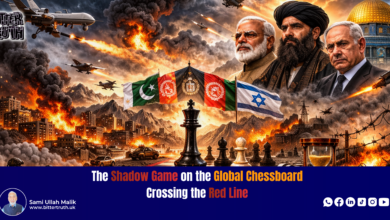
Between the two great states of the Subcontinent—Pakistan and India—the recent aerial skirmish may have worn the outward cloak of a regional crisis; yet a third power, vast, inscrutable, and patient—China—quietly secured advantage in a fashion that compels serious historical and geo-strategic reflection. To an inattentive eye the contest appeared bilateral; but to those whose eyes are open and whose judgement has not slumbered, it was a decisive etching upon the geo-strategic canvas of Asia—and the true architect of that image, one must ask, was it Islamabad or Beijing?
This was not the familiar, overheated exchange between two nuclear neighbours. It was, rather, the proving ground of China’s military industry, an assertion of impassioned nationalism, and an exercise in diplomatic craft—demonstrating to Asia and, indeed, to the wider world where a “steel-clad friend” stands in the nascent alignment of global power. When the Indian Army, so bellicose in its rhetoric against Pakistan, wraps itself in a shroud of silence upon the icy heights where Chinese shadows lengthen, the question is not merely why it is silent, but whether that silence is, in truth, the veil of defeat.
This essay contends, in the light of these clashes, that the real victor—whether China or Pakistan—asserted primacy not only in matériel but in the arena of ideas and diplomacy. My endeavour herein is to delineate the strategic and historical context of the recent aerial confrontation, China’s unannounced yet decisive role, the standing of Chinese defence industries in global markets, the cartographical symbolism of renaming in Arunachal Pradesh, and India’s quixotic attempt to open fronts on every border at once.
The battle, though fought in the empyrean, sent its reverberations through the market squares of the world. When Pakistan launched the J-10 and JF-17 aircraft, fruits of Sino-Pakistani collaboration, these were not merely warplanes; they were flying manifestoes—testaments to a defence partnership whose confidence had outgrown parade grounds and now made its claim upon the theatre of war itself. One could almost sense that, as the Chinese Colonel Zhu Bo spoke, a fresh page of history was being signed.
For China’s defence industry this engagement was nothing less than advertisement—though written not in pamphlets and prospectuses, but in the fire-traced script of combat. For the first time Chinese fighter aircraft were tested in the crucible of a real conflict; and, as Eastern wisdom has often reminded us, the line upon stone is etched only when steel is set in motion.
India christened its air operation “Operation Sundoor.” Drones, missiles, and fighter aircraft were hurled into the fray. India deployed French Rafales and Russian jets; Pakistan responded vigorously with the Sino-co-produced J-10s and JF-17s. Pakistani aircraft, without crossing the frontier, loosed missiles that, according to its claims, destroyed six Indian aircraft. Delhi issued formal denials, yet the Rafale manufacturer itself acknowledged the loss of three aircraft—an admission that marked a turning point of no small historical significance. The chief executive of the company, striving perhaps to staunch reputational wounds, conceded that while they could sell aircraft, they could not sell courage. The markets, that remorseless tribunal, were unsparing; Rafale’s shares faltered, while the stock of the JF-17—slayer of its French rival—rose sharply, sending an unambiguous signal to buyers across continents.
When Indian media breathes fire against Pakistan, one might think New Delhi stands on the verge of proclaiming victory from Kabul to Islamabad. Yet in Ladakh’s snow-laden valleys the same voices fall mute when confronted with Chinese sentinels. Former Foreign Secretary Shyam Saran’s admission—that the Indian military either will not act or cannot—was in essence a diplomatic confession of timidity. It is the same tongue that thundered against Pakistan now faltering before China. Why?
The Chinese People’s Liberation Army’s former Colonel Zhu Bo declared before the world’s media that this air engagement served as a major showcase for China’s defence industry. Never before had Beijing’s platforms been tested in actual combat. Following the J-10’s successful trial by fire, shares of the Chengdu Aircraft Corporation surged by some forty per cent. Victory, therefore, belonged not merely to the soldier in the cockpit, but to the live demonstration of Pakistan’s courage—proof conclusive that the contest was won both on the battlefield and in the financial markets. Chinese weapons now stand poised for wider acceptance across Asia, Africa, the Middle East, and Latin America.
The Indian Air Force spokesman’s remark, “Loss is part of war,” was in truth an oblique confession of defeat. The government’s wary silence, the international media’s reporting, and the Rafale company’s admissions together signalled a reality that had outgrown the fictions of narrative. Here again, China eclipsed India on the diplomatic stage—not by declamation, denunciation, or theatrical rhetoric, but by the stark eloquence of results. This reticence is, indeed, the signature of Chinese statecraft.
India’s Rafales—purchased at extravagant cost—proved unequal to Pakistani missiles. Their confirmed losses plunged Delhi into a silence as heavy as mourning beneath the red sandstone of Agra Fort. The repeated refrain that “such losses are normal in war” was but a gauze placed over an unstaunched wound. The world, however, saw the blood seep through.
Pakistani aircraft did not cross the frontier, yet their missiles exacted a toll across it; this was more than a display of military skill—it was an unannounced rehearsal of Sino-Pakistani strategy. Pakistan’s triumph became China’s masterclass in military marketing; the forty-per-cent surge in Chengdu’s stock was no mere economic incident, but proof that modern conflict is fought not only with gunpowder, but with brands and narratives.
Let it not be forgotten that when Defence Minister Rajnath Singh himself acknowledged that significant numbers of Chinese troops had crossed the Line of Actual Control into Indian territory, it seemed as though India’s geographic sovereignty had been crushed beneath glacial boots. It was not simply a border incident; it was the victory of Chinese self-assurance and the retreat of Indian claims. What was most conspicuous was not India’s protest—but India’s military inaction.
President Trump’s offer of mediation resembled the well-meaning overture of a monarch eager to reconcile quarrelling princes; yet China dismissed it with the quiet dignity of one certain of its own poise—declaring, in effect, that it was sufficient unto itself, sovereign, self-reliant, and intellectually confident. Such composure marks those who stand upon the threshold of regional pre-eminence. The lesson for Pakistan’s own leadership is clear: cast out the lingering fear of international financial institutions; as Pakistan once turned its gaze from West to East in defence procurement, so too must it liberate itself from the tutelage of borrowed anxieties.
إِنَّ ٱللَّهَ لَا يُغَيِّرُ مَا بِقَوْمٍ حَتَّىٰ يُغَيِّرُوا۟ مَا بِأَنفُسِهِمْ
“Indeed, God does not change the condition of a people until they change what is within themselves.” (Qur’an 13:11)
And again:
وَأَعِدُّوا۟ لَهُم مَّا ٱسْتَطَعْتُم مِّن قُوَّةٍ
“Prepare against them whatever strength you can muster.” (Qur’an 8:60)
Such are the admonitions of Revelation and the verdicts of history: the age belongs to those who couple resolve with restraint, courage with wisdom, and power with principle.
A few days after the ceasefire, China unveiled a new diplomatic and psychological stratagem. While India remained preoccupied with Pakistan, Beijing launched a quieter—yet intellectually decisive—offensive: twenty-seven locations in Arunachal Pradesh were rechristened in Chinese and Tibetan.
Mountains, passes, rivers, lakes, hamlets, and settlements alike were renamed. This was not merely a symbolic blow to India’s geographical claims; it was a reminder to the world that maps are not only drawn upon paper, but first inscribed in the minds of those who rule. The act demonstrated that China and Pakistan are not merely emblematic powers; they advance vigorously also in the domain of soft power. The renaming was no linguistic pastime; it was a steel-tipped assertion of historic claim, executed precisely when India’s military gaze was fixed westwards upon Pakistan. To the strategic triad of India–Israel–the United States, the message was clear: when you turn to the East, you shall read names upon the earth that are not your own; and when you open your atlases, even the words may elude your ownership.
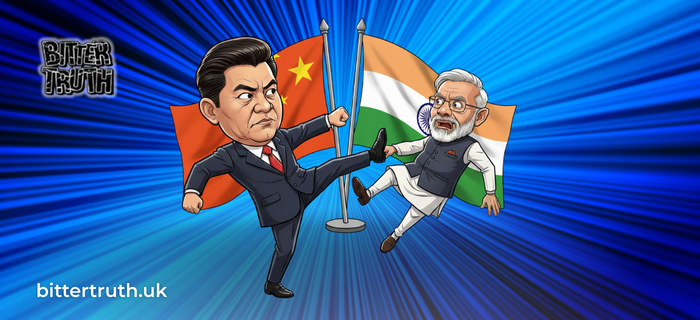
Nepal, Pakistan, and China—situated upon three of India’s frontiers—are each, at this hour, in various states of tension with New Delhi. One must ask: in what dream or cartographic delusion does India open simultaneous fronts on three sides? Nepal, though small in size, has asserted a diplomatic independence that has unsettled Indian policymakers; Pakistan has strengthened itself both militarily and ideologically; and China stands as a global power that has surpassed India in economic and military spheres alike. It is as though a mosquito had strayed into the lairs of three lions, imagining itself to be a passing cloud destined merely to shower and be gone.
At first glance the skirmish seemed between India and Pakistan alone; in truth, it marked the success of a trilateral understanding between Pakistan and China. At the military level there was Pakistan’s operational dexterity in the field; alongside this stood the successful combat validation of Chinese J-10 and JF-17 aircraft, amplified in the global marketplace by a remarkable rise in the shares of Chinese aviation industries. Diplomatically, psychological ascendancy was achieved by engaging India on two fronts—Pakistan and Arunachal—rendering its regional image blurred upon the world’s stage; and strategically, the world was made to understand that, following Pakistan’s practical demonstration, China had emerged not only as an industrial giant but as a leader in the rhetoric of war. All these dimensions point towards a single reality: China has won an undeclared conflict—without firing a shot—upon the strength of Pakistan’s performance in the field.
Pakistan’s military success is indisputable; yet if there is a principal beneficiary of the encounter, it is Beijing. Without discharging a rifle, expending fuel, or sacrificing soldiers, its corporate shares soared, its weapons gained practical certification, its political narrative was fortified, and new colours were added to its cartographic aspirations. This is the art of Eastern statecraft—where silence proves more potent than bullets, and the map becomes a subtler weapon than the battlefield. Little wonder the verdict of history has often been: victory belongs to those who quietly carry the day.
Wars are not won by artillery alone; behind them stand the minds that alter the temper of history. Quietly, patiently, and with an astute reading of Time’s mood, Pakistan and China appear to have done precisely this. One is reminded of an arresting parable: when the hour of decision arrives, nations either preserve the moment as history—or, neglecting it, themselves become its cautionary tale. The partnership between Pakistan and China seized the hour, lifting their narrative, their armaments, and their strategy to a higher plane. This now stands as an undeniable reality of the international landscape—and perhaps as the herald of Asia’s shifting centre of gravity.
Some have called India’s silence “prudence,” yet history insists that prudence is timely, responsive, and crowned with success. If an adversary crosses your frontier and you cannot even protest in voice, such silence is not wisdom but fear. The media chorus that daily sings martial anthems against Pakistan fell conspicuously mute before China. The moment demands not merely to measure one’s enemy, but to recognise him.
India’s reticence before China is not merely geography rendered wordless; it evokes the ancient maxim associated with Kautilya—submit before the stronger power, and reserve defiance for the weaker. Hence, many spectacles have circulated in the global press: rituals performed before weapons systems, votive offerings placed before fighter aircraft, symbolic gestures of devotion in the presence of arsenals. These images speak less of faith than of the uneasy marriage between populist spectacle and strategic anxiety. The malaise is not India’s alone; wherever media is captive to expediency, politics to slogans, and people to silence, the same pattern emerges.
In the snowbound valleys where Pakistan and China face the heights, cannons may not yet have spoken; but truth and history speak even through ice. And they say: you were fierce against the weak and hesitant before the powerful; bold in claim yet unversed in strategy; generous with threats to Pakistan yet deferential in silence before China.
India’s martial bravado against Pakistan unsettles the region; its silence before China reveals the contrast between performative militancy and realpolitik. In these conditions, the balance of power in South Asia inclines steadily eastward—while Sino-Pakistani amity rises like a sun, casting a reshaping light upon the region’s destiny.
From this analysis one truth emerges with clarity: during the recent aerial tensions of South Asia, the people of Pakistan stood as a wall of steel—setting aside political divisions and, in humility before God, achieved a manifest success under the canopy of unity. At the same time, it must be acknowledged that China presented a rare fusion of military industry, geopolitical subtlety, and diplomatic intelligence seldom witnessed in classical statecraft. The hour now calls for strengthening national cohesion, curbing political anarchy, and replacing rancour with concord. As Pakistan has reset the foundations of fraternal relations with its neighbours—embracing again its friends with sincerity—so too must it nourish the spirit enjoined in Revelation:
إِنَّمَا الْمُؤْمِنُونَ إِخْوَةٌ
“The believers are but brothers.” (Qur’an 49:10)
Thus, may unity of purpose, sobriety of politics, and the discipline of history guide the region through its present storm and toward a more considered peace.