
Caste and Conscience
The Silence of Justice

In the Shadow of Cruelty
India’s civilisation is counted among the most ancient in the world. History bears witness that under Muslim rule, this very land imparted to humankind the lessons of love, philosophy, and spirituality upon which humanity has long prided itself. Yet, lamentably, upon the bosom of this soil there festers a wound that refuses to heal. The caste system, a malignant tumour in the body of the Subcontinent’s history, has extinguished the light from the countenance of human equality. On this earth where once the Upanishadic call “Aham Brahmāsmi” proclaimed the unity and dignity of all beings, the dust of time has divided men into ranks of purity and pollution, into hierarchies of blood and birth.
The caste system was not always the monstrous instrument of exploitation it has now become. A notion that perhaps emerged from theological interpretation or economic differentiation gradually evolved into a merciless structure of oppression. Man began to play God over his fellow man; and “untouchable” became the title bestowed upon those whose spirits remained pure, yet whose lineage was deemed low. It has rightly been said that the degradation of human dignity is nothing less than rebellion against the Almighty upon His own earth. In today’s India under the influence of the RSS, the word Dalit is not a mere label; it is a chronicle of centuries-long subjugation, hatred, and collective shame. The political wing of the RSS, the BJP under Narendra Modi, stands accused of turning this sordid legacy into a renewed project of national humiliation.
The fertile expanse of Madhya Pradesh—once resonating with the music of serenity—now trembles with the screams of the downtrodden. The recent events unfolding in this state appear as a revival of that ancient tyranny. Gyan Singh, 33 years old; Rajkumar Choudhary, merely 26; and that silent, unnamed Dalit in Damoh—each stands as a chapter in a chronicle that has long dishonoured humanity with its repetition. In mid-October 2025, three incidents shook the very pillars of justice in Madhya Pradesh. When a nation loses its sense of justice, oppression ceases to be an act against another; it becomes a curse upon oneself.
The tears shed upon the soil of Madhya Pradesh testify to this grim truth. The ordeal of Gyan Singh—forced at gunpoint to drink urine—belongs to those chapters of human history so dark that even shame itself shivers in revulsion. This was not merely the humiliation of an individual; it was a proclamation of Brahminical supremacy and the erasure of a subjugated people. When identity is stripped solely because one is Dalit, the injustice ceases to be a regional issue. It becomes a civilisation’s tragedy.
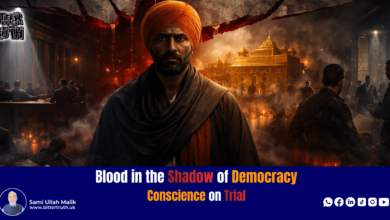
The days of October 2025 descended upon the Dalits of Madhya Pradesh like a Day of Reckoning. Bhind, Katni and Damoh: three districts, three Dalit families, one shared calamity—the humiliation of a human being solely on the pretext of caste. Gyan Singh’s cry of agony on the soil of Bhind mocked India’s proud claim of being the world’s largest democracy, leaving humanity across the globe bowed in shame.
The abominable evening of 20 October: the sun sinking into the western horizon while brutality rose in Bhind’s outskirts. Gyan Singh, a helpless son of the soil, was abducted at gunpoint, tortured, and with trembling voice retold his ordeal through tears that seemed to bleed: “They forced me into a
vehicle at gunpoint, beat me mercilessly, and compelled me to drink from a bottle filled with urine. Had I not been a Dalit, would this fate be written for me? Would I have been forced to swallow such indignity? Would I be suffering this torment today?”
His only crime was weakness, and his punishment absolute humiliation. Merely refusing to drive a known criminal, Sonu Barwa, led to his abduction, assault, and degradation beyond imagination. From his hospital bed he still asks: “Is fear a crime? Had I been born of another caste, would this torment still have been my destiny?”
This is no solitary prayer for justice. It is a deep fracture running through the rock of society, a space where humanity is crushed beneath the monstrous weight of caste. Gyan Singh lies not only wounded in flesh, but drenched in the stains of dishonour—stains darker than blood. This is neither the first such atrocity, nor the last hidden beneath the shroud of silence. In a fortnight alone, three such horrors have come to light—three Dalit homes, three mutilated souls. A stinging slap upon the face of the Modi government and a raging question: Is law meant only for the powerful? The police in Bhind may have filed an FIR against the accused, but such steps seem no more than droplets of water upon a spreading inferno.
When the guardians of justice become the gatekeepers of darkness, where shall hope seek refuge? The pattern did not end there. Travel five hundred kilometres to Katni and the anguish deepens. On 13 October, a young Dalit farmer, Rajkumar Choudhary, dared to raise his voice against illegal mining. His courage was rewarded with savage cruelty beaten by Pawan Pandey, son of the influential village head, urinated upon, and his mother dragged by the hair before the entire village as casteist slurs poisoned the air. Violence rained not only upon his body, but upon the very soul that dared to speak.
Ram Bahari, Rammanuj Pandey, and Pawan Pandey—names that should be etched beneath the heading “Criminal” in the annals of justice—still walk free under the protective shadow of the BJP, that torchbearer of a politics that dishonours humanity. Police murmurs that “the search continues” echo feebly against the wounded heart, for justice delayed becomes mercy for the oppressor and torment for the oppressed.
Nor does the agony pause in Damoh. Terrified silence hangs over the district like a haunted mist. A Dalit man was compelled to wash the feet of a Brahmin and drink that very water. The defilement transcended the body; it violated the essence of his personhood. When asked why he dared not file a complaint, his reply stunned the conscience of the nation: “I must live here. After filing an FIR, where shall I go?”
This single sentence stands as a death certificate of societal morality. It symbolises an enslavement no legislation has yet been able to abolish.
These three incidents in Madhya Pradesh strike a deadly blow to the soul of India’s Constitution. Articles 15, 17 and 46 explicitly prohibit discrimination on grounds of caste, creed, or descent; yet the nation continues to inhale beneath the suffocating shadow of Manusmriti. Article 17 declares untouchability a crime, though in truth it lives vigorously in the streets and lies buried only in the law books. The Scheduled Castes and Scheduled Tribes (Prevention of Atrocities) Act of 1989 has become a mere museum of words. Complaints are reduced to trivial “village disputes,” and often the victim, rather than the perpetrator, is thrust into the dock.
Lawyers and social activists assert that the absence of accountability lies at the heart of this tragedy. When the very act of raising one’s voice against injustice becomes life-threatening, silence evolves into a compulsory civic habit. The walls of justice have been draped with cobwebs of silence and smothered beneath the tyranny of expedience. Those who stand for human dignity cry out that the root of these crimes is impunity itself. Cases are dismissed as mere “village disputes,” or worse, the victims become the accused. One social worker lamented that the law exists, yet justice has turned into an elusive dream. When the guardians of power station themselves before the doorway of justice, the plea of the oppressed strikes against the fortress walls and returns defeated, carrying the stain of deeper wounds.
The caste order, enshrined in ancient Hindu texts under the label “Varna-Ashrama,” may once have been intended as a primitive framework for social regulation. Gradually it cloaked itself in religious sanctity until it evolved into a hierarchical dictatorship over human worth. The Manusmriti offered divine sanction to this stratification: the Brahmin bestowed with knowledge, the Vaishya with commerce, the Shudra with servitude. Yet the Dalit was condemned to silence and slavery, while adherents of other faiths, including Islam and Christianity, found themselves subjected to hostility even harsher still, a fact confirmed by innumerable historical examples.
History nonetheless bears witness to those who resisted this oppression. Buddhism forged a spiritual revolt against caste by preaching Karuna (compassion) and Ahimsa (non-violence). The Bhakti movement, and especially Saint Kabir, called upon humankind to shatter the shackles of caste. Kabir’s voice echoes still:
“Jāt na pūchō sādhu kī, pūchh lijiyē jñān.”
Ask not the holy man of his caste, but ask of his wisdom.
Islam proclaimed the message of equality in words that shine through eternity:
إِنَّ أَكْرَمَكُمْ عِندَ ٱللَّهِ أَتْقَىٰكُمْ﴿الحجرات
“Indeed, the most honoured among you in the sight of God is the one most righteous.” (Al-Hujurāt 49:13)
This timeless dictum could provide the very foundation for a just Indian order, if only hearts and minds might be freed from the shroud of prejudice. Yet tragedy lies here: as the RSS enters its centenary, it champions the chilling claim that “Akhand Bharat” must be governed solely under Brahmin dominion, leaving all others in perpetual bondage.
The Constitution of India, adopted in 1949, declared Dalits equal citizens and outlawed caste-based discrimination. Article 15 prohibited exclusion on the grounds of religion, race, caste, or sex. Article 17 criminalised untouchability. Article 46 obliged the state to promote the educational and economic welfare of Scheduled Castes and other backward communities. In 1989, a law specifically for the prevention of atrocities was enacted. Yet in practice this legislation buckles beneath the weight of social dominance.
Human rights defenders caution that justice cannot enter where the sentinels of power guard the gates. Judicial precedents, notably State of Karnataka v. Appa Balu Ingale (1995), recognise caste-driven crimes as not only social perversions but constitutional rebellions. Yet despite the statutes, justice remains a distant dream, a tragedy without intermission.
Viewed through the prism of civilisation and intellect, the sanctity of the human person, justice, and faith are the rightful guardians of cultural beauty. The societies that uphold human dignity and fairness alone endure. Islam knocked upon every door where slavery resided, raising humankind to honour by virtue of humanity itself. Language is not merely a tool of expression; it is a vessel of civilisation. When justice and humanity retreat from our tongues, society forfeits its culture. Justice is not only a legal necessity; it is an ethical and intellectual obligation. A nation that tolerates injustice grants tyranny eternal life.
The lessons embedded in the events of Madhya Pradesh are stark: Silence strengthens the oppressor. Silence itself is a crime.
These three tragedies demonstrate that the crisis of justice is not merely legal; it is a societal disease. The roots of oppression spread their poison when accountability is denied. Today’s Modi-era India rushes headlong into a frenzy of Hindu supremacy. These incidents are not simply the result of police incompetence or a few men’s brutality; they signify a toxin that has seeped through generations into the marrow of society. Police actions often boomerang against the complainants, perpetrators enjoy political patronage, and a once-conscientious society has turned voyeur. Social workers warn that when justice is rare for one class and guaranteed for another, society becomes its own worst enemy. This is the crisis of contemporary India, where the agony of the Dalit still struggles to reach the court of justice.
This essay is not a mere catalogue of incidents; it is a summons to the conscience of India. The tears of Gyan Singh, the cries of Rajkumar, the silence of Damoh’s forgotten Dalit—each stands as a mirror before the nation. Caste is the blemish upon the face of humanity that no statute alone can cleanse. Only an awakened conscience can erase it.
The question is not for the brutal government of Narendra Modi alone, which seeks to fulfil the RSS’s dark prophecy. It is for the entire world—especially those Western nations and American institutions who boast of championing human rights. Shall the dignity of a human being be sacrificed upon the altars of caste and creed? If we fail to discern humanity reflected within these tears, future generations will curse our memory.
The hour demands that the pen of law be freed from the shadow of power, and that justice be measured not by bloodlines but by the scale of humanity. Madhya Pradesh has warned us anew: when justice bows to fear, tyranny rules. The venom must be cleansed through faith, education, and the resolute will of the law.
Nations may retain their temples and monuments after forsaking justice, yet their souls perish. Should those who chant the slogans of human rights allow this spiritual death to continue by granting Modi’s regime unchallenged impunity, history will again count us among the oppressors.
The media carries a solemn obligation: to transform such tragedies from fleeting headlines into enduring dialogues of reform. This essay stands not only as a document of social inquiry, but as a moral calling—that every human being, irrespective of caste, creed, or colour, is the bearer of an inviolable honour, a noble dignity, and a sacred right to justice.