Blood in the Shadow of Democracy
Conscience on Trial

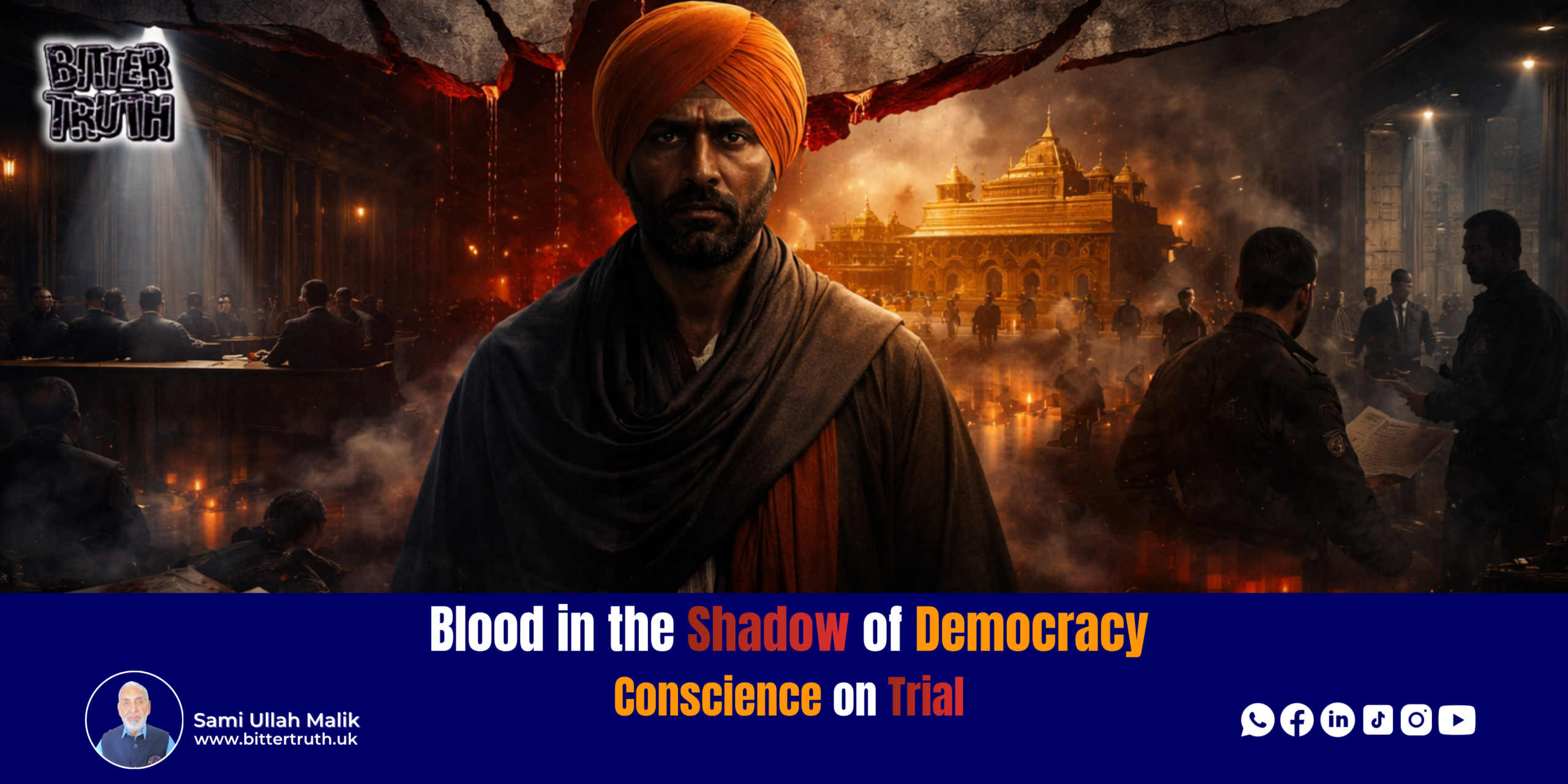
At times, the annals of history are inscribed not in ink but in blood — in episodes so grievous that they shake the human conscience and compel us to re-examine the ancient scales by which justice is weighed. The harsher realities of contemporary Indian politics stand as a sombre mirror to such wrongs, whose gravity has scarred not only the Sikh community but the moral sensibilities of the wider world. The tragedy of 1984 endures in the Sikh heart as an unhealed wound, a sorrow that time has neither softened nor erased. In that cataclysm, more than two hundred thousand Sikhs were slain, their only alleged offence being the assertion of constitutional rights which, in any civil polity, ought to have been inviolable.
The assault upon the Golden Temple — a sanctuary that embodies not merely the spiritual radiance of the Sikh faith but a universal message of peace — marked a moment of profound moral rupture. To bombard so sacred a place was to trespass against the most elementary principles of religion, decency, and human dignity. Thousands of Sikh men, women, and children perished. Yet among the cruellest ironies was the reported selection of a Sikh general to command the operation — a decision that seemed designed to deepen the wound by forcing a nation to behold its own hand turned against itself.
Nor did the machinery of coercion halt there. In the years that followed, accusations arose that efforts were made to tarnish the Kashmiri movement for self-determination by recourse to stratagem and misdirection. During the visit of President Bill Clinton to the region, Sikhs were brutally shot at Gurdwara Chatti Singhpora in Jammu, an atrocity swiftly attributed to Kashmiri militants. To many observers, the episode appeared as a grim tableau in which state power, clandestine intrigue, and international diplomacy converged in a most disquieting alliance — a drama in which truth itself seemed imperilled.
Under mounting international scrutiny, a three-member investigative committee was convened. It included Justice (Retd.) Ajit Singh Bains, Chairman of the Punjab Human Rights Organization; Sardar Inderjit Singh Jaijee, Convenor of the Movement Against State Repression; and Lieutenant-General (Retd.) Kartar Singh Gill, associated with both bodies and possessed of experience in military command and human rights advocacy alike. Following its inquiry, the committee is reported to have held the Indian external intelligence agency, Research and Analysis Wing, responsible. Efforts were allegedly made to suppress the findings; yet truth, though often obscured, is seldom extinguished, and the report entered the public domain beyond India’s borders.
Taken together, these episodes have been cited by critics as evidence of how a government animated by an exclusionary Hindutva ideology may, beneath the formal vestments of democracy, subordinate human dignity to political expediency. The sacrifice of two hundred thousand Sikhs, the desecration of the Golden Temple, the bloodshed at Chatti Singhpora, and the labyrinthine manoeuvres that followed stand, in this telling, as stark reminders that when power, religion, and politics are fused without restraint, the individual life may become tragically expendable. Such historical deceptions and alleged conspiracies serve as a warning to the global conscience: that without the vigilant defence of justice and human rights, liberty risks becoming a hollow abstraction.
World politics has often been likened to a great, shadowed tree, its branches heavy with influence, stratagem, and designs conceived beyond the public gaze. It is also a gilded ledger upon whose pages the contest between blood and justice is faithfully recorded. In that theatre of veiled manoeuvre, an episode unfolded in a New York courtroom that startled observers across continents.
There appeared before the court a fifty-four-year-old man, Nikhil Gupta, whose testimony cast light upon what critics describe as one of the darkest boughs of that tree. Gupta alleged that the government of Prime Minister Narendra Modi had orchestrated, through intermediaries and hired assassins, a plot to carry out a killing on American soil, furnishing the requisite resources and direction. The disclosure, if sustained by judicial scrutiny, lays bare a design in which the elemental principles of sovereignty and human dignity are subordinated to the calculus of power — a spectacle that unsettles the moral equilibrium of any civilised order.
Gupta, aged fifty-five, pleaded guilty to three grave offences: providing financial support for murder, conspiracy to commit murder-for-hire, and money laundering. He faces a potential sentence of up to forty years’ imprisonment. The alleged target was Gurpatwant Singh Pannun, an American citizen and a prominent advocate of the Khalistan movement — a campaign that envisions a separate Sikh homeland and commands fervent support among segments of the diaspora as well as within India itself.
In court, United States Attorney Jay Clayton declared that Gupta had conspired to murder an American citizen on United States territory solely because that citizen exercised his lawful right to free expression. The statement stands as a sober reminder that even within free societies, external powers may seek to cast long shadows over fundamental rights. The lamp of liberty, though resilient, may flicker when confronted by the gusts of geopolitical ambition — yet the architecture of justice, if steadfastly upheld, can still admit the clarifying light of law.
Gupta, it is said, imagined himself shielded by the presumed protection of powerful patrons, believing that proximity to authority would render him immune to consequence. Yet the law has a way of dispelling such illusions. In this instance, the processes of justice drew back the curtain, placing him before the mirror of his own deeds and at the threshold of accountability, as though a lantern had been lit along a darkened road.
International media have treated Gupta’s confession as judicial corroboration of a plot extending to the highest reaches of political authority. If these proceedings bear out the allegations, they will mark a moment at which the intricate byways of global politics are illuminated with uncommon clarity. It is, perhaps, one of those rare junctures when history pauses — and inscribes, in unmistakable script, the austere syllables of truth.
India has formally designated Pannun a terrorist; he, for his part, describes himself simply as an activist. The Sikhs constitute scarcely two per cent of India’s vast population, yet among certain circles there persists the aspiration for a separate homeland — a longing sustained by memory, grievance, and an unextinguished sense of nationhood. Across the diaspora, voices are raised in favour of Khalistan, a cry that its adherents present not as sedition but as the expression of a collective temperament marked by endurance and resolve.
According to the prosecution, in May 2023 an Indian government employee, Vikas Yadav, is said to have tasked Gupta with arranging the killing of Gurpatwant Singh Pannun. The alleged planning unfolded in meetings in Delhi, where the outlines of the plot were sketched. Yadav, it is reported, served within India’s Cabinet Secretariat — a precinct that houses offices of the Research and Analysis Wing. The tableau, as described in court papers, resembles a dark web of political intrigue, its strands stretching from bureaucratic corridors to foreign streets.
Acting, it is alleged, upon Yadav’s direction, Gupta made contact with an undercover American officer posing as a hired assassin. In a drama worthy of the most intricate statecraft, the officer played his part, receiving from Gupta personal details of the intended target — home address, telephone numbers — the mundane coordinates of a life rendered perilous by geopolitics. It is an enduring parable of law that where deceit burrows deepest, justice keeps its vigil.
Prosecutors further contend that, following the killing of Hardeep Singh Nijjar in Canada, Gupta furnished the supposed hitman with a list of additional targets. Ottawa, citing these allegations, levelled sharp criticism at New Delhi; India rejected the charges in the strongest terms. Thus, the affair passed from the realm of covert design into the open forum of diplomatic contest, where accusation and denial contend beneath the stern gaze of international scrutiny.
Pannun himself read law at Punjab University in Chandigarh during the 1990s, imbibing politics as readily as jurisprudence. After pursuing further studies in the United States, he founded Sikhs for Justice, an organisation advocating the creation of Khalistan — a campaign cast by its supporters as the latest chapter in a protracted historical struggle. To sympathisers, it is the embodiment of an idea whose colours are carried not only in Punjab but across continents.
On 6 May 2024, Canadian police arrested three Indian nationals in connection with Nijjar’s murder. Nijjar, president of the Guru Nanak Sikh Gurdwara in Vancouver, had been shot dead on 18 June 2023. The arrested men — Karan Brar, Karanpreet Singh, and Kamalpreet Singh — hail from different districts of Punjab. The arrests suggested, at least to Canadian authorities, that the alleged conspiracy was neither solitary nor incidental, but networked and deliberate.
By 14 September 2023, relations between Canada and India had reached a fevered pitch, shaken both by the killing and by the suspension of trade discussions. Prime Minister Justin Trudeau publicly alleged the involvement of agents of the Indian state, precipitating a diplomatic rift of uncommon sharpness. It was a moment in which politics and morality collided in full public view.
During the G20 Summit in New Delhi, tensions surfaced unmistakably. Mr Trudeau’s departure was delayed by technical difficulties, an episode freighted with symbolism amid the wider discord, and Canada formally paused bilateral trade negotiations. Statements from Ottawa confirmed that commercial dialogue would be suspended. In global affairs, as ever, each gesture carries consequence; each move alters the board upon which nations play.
Reports spoke of a heated exchange between Prime Minister Narendra Modi and Mr Trudeau, in which Sikh separatism and diplomatic grievances were debated with candour. To New Delhi, the growing international profile of Sikh separatist activism — and occasional acts of vandalism against Indian diplomatic premises abroad — was a source of deep displeasure. To Ottawa, alleged foreign interference in domestic affairs struck at the very core of sovereignty. It was a scene of high political drama, every syllable weighted with implication, revealing once more the perennial contest between authority and resistance.
Mr Trudeau asserted that India’s actions amounted to interference in Canada’s internal politics. The episode opens a contentious new chapter in the annals of global diplomacy, raising searching questions about power, influence, and the rights of minorities in an interdependent world. International politics, like chess, demands foresight; each move reverberates beyond the immediate square upon which it is played.
This sequence of events stands as a stark testament to the manner in which political, religious, and diplomatic forces are refracted in the mirror of human rights and justice. Each incident reminds us that truth, however encumbered, cannot indefinitely be concealed from the light of law, and that the conscience of the world, though sometimes slow to stir, is seldom permanently asleep.
The blood-stained chapters of 1984, the allegations of clandestine plots abroad, and the recurring charges of repression together compose a narrative that critics interpret as evidence of democratic forms strained by majoritarian impulse. The assault upon the Golden Temple and the massacre at Chatti Singhpora endure in historical memory as warnings of how state power, when entangled with sectarian animus, may trespass upon human dignity. Whether viewed as tragedy, as controversy, or as contested history, these events remain inscribed upon the public record.
For the Sikh community, they are wounds; for the wider human family, admonitions. To obscure their reality would be to dim the lamp of history itself. Allegations concerning the designs of the Research and Analysis Wing, whether in relation to plots on American soil or to attempts to discredit movements for self-determination, underscore the perils inherent in the abuse of power. Wherever authority is unmoored from accountability, injustice is never far behind.
The nations of the world would do well to recall that democracy is not sustained by the mere recital of its name, but by the vigilant protection of minority rights and the scrupulous observance of law. In the court of history, these episodes will remain on record; and those who hold aloft the standard of truth will not forever be silenced. The sacrifice of multitudes, the blood of innocents, and reports once suppressed yet later revealed all testify to a single enduring proposition: that oppression may strike deep roots, but it cannot extinguish truth.
Thus, the lesson endures. Power, politics, and religion — formidable though they are — cannot erase the inherent dignity of human life. The ray of justice may at times seem faint beneath gathering shadows, yet it persists. And it is to that persistent light — rather than to the transient glare of power — that history, conscience, and posterity ultimately render their allegiance.