Between the Lamp and the Sword: India, Power, and the Lessons of History
The Conscience of Nations: Wisdom, War, and the Path of Peace

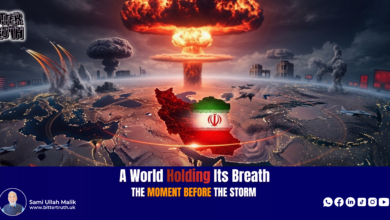
Today this convocation of reflection assembles for no small reason: the age is turning its page, the world is shifting upon a fresh axis of power, and the destinies of nations are no longer forged solely in marble chambers but in the furnace of global pressure, economic scourge, and the harsh metallurgy of geopolitical coercion. At times, the fate of nations hangs upon a single drop of oil; at others, one ill-starred decision hurls them back by centuries. The vista before us is not confined to the electoral intrigues of India alone; it touches the dawn and dusk of an entire region.
The world observed with a familiar chill when the clouds of Western suspicion settled over Delhi’s sky; when Washington’s gaze acquired the glint of doubt; when India felt its footing falter upon the highway of Russian crude—a route once as effortless as a river in monsoon flood, now reduced to a hesitant trickle. Bloomberg’s report held up a mirror before the world, and in that clear reflection Delhi’s new compulsions glimmered without disguise. Thus, the saga of India and Russian oil—like a lamp sputtering in the wind—was heard across the globe.
As Western misgivings deepened, and whispers of sanctions crept through the corridors of Washington, the political pulse of India began to throb irregularly. The dense clouds of the West, the looming spectre of punitive measures, and Washington’s cold metallic stare cast a long shadow across Delhi’s courtyard, until India deemed it prudent to extinguish its lamp upon the stream of Russian oil.
The same Russian crude which, until yesterday, had seemed the very life-essence of India’s economic machinery now appeared as though tinged with guilt. What had once flowed like the evening prayers along the ghats of the Ganges now dimmed; and the world sensed that Delhi grew faint to the rhythms of Moscow. Entangled in the knots of its own decisions, India withdrew its feet from the Russian path, and what had been a river became little more than a drainage trickle. This was not mere commerce; it was the poetry of power altering its metre in profound and silent ways.
Bloomberg, in its customary fashion, penned the revelation that stripped away the veil from the economic tremors rattling the chambers of Delhi—tremors which even the Modi establishment, for all its efforts, could not suppress. It reported with unsettling clarity that India had sharply reduced its purchases of Russian crude for December, as though a covert tremor had passed beneath the feet of the Indian state. That month’s imports—once a preference, almost an instinct—now slipped from India’s grasp like a frightened hand releasing a burning ember. The world understood then that Delhi’s decisions were no longer sovereign; some other hand now moved its pen.
Five major refineries—normally prompt in dispatching their monthly orders to Moscow—fell silent.
This silence was a political scream. Modi’s hubris reverberated through it, for it declared that India’s decisions were no longer unchained.
On another facet of Bloomberg’s crystalline mirror flickered the revelation that India’s five principal oil refineries, which seldom delayed their orders past the tenth of each month, had this time sunk into a sepulchral quiet—as though the pen had been snatched from their hands, or vibrant life had been abruptly gripped by the cold fingers of death, or circumstances had coerced them into new, unwelcome choices. This was not commercial discretion alone; it was testament to fear, compulsion, and the weight of consequences. In the language of statecraft, silence is often the most piercing cry.
Meanwhile, the state-run Indian Oil Corporation issued a proclamation that laid bare the new orientation of Delhi’s strategic posture: it would henceforth procure only such Russian crude as lay beyond the compass of sanctions. A vessel caught in a swirling political whirlpool had shifted its rudder, fearful that the approaching tempest might capsize its fragile balance.
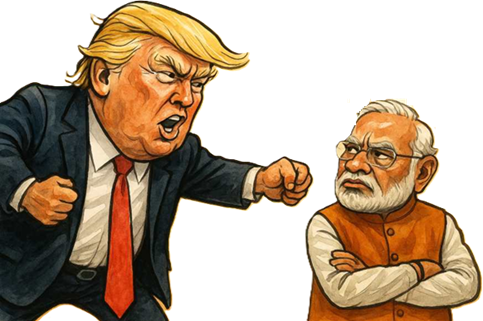
This was no announcement—it was a confession. A moment when a large state sensed the shadow of foreign will upon its own choices. And above this hung the American tariff, levied at fifty per cent—an economic lash whose stroke did not merely stagger Delhi but scorched it. Against this backdrop, President Trump’s remarks thundered like a gale: he declared India an unreliable trading partner, and its purchases of Russian oil tantamount to fuelling the battlefields of Ukraine.
His words did not merely fall upon Delhi’s ears; they entered the very sinews of its politics. This was not a remark but an indictment—ethical, political, and strategic—upon which the world’s gaze instantly fixed. It was not a sentence but a verdict, one that binds nations within the iron clasp of geopolitical necessity. America’s imposition of a fifty per cent tariff upon India’s Russian purchases was a message unmistakably cast: that in the economic world one cannot sail upon two vessels at once. On one side stood the iron pressure of Washington; on the other, the surging river of Moscow’s energy. India appeared trapped between them.
Thus, the IOC’s statement—claiming it would import Russian crude only from non-sanctioned suppliers—was, in truth, a political avowal. It was not refusal but partial surrender. Modi, the wolf who had donned a lion’s hide to roar at the region, now found himself reduced to a cowering jackal before Trump’s doctrine—driven not merely to bow but to fall flat upon his face, tasting the dust like a soldier who lays down his shield only to cast his sword at the feet of his adversary.
﴿وَتِلْكَ الْأَيَّامُ نُدَاوِلُهَا بَيْنَ النَّاسِ﴾
“These are the days We alternate among mankind.” (Qur’an 3:140)
The United States’ imposition of a fifty-per-cent tariff upon India was, in truth, the harshest chapter in this unfolding economic chronicle. It was not a proclamation but a whip-crack—struck at the very moment when India had begun to fancy itself an emergent force in the global marketplace. One could almost sense Washington whispering into Delhi’s ear the same imperious phrase rulers once uttered during the darker ages of subjugation: “Our decisions shall prevail; yours are merely to obey.”
The lash of the American tariff sent tremors through India’s corridors of power, and at last Mr Modi found himself assuring Washington that the conduits of Russian oil would henceforth be constricted, sinew by sinew, until they faded entirely—much as a junior partner must display a spotless cloak before his greater ally.
President Trump’s words were not merely a warning; they were a hatchet laid upon India’s policy, heard the world over. Those phrases etched themselves upon the margins of India’s diplomatic ledger like a dark stain across the proud visage of Mr Modi.
A question thus arises: has the turbulence of Modi’s own policies driven India to the brink of an
economic quake? Among the intelligentsia a murmured conclusion takes shape: that misguided decisions, diplomatic imprudence, and a bravado steeped in folly can upturn the entire economic chessboard of a nation.
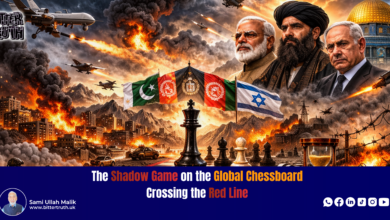
Beneath the weight of this heavy tariff, India did what weaker states often find inevitable: it pledged to shutter the doors of Russian oil. This was the juncture at which India appointed constraint—not sovereignty—as its counsellor. From such policies are born the dark outcomes which surfaced starkly during the military tensions of May 2025. Warfare—whether brief or prolonged—strikes deeply at a state’s political poise and martial confidence. The destruction of Indian aircraft and the ensuing global commentary, however one interprets it, left question marks burning in the minds of Delhi’s strategic planners. And yet, India’s renewed drift towards confrontation with Pakistan revealed a troubling truth: that Mr Modi and his war-minded coterie appear unwilling to learn the lessons which history—etched with defeat and humiliation—has already taught.
Thus, the question reverberates in every Delhi research room and across every economic observatory: is aggression overwhelming prudence within Modi’s policy machine? Does his government’s own folly stoke the fever and decline of India’s economy? Restlessness in the markets, distrust among investors, and an unending submission before political pressure—all herald the approach of a greater economic storm. The intoxication of aggression, the frailty of diplomacy, and the perpetual opening of fronts against neighbours—these are paths upon which nations ultimately tire and then drown. These are the very fruits Delhi now consumes: suspicion, fear, and economic helplessness. Nations meet their ruin when their rulers govern not by reality, but by illusion.
In such conditions, should Modi’s war-driven inner circle commit yet another folly, it would not be mere political incompetence—it would be tantamount to national suicide. Even retired Indian generals have conceded, “If India commences a new war, it shall break—and it shall be ruined.” This is the mirror held up to Delhi’s ruling chambers, wherein the reflection of future defeat is plainly visible. Yet, lamentably, some rulers would rather cloak the mirror than face its truth.
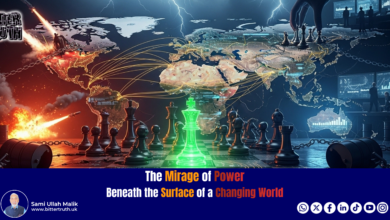
World politics has never been still. At times a single whisper in the halls of power reshapes continents; at others a solitary sentence from a president makes whole economies tremble. It is within such whirlpools that India’s political chessboard now finds itself overturned in ways that have confounded even the Chanakyan minds of Delhi’s strategists.
War—the book of history whose every page is written in blood. Before us lie analyses and declarations by observers who have highlighted the spectre of future conflicts. The chapter of war is always bitter—no matter the nation. Reports of military setbacks—whether exaggerated or grounded in inquiry—induce that chilling tremor which forces nations to think anew.
The chapter of May 2025 is no exception: a searing and shameful lesson, whose martial revelations tore away the veil India’s military leadership had concealed for years. The destruction of aircraft, the global ridicule, and the reproach of powerful allies—each exposed the fissures within Delhi’s military planning. And yet, astonishingly, despite defeat, India’s political leadership has shown none of the humility by which wise nations salvage themselves.
﴿فَاعْتَبِرُوا يَا أُولِي الْأَبْصَارِ﴾
“So take heed, O you who possess insight.”(Qur’an 59:2)
The question that looms above all others today is this: Could the Modi government once again commit the folly of war? This query now circulates not only within Pakistan but among India’s own sober circles of thought. A leadership beset by internal fragility, external pressure, and economic unease will, on occasion, seek refuge in war as a means of distracting its populace from its failures. History bears grim witness that such moments mark the beginning of a nation’s ruin.
When a war lobby gains ascendancy over the institutions of state, destruction stands upon the threshold. And when wisdom departs from politics, when reason is exiled, nothing remains but the bitter tears of regret.
Military observers the world over have declared repeatedly that war in South Asia has never been a solution—only a problem uncoiled. Even India’s own retired generals have placed their seal upon this truth: that India could not defeat Pakistan even if the father of India himself were to command the battlefield. Should a new conflict ignite, they warn, the Indian state could fracture—and collapse. And with over thirty separatist movements simmering across the subcontinent, it is not unthinkable that under Modi’s heavy hand India could splinter into two dozen pieces, each insurgent movement claiming the destiny it has long imagined. The Soviet Union—a superpower—crumbled into half a dozen states; and compared to that colossus, what truly is India? These are not mere words; they are history reflected in a mirror. Wars do not enlarge nations—they only enlarge graves.
The admissions of India’s retired generals comprise not opinion but military fact. Wars are not won by slogans; they are won by reason, prudence, and foresight—three virtues now distant from India’s present political leadership. Should Mr Modi’s war-driven coterie raise its head again, it would be not merely political folly but national suicide—its consequences etched into the lives of generations yet unborn.
Nations are not built upon the smoke of war, but upon the light of peace. We are inhabitants of a region that has already borne too much pain, too many wounds. This land cries out for wisdom, conciliation, and progress. Wars carve lines that divide nations; peace is the river that unites them in a single crossing. Leaders come and go; governments rise and fall; but a people’s life is shaped by the celestial descent of wisdom, justice, and tranquillity—and this is the message we need most urgently today.
Remember: leadership devoid of prudence, estranged from reason, drunk upon power, and willing to fling its people into the fires of war for the sake of political survival—is not a nation’s treasure, but its curse. And history tells us that wars are not won by leaders… they are lost by nations. It is not borders that burn—it is homes.
Today time calls out to us; history knocks at our door; and the future of the region rests upon our decisions—our restraint, our insight, our wisdom. War does not open roads; it closes them. Peace alone opens the path. Prudence builds nations; wisdom preserves them. It is upon every one of us that we seek not a future in the fumes of war but in the clarity of peace. This region cannot afford conflict; it is deserving of tranquillity.
Across the world every thinker, every general, every observer repeats the same truth: war lays no
new chessboards—it simply overturns the old. The decision for war is not made in sealed rooms; it is made within the conscience of a nation. And conscience whispers: embrace reason, do not stoke the flames of discord.
Allow me now to speak directly to Modi’s war establishment, and to the people of India themselves:
History demands a pledge from you, and the future stands before you with outstretched hands. The choice before you is stark—one of two paths: either pursue power through the tinder of conflict, or walk the earth with dignity, wisdom, and peace. Nations are not forged by the arrogance that fuels war; they are built by unity. Lands are not secured by cannon fire, but by justice. Prosperity is not born of blood, but of reason. This region does not need war—it needs peace. Not fresh wounds, but healing. Not darkness—but light. This is not an hour for war, but an hour for peace with honour.But if Mr Modi still wishes to stoke the furnaces of conflict, then let him remember: the Pakistani nation stands shoulder to shoulder with its valiant armed forces, a fortress of steel—and no tempest can break a people who rise with thunder in their voice.
Address to the Brave Youth of Balochistan
And now, within the same canvas of thought, I turn to the proud Baloch youth:
O young sons of Balochistan,
you are lamps whose flame burns higher than mountains and deeper than the ocean’s breast. In your veins runs both the cool breeze of this ancient land and the fierce heat of its proud blood. Your history is like a solitary tree in the desert—centuries old—its roots set deep in patience, honour, and dignity, unbowed even in the fiercest storms.
Today the world is shifting. Powers are drawing new circles, and the tempests of time often blur the line between truth and deception. In such hours, it is the youth who are tested most. This is the moment when awareness becomes a sword, and insight a shield. Remember—nations that surrender the torch of their destiny into the hands of others are destined to wander. Only those find their path whose gaze is attuned to the heartbeat of their homeland.
O youth of Balochistan,
your land is rich in treasure; your future, your skill, your education—these are the keys that unlock the doors of generations to come. Your greatest strength is unity—that unity which turns the grains of a desert into a storm. Your power lies in creation, your thought in aspiration, and your love of peace in your identity. This land no longer needs wounds—it needs healing. And that healing is found in knowledge, in craft, in affection, and in the confidence a nation places in its own children.
Your enemies seek to destroy these very qualities—not because of your weakness, but because of their own. They are besieged by more than thirty separatist movements within India itself, and seek to distract their people by casting false dreams before you.
﴿وَلَا تَهِنُوا وَلَا تَحْزَنُوا وَأَنْتُمُ الْأَعْلَوْنَ إِنْ كُنْتُمْ مُؤْمِنِينَ﴾
“Do not falter, nor grieve; for you shall be the higher, if you remain steadfast in faith.”(Qur’an 3:139)
O youth,
You are the generation in whose breast dwell the pride of mountains, the vastness of seas, and the liberty of winds that sweep across the desert. Yours is a lineage wrought from courage, steadfast loyalty, and that fierce dignity of soul which has long lent this region its enduring honour. Yet the age before us is more intricate, swifter in its turns, and more unyielding than any your forefathers confronted. The world shifts beneath our feet; powers redraw their orbits; and global politics sketches circles whose shadows fall even upon the most distant of peoples. In such a time, a heavier burden of responsibility rests upon your shoulders: that you should act not merely from emotion, but from wisdom, discernment, and a far-seeing judgment.
If today’s youth seek to be the architect of tomorrow, he must first recognise that not every whisper from beyond his borders comes with goodwill. Nations falter when doubts are sown in the hearts of their young—when they cease to trust their own compass and begin instead to move at the echo of another’s call. The path you must choose will be your own: shaped by your reason, your conscience, and your commitment to the collective good. No nation ever strode forward while living at the nod of others; progress belongs only to those who take their steps with their own feet.
Young sons and daughters of Balochistan,
your homeland is rich in resources, resplendent in culture, and radiant with the promise of a luminous future. Let your hands be adorned with knowledge, your thoughts devoted to construction, and your labour become the foundation upon which generations to come may walk with confidence and security. Your strength lies not in division, but in unity—in your learning, and in the integrity of your character.
Time calls upon you to banish the shadows within, to lift your courage to the height of the sky, and to hew such a course for your homeland that tomorrow’s lamps may be lit upon it. Power does not reside in the mere raising of a sword, but in opening the gates of hope for those yet unborn. Rise—for the very resolve of this soil is anchored in your stride. Rise—for your thought is the cornerstone of the future. Rise—for Balochistan seeks light from you, and light springs only from those hearts that dare to dream and labour to bring those dreams to life. Your land asks of you illumination, and illumination belongs only to those who behold the future with the eyes of hope.
This region can no longer endure fresh discord, further estrangement, nor the machinations of strangers. It bears many wounds already; now it yearns for balm—for the balm of knowledge, of skill, of dialogue, of peace, and of that respect which one human being owes another.
You are the generation that, will it so, may raise Balochistan to a new exemplar of progress, harmony, and self-assurance. In every age, the mightiest youth is not he who conquers enemies, but the one who conquers the fear within, the darkness of ignorance, and the turmoil of disunity. Time summons you to take wisdom as your companion, to claim the future as your field of endeavour, and to become for your people that lamp which brightens the path ahead.