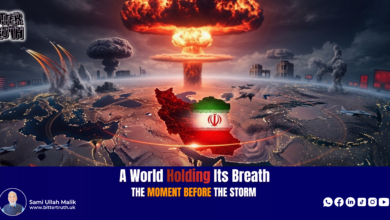

At the Crossroads of Fate and Strategy
The Great Chessboard of South Asia

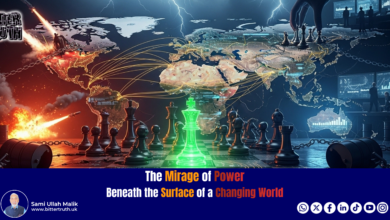
There are moments in history when chapters are inscribed not by the pen, but by the unsheathed spear of circumstance. The present landscape of South Asia is one such chapter—a chessboard upon which neither the pieces nor the moves conform to convention. Upon this dusty board of time, certain pieces appear inert, yet their stillness alters the destiny of the entire game.
The winds now stirring between Delhi and Islamabad are no passing zephyr, but the forewarning of a gathering storm. The distance between the two capitals can no longer be measured in miles along riverbanks or highways; it is a distance of temperament, of interest, of strategy. That gulf is neither geographical nor cartographic, but psychological and political, fashioned from the calculus of advantage.
And in one corner of this board sits the President of the United States—sometimes wearing the smile of a friend, at other times weighing the scales like a merchant at market. This essay is devoted to disentangling the skein of those shifting relations, those diplomatic signals, those manoeuvres of arms and veiled stratagems of state, where each event is not merely a piece of news but a parable, and every parable conceals a hidden wisdom.
Time bears witness that geography is not the mere demarcation of lines across a map, but the delicate embroidery of relations among nations, woven with threads of politics, commerce, and defence. And history, too, testifies that geography is no mere heap of earth and stone, but a mirror wherein shimmer the hopes, the fears, and the ambitions of peoples.
The story of Pakistan’s relations with the United States is a chronicle of tides rising and receding. Once, Islamabad was the intimate ally of Washington—through the Afghan jihad, through economic largesse, through military cooperation. Then came the cataclysm of September the Eleventh, and with it a new alliance in the so-called war on terror. Yet in recent years, especially after the opening salvos of the Trump administration, the relationship fell into chill estrangement. Under President Biden, a new chapter is being drafted, though its character is altered: it is not sentiment but regional necessity that drives the embrace.
Today Pakistan stands before an American President unlike his predecessors—one who eschews the courtesies of diplomacy for the idiom of trade; one whose utterances carry either the guise of an offer or the shadow of a threat. Here, for the first time in the annals of American statecraft, is a tongue that can be soft as wax or hard as steel, where the fragrance of diplomacy is displaced by the odour of bargaining, and every word conceals either inducement or menace.
Yet the principle is ancient: nations seldom approach one another out of bare necessity; it is the magnetism of interest that draws them into common councils. The United States has little need today of direct Pakistani arms or immediate economic aid, but Washington is not blind. Three imperatives keep the tie alive. First, the road to stability in Afghanistan runs through Islamabad. Second, the Belt and Road Initiative, and its flagship, the China–Pakistan Economic Corridor, challenge American sway in the region. Third, frictions in Indo-American commerce impel Washington’s strategists to glance anew towards Pakistan.
Indeed, America knows that the political and commercial future of Afghanistan, Pakistan, Iran, and their neighbours grows ever more entwined with Beijing. Washington’s courtship of Delhi has been pursued often at Pakistan’s expense, but the nations of the region know well that America, in pursuit of its own advantage, does not hesitate to sacrifice its friends upon the altar of expedience. Pakistan and Afghanistan learnt this truth long ago; India too has tasted the bitterness of American friendship.
A decade past, it was written in these very columns that while Pakistan had borne the consequences of such an alliance, India would, in time, prove no more immune. For the centrifugal forces within the subcontinent—the separatist movements, once muffled, now rise with renewed clamour—and India’s military institutions, corroded from within, display the strain. The rising incidence of suicide among Indian soldiers, and the waning desire of the youth to enlist, are omens writ large upon the wall.
Thus it may be affirmed with certainty that America’s dealings with Pakistan are not the fruit of sudden necessity, but of strategic compulsion: the withdrawal of American forces from Afghanistan, the lengthening shadow of China across Asia, and the commercial estrangement from India—these together have driven Washington to knock upon Islamabad’s door. It is a proximity that may appear mercantile, yet beneath it lies a move upon the chessboard, where a single misstep may overturn the entire game.
When Pakistan’s Army Chief spoke upon American soil, his words were no mere utterances but the herald of a new chapter. His address fell upon Washington like a stone upon still waters—its ripples yet spreading, its consequences yet unseen.
The address delivered by Pakistan’s Chief of Army Staff at a Washington think-tank was no ordinary oration. It was laced with arguments that succeeded in creating an atmosphere of confidence in the American capital. Islamabad greeted it as the dawn of a new chapter in bilateral relations; Delhi, by contrast, received it with suspicion and disquiet. For New Delhi, the speech was a dart that struck deep into its pride.
Mr Modi, who had hurriedly sought to monetise India’s supposed indispensability to Washington—imagining himself a regional superpower, a necessary sentinel in America’s encirclement of China, and basking in the membership of the Quad as though it were the seal of a third great power—saw his balloon of conceit pricked by the smallest of pins. His sycophantic flattery, his repeated “My friend” addressed to President Trump, availed him naught; for Trump himself, before the world’s media, dismissed the Indian economy as lifeless, and consigned the myth of “Shining India” to a deep and cavernous pit.
Modi, with customary guile, once again turned to courting Moscow and Beijing. Yet both Russia and China know him too well. The Russians, in particular, bear old grievances: for when the Soviet Union’s shadow still lay across Asia, and in the crises of Kashmir and Bangladesh it was Moscow that shielded India, Delhi was nonetheless the first to turn its gaze away and bend its knee before an American President. Of late, Modi had fancied India as the world’s “third power,” ranking just beneath America and China. Now, stung by humiliation in a brief clash with Pakistan and unsettled by Washington’s recalibrations, India’s pretensions have been shaken, and the old balance of power unsettled.
Recall that moment when Narendra Modi, with rehearsed bonhomie, hailed the American President as “my friend.” In those days the relationship seemed radiant; his lips showered blossoms of endearment, while his haughty demeanour signalled to neighbouring states a posture of pride. But the wheel of fortune turned. The revocation of trade concessions, the imposition of tariffs, and the cold steel of American commercial policy rent the relationship asunder. In but a few months, that warm friendship curdled into mockery, and the epithet “Tariff King” pierced the bond like a thorn lodged in the throat. The offer of F-35 aircraft to others, and Washington’s direct dialogue with Islamabad, slackened the rope that had once been taut between Delhi and the White House.
Modi’s one-hundred-minute speech was a long caravan of words, yet within it there was no mention of the F-35, no refutation of Trump’s hints at mediation. He invoked Nehru fourteen times, but China not once—as though the true adversary’s camp might be ignored into non-existence. But silence, too, is a form of discourse. His opponents seized upon it, branding his avoidance as not merely a “Modi blunder” but a “Modi surrender,” tormenting him in Parliament. It was as though a Field Marshal, confronted by an enemy’s main encampment, had chosen instead to fire his cannon at lesser outposts. Thus was Modi’s duplicitous politics unmasked, his silence exposed as tacit confession. The opposition, relentless, demanded that he own his errors, admit his defeat, and bear the burden of failure.
At this point the reflection turns to the Qur’ān, where a mighty metaphor is bestowed:
﴿إِنَّ اللَّهَ يُحِبُّ الَّذِينَ يُقَاتِلُونَ فِي سَبِيلِهِ صَفًّا كَأَنَّهُم بُنيَانٌ مَّرْصُوصٌ﴾
“Indeed, Allah loves those who fight in His cause in ranks, as though they were a solid structure, compact and unyielding.” [al-Ṣaff 61:4]
This vision—bunyānun marṣūṣ, the firm and solid edifice—has ever inspired the faithful. In the military sphere, it signifies a force united within and formidable without. It was from this Qur’ānic metaphor that the name of a modern military campaign was drawn: Operation Bunyān al-Marṣūṣ. Its beating heart was the Fatah missile, towering like the citadel of that edifice. Thus the campaign fused faith with force, strategy with scripture—and victory, by the grace of the Almighty, was granted.
The establishment of Pakistan’s Rocket Force Command came at a moment when the regional arms race assumed a new form. This was not merely an adjunct branch but a decisive arm for the wars of tomorrow—a smouldering volcano with the power to reduce an adversary to ash. Its remit is the command and operation of missile and rocket systems across a spectrum of ranges and capabilities. The need arose because modern warfare no longer consists of rifles and tanks alone; it is the integration of missiles, drones, and rockets that now defines the field of battle. The Rocket Force Command is the proclamation that the wars to come will be waged not only with cannon and infantry, but with the joint assault of earth and sky.
Elsewhere in the world—China, Russia, the United States, North Korea—such rocket forces have long been active. India expanded its drone battalions; Pakistan’s rejoinder was to marshal its own Rocket Force, preparing an onslaught of earthbound firepower. If drones are the predatory birds of the heavens, the rocket force is the volcano of the earth—together illustrating that in modern war both the sky and the soil must bear their own soldiery.
In the most recent Indo-Pak conflict, Pakistan’s mastery of drone warfare astonished the world. The dramatic destruction of Israel’s kamikaze Harop drones—and their forced descent into Pakistani hands—sent shockwaves to Tel Aviv. Israel, which had once vaunted these machines as invincible, found itself bereft. The coffins of its operators, dispatched in silence from the Adampur base back to the night-bound streets of Tel Aviv, carried with them the grim testament that Pakistan’s reach had extended even to Israel itself. Henceforth, the signal was clear: Israel itself lies within the arc of Islamabad’s resolve.
The question must be asked: why did Pakistan find it necessary to forge such a force? The answer lies in the growing arsenal of India—its ballistic missiles, its drone technology—and in the imperative of maintaining the regional balance of power. In the modern theatre of war, the harmony between weapons of earth and weapons of air has become indispensable; without such integration, the designs of the adversary cannot be repelled with full vigour.
It is here that the Holy Qur’ān enjoins:
﴿وَأَعِدُّوا لَهُم مَّا اسْتَطَعْتُم مِّن قُوَّةٍۢ وَمِن رِّبَاطِ الْخَيْلِ تُرْهِبُونَ بِهِۦ عَدُوَّ ٱللَّهِ وَعَدُوَّكُمْ وَءَاخَرِينَ مِن دُونِهِمْ لَا تَعْلَمُونَهُمُ ٱللَّهُ يَعْلَمُهُمْ ۚ وَمَا تُنفِقُوا۟ مِن شَىْءٍۢ فِى سَبِيلِ ٱللَّهِ يُوَفَّ إِلَيْكُمْ وَأَنتُمْ لَا تُظْلَمُونَ﴾
“And prepare against them whatever force you can muster, and steeds of war, by which you may strike terror into the enemy of Allah and your enemy, and others besides them whom you do not know but Allah knows. And whatever you spend in the way of Allah shall be repaid to you in full, and you shall not be wronged.” [al-Anfāl 8:60]
This divine command is not merely a call to arms; it is a philosophy of preparedness, a summons to vigilance in both spirit and steel.
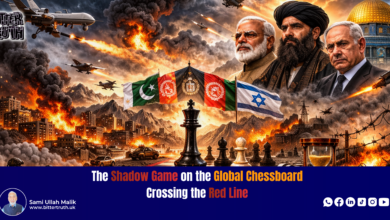
These events, in their totality, reveal that upon the South Asian chessboard every move is calculated with a strategist’s care. The distance between Delhi and Islamabad is not one of miles but of policies, of priorities; and the warmth of Washington’s proximity is not the glow of friendship, but the blaze of interests. History moves at times with a slow tread, yet at others it gallops past without a backward glance. South Asia now stands at such a threshold, where each decision may determine the destiny of decades.
The gulf between Delhi and Islamabad, and the shifting embrace of Washington, together herald the dawn of a new epoch. It is an age in which military might no longer be measured merely in cannon and gunpowder, but in the fusion of intellect, technology, and diplomacy. The board is set, the pieces stand in readiness—the question now is: whose hand shall make the move that wins the game, and who shall inscribe a victorious chapter in history?
Time’s caravan halts for none—it marches with the victors and leaves the vanquished as dust along the road. The moves now unfolding upon the South Asian board are not transient politics but the very foundations of the next half-century. They are the prelude to a new era, where knowledge, technology, and resolve will be the true armaments. The chessmen stand poised—who, then, shall play the move that writes history’s triumph?
My esteemed friend, General (Retd.) Naeem Lodhi, a keen observer of the political and military currents of the region, has posed a question of great gravity: If the flagship projects of the Belt and Road Initiative and CPEC—expanding through Afghanistan, Iran, and much of the surrounding region under China’s influence—advance to fruition, then is it truly in America’s interest to labour for peace in South Asia, particularly in Pakistan? Does American cooperation with Pakistan in the so-called war on terror bear genuine political meaning?
It is a question of utmost importance. Its answer shall be attempted in my next column. In shā’ Allāh.