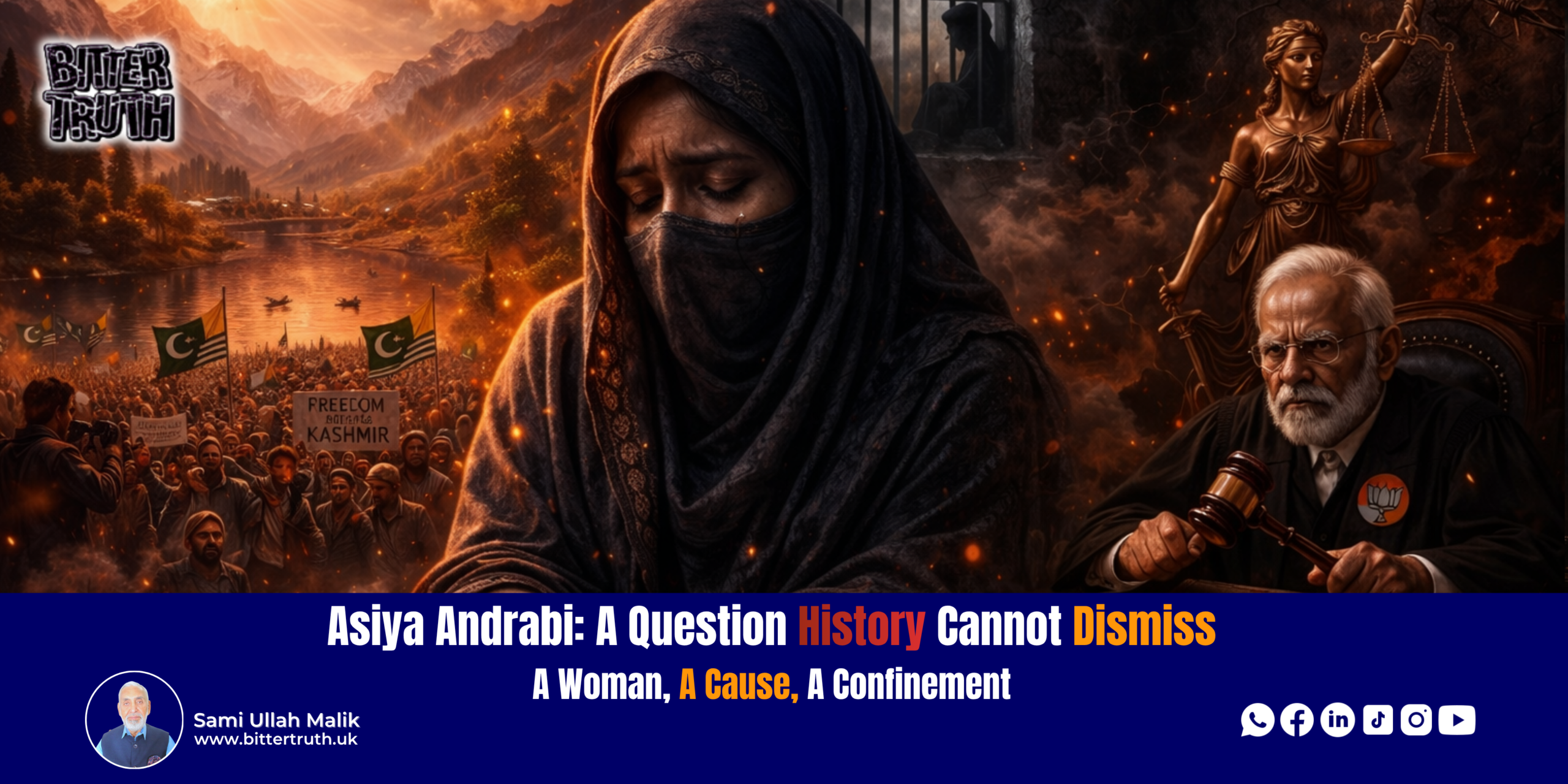
Asiya Andrabi: A Question History Cannot Dismiss
A Woman, A Cause, A Confinement

Kashmir is no mere name; it is a wound—one that, instead of healing with the passage of time, has only deepened, layer upon unquiet layer. If ever a chronicle were inscribed upon the pages of history in ink distilled from tears, it would surely be the chronicle of Kashmir. Its snow-clad summits stand not only as emblems of beauty, but as silent sentinels to centuries of sorrow. When the winds course through its valleys, they do not merely herald a change in season; they carry with them the echoes of cries, the laments of separation, and the heavy freight of unfulfilled longing.
This is a land where childhood matures beneath the shadow of fear, where youth dissipate into unanswered questions, and where old age lingers upon the threshold of waiting. Behind every door lies a story; within every eye, a buried dream; within every heart, an unspoken ache. Kashmir is not simply a demarcation upon a map—it is a living condition, an unremitting trial, a case yet unresolved in the austere court of history.
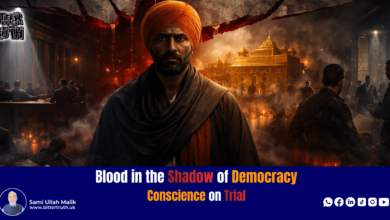
Amidst this enduring tragedy, there emerge figures who stand, resolute, against the current of their age. Asiya Andrabi is one such figure—a name that has come to signify not merely an individual, but an idea, a defiance, a question rendered in human form. Her story conducts us to a place where judgement yields to perception; where one must not merely hear but listen with the full weight of conscience.
For over seven decades, Kashmir has remained the crucible of political, geographical, and human crisis in the subcontinent. It is not merely a territory, but a living tragedy—one in which generations are born, come of age, and inherit the burdens of those before them. When the wind stirs through its frost-laden valleys, it unsettles not only the branches of trees but also releases the long-held sighs, muffled sobs, and half-uttered prayers of a protracted past. Here, beauty and anguish breathe in uneasy unison: the waters of its lakes may be limpid, yet within the human breast there surges a restlessness long denied repose.
This conflict has not only sustained tensions between two nuclear powers, Pakistan and India, but has also profoundly altered the lives of millions of Kashmiris. Within this fraught landscape, certain names within the Hurriyat leadership have assumed prominence—among them, Asiya Andrabi, who emerges as both a significant and a contested figure. To some, she is an emblem of resistance; to others, a locus of controversy. Yet beyond these competing portrayals lies an incontrovertible truth: she is a woman whose life has unfolded as a prolonged narrative of struggle, sacrifice, and sorrow. Her life transcends the confines of individual biography; it has come to embody an era, an ideology, and a continuous struggle.
Born in the 1960s into an educated family in Kashmir, Andrabi received her early education in Srinagar before pursuing studies in the sciences. Yet the trajectory of her life altered decisively as she bore witness to the mounting political unrest and popular disquiet in the region. It was not long before she came to believe that the question of Kashmir demanded not only political articulation but also an ideological framing. This conviction would, in time, furnish the foundation of her public life.
The turbulence of the 1980s and 1990s—marked by the rise of both armed and unarmed movements—drew her more deeply into active resistance. This was a period in which the Kashmiri youth, in particular, found themselves profoundly shaped by currents of dissent and mobilisation. Against this backdrop, Andrabi founded Dukhtaran-e-Millat in the 1980s—an organisation that would prove a defining chapter in her life.
Conceived as a vehicle to mobilise Kashmiri women, foreground Islamic identity, and organise political resistance against Indian rule, Dukhtaran-e-Millat sought not merely to represent women as passive victims, but to recast them as active participants in resistance. In doing so, it advanced a distinctive model—one that attempted to reconfigure gender roles within the broader movement. Unlike many contemporaneous groups, it drew women directly into the political and ideological sphere. Andrabi herself maintained that the role of women in any struggle for self-determination was not ancillary, but indispensable.
The roots of the Kashmir dispute lie in the partition of the Indian subcontinent in 1947, after which the region became a contested territory. United Nations resolutions spoke of the Kashmiri people’s right to self-determination, yet this pledge has remained unfulfilled. In international law—most notably within the Charter of the United Nations—the principle of self-determination is recognised as fundamental. Yet, as so often in the theatre of global politics, principle yields to expediency.
Kashmiri leaders, including Andrabi, have consistently asserted that the people of Kashmir possess the right to determine their own future—a claim grounded in the language of international law. The Government of India, by contrast, has characterised such movements as secessionist and inimical to the integrity of the state. It is this enduring contradiction that has perpetuated Kashmir as a site of unresolved conflict.
Legal proceedings were initiated against Andrabi under statutes including the Unlawful Activities (Prevention) Act (UAPA) and provisions of the Indian Penal Code. According to the National Investigation Agency, her activities were deemed prejudicial to the sovereignty of the state. The UAPA, a stringent legislative instrument designed to counter terrorism and anti-state activity, has, in the view of critics, at times been deployed against political dissent as well.
Yet Andrabi’s struggle has never been confined to the political sphere alone; it has also been deeply ideological. Her speeches reveal a pronounced interweaving of religious and national identity. Over decades, she has articulated her position through oratory, writing, and public protest, frequently participating in rallies in support of Kashmiri rights. The religious inflection of her rhetoric has led many to regard her as an ideological leader, even as others have subjected her to critique. It is, however, precisely this dimension that distinguishes her from many of her contemporaries: she presents the movement not only as a political cause, but as one undergirded by ideological and religious conviction.
The Government of India has instituted multiple legal proceedings against Asiya Andrabi, the most prominent of which was brought under the auspices of the National Investigation Agency. She was convicted under provisions of the Unlawful Activities (Prevention) Act (UAPA) and sections of the Indian Penal Code and sentenced to life imprisonment. Her associates, Sofi Fehmeeda and Nahida Nasreen, were likewise condemned to lengthy terms of incarceration, reportedly extending to three
decades. Thus, the machinery of the state, invoking the imperatives of sovereignty and security, has dealt with these figures in the full severity of the law.
Her husband, Qasim Faktoo, himself a recognised figure within the Kashmiri movement, has spent decades behind bars, similarly accused of activities deemed inimical to the Indian state. His prolonged imprisonment has, in certain human rights circles, been regarded as emblematic of deeper concerns—raising questions not only of justice, but of duration, due process, and the very architecture of legal fairness. It is said that he has endured the rigours of confinement—privation, isolation, and the slow erosion of time—yet has not recanted his convictions.
Imprisonment, in such circumstances, is not merely a juridical penalty; it is a psychological crucible. Both Andrabi and her husband have endured extended periods of solitary confinement, facing limited facilities, medical challenges, and prolonged separation from their families. These conditions inevitably invite scrutiny when measured against the universal standards of human rights: whether the treatment of detainees accords with the principles that the modern world so often professes to uphold. Organisations such as Amnesty International and Human Rights Watch have, in analogous cases, raised their voices; yet, in Andrabi’s case, some critics discern either a notable restraint or a muted response.
Such silence—or perceived reticence—may arise from a confluence of causes: political sensitivities, the pressures exerted by regional powers, or the perennial difficulty of securing reliable information in contested terrains. Yet the question persists with an uncomfortable insistence: why does the global conscience appear, at times, so selectively engaged? For, in principle, the defence of human rights admits of no hierarchy of suffering; it demands a consistency that transcends expediency.
The Kashmir question, after all, is not merely a regional dispute; it is a deeply entangled problem within the wider fabric of international politics. Great powers, guided by interests as much as by ideals, have often chosen discretion over declaration. In such a climate, human suffering is frequently relegated to the margins, and those who endure it—among them figures like Andrabi—may find themselves isolated upon the global stage, their voices echoing into a disquieting void.
Asiya Andrabi herself remains a profoundly contested figure. To some, she is an emblem of freedom; to others, a standard-bearer of resistance; still others associate her with extremism. The truth, as is so often the case in protracted conflicts, resides somewhere in the interstices between these competing narratives. To apprehend her struggle fully requires an appreciation of Kashmir’s intricate political, religious, and social tapestry—and, above all, a willingness to entertain more than one perspective.
Yet there is an additional dimension that lends her story a particular gravity: she is a woman who has traversed a path seldom walked. Her struggle is not solely political; it is also deeply human. It is a narrative of sacrifice, of endurance, and of emotional cost. Hers is not merely the story of an activist, but of a mother, a wife, a daughter—roles that anchor her not in abstraction, but in the intimate realities of life.
One may imagine that, in her youth, her aspirations were not unlike those of countless others: a life of tranquillity, a home suffused with warmth, the laughter of children, the quiet assurance of a secure future. Yet the unrest that permeated the streets of Kashmir—the reverberation of slogans, the pervasive climate of fear—altered the trajectory of those dreams. She could not remain a silent spectator. She asked questions—and, in time, became a question herself: one to which the world has yet to furnish a definitive answer.
The founding of Dukhtaran-e-Millat was not merely an organisational act; it was, in essence, a declaration—a pronouncement that Kashmiri women would no longer remain confined to the domestic sphere but would assert their place within the unfolding of history. Andrabi gave voice to those long rendered voiceless, instilling the notion that silence itself might constitute a form of complicity, and that to speak was, at times, an obligation. Yet every voice exacts its price—and hers was paid in the currency of freedom.
The bars of a prison are not fashioned of iron alone; they are forged also from time itself. They sever the individual from loved ones, from aspirations, and, at times, from the very sense of self. Andrabi has spent years within such confines, where each passing day assumes the weight of an age, and each night stretches into an unbroken stillness.
Consider, for a moment, the anguish of a mother unable to feed her children with her own hands, to rest her palm upon their heads, to wipe away their tears. What measure of sorrow inhabits such a condition? The walls of a prison may absorb her silent weeping, but where, one wonders, do the cries of the heart find their release?
And then there is her husband—Qasim Faktoo—another life, another confinement, another long vigil. A marriage reduced to fleeting encounters, where words are often exchanged through glances, and silence itself becomes a language. It is not merely the story of a single household; it is, in truth, the story of many. Yet theirs appears more acute—its sacrifices more exacting, its solitude more profound, its waiting more prolonged.
Where, then, stands the world that proclaims its allegiance to human rights? Where are the voices that rise, unwavering, against injustice? Are some stories rendered so quiet that they pass unheard, or are certain silences so heavy that they deter even the will to listen? This is not a question that pertains to Andrabi alone; it confronts all who profess a belief in justice.
The nights in Kashmir are long. When darkness settles upon its snow-laden mountains, time itself appears to falter. In some prison cell, one imagines, a solitary figure may look upward—towards the distant firmament—and wonder whether freedom might one day draw as near as the stars.
Therein lies a strange and haunting paradox: the sky is free, the birds are free, the wind is free—yet man remains confined. His dreams are confined, his desires are confined, his very life held in abeyance.
The story of Asiya Andrabi compels us—almost against our will—to pause and reflect. It unsettles, it disquiets, it presses upon the conscience with an insistence that cannot easily be ignored. It asks, with quiet but unrelenting force: do we indeed inhabit a world governed by justice, or merely one that professes it?
This is not an essay of verdicts. It does not presume to pronounce guilt or innocence, nor to marshal arguments in favour of one side over another. It is, rather, a human story—one inscribed in tears, tempered by patience, and tested by the long and unyielding passage of time.
When a woman relinquishes the ordinary comforts of life in service of an idea, she ceases to be merely an individual; she is transfigured into a symbol. So it is with Asiya Andrabi. To some, she embodies hope; to others, resistance; to yet others, the persistence of an unresolved conflict. Yet one truth remains inescapable: her story will be heard. For truth, however deeply buried, possesses a peculiar tenacity—it has a way, in the end, of making itself known.
And perhaps, on that distant day, the sighs that ride upon the winds of Kashmir may yet be transmuted into prayers; tears may soften into smiles; and the harsh architecture of confinement may recede into the gentler province of memory. Until then, the story endures—alive in hearts, in words, and in those eyes that moisten upon encountering it.
Yet reflection alone is not sufficient. There arises, inevitably, the question of responsibility—of what ought to be done. It may be argued that international human rights bodies should assume a more active and visible role. A neutral investigative commission under the auspices of the United Nations, empowered to conduct independent inquiries, could lend clarity where ambiguity now prevails.
Organisations such as Amnesty International and Human Rights Watch might, through detailed reporting, draw wider global attention to the matter. The international community, acting in concert, could exert pressure to ensure greater transparency in legal processes, while independent observers might be dispatched to monitor conditions within places of detention and to safeguard the rights of prisoners.
States, too, are not without agency. Pakistan, for instance, may choose to raise the issue more forcefully within diplomatic forums, to collaborate with international non-governmental organisations in amplifying human rights concerns, and to engage global media in presenting the case with greater coherence and urgency. There remains also the possibility—however complex—of pursuing recourse through international legal mechanisms, guided by the counsel of experts in international law.
Yet beyond the realm of policy and prescription lies a more elemental truth: this is not merely a political narrative; it is a human one. A woman confined for years behind bars. A husband whose life has been spent in incarceration. A family, gradually dispersed by the attrition of time. Together, they direct us towards a question both simple and profound: is justice, in truth, equal for all?
The case of Asiya Andrabi offers but a single aperture through which to glimpse the wider condition of Kashmir. It reminds us that behind every political dispute stand human beings—with their dreams, their sorrows, their fragile but persistent hopes. The question of Kashmir, it may be contended, cannot approach resolution until the fundamental principle of self-determination is meaningfully addressed, and until all parties approach the negotiating table with seriousness of purpose. Without a sustained commitment to justice, transparency, and human dignity, such stories will continue to arise—and the world may continue, uneasily, to look on.
Time will pass. Borders may shift; maps may be redrawn. Yet there are stories that resist erasure. The story of Asiya Andrabi is one such narrative—one that endures even as it collides against the hard walls of confinement, that speaks even in silence, that finds resonance in every heart attuned to the language of suffering.
It compels us, finally, to interrogate our own moral bearings. Is justice contingent upon power? Are human rights merely rhetorical flourishes, or do they possess a tangible, enforceable reality? And, most searchingly of all, does the world truly hear every cry of the oppressed—or are some voices consigned, irrevocably, to silence?
Kashmir remains as it has long been—beautiful, and burdened. Its lakes retain their clarity, yet one suspects that beneath their still surfaces lies the trace of unwept tears. Its mountains stand in their accustomed majesty, yet within their shadows linger dreams that await fulfilment.
And somewhere, within the dim confines of a prison cell, a woman endures—sustained by conviction. Time has not wearied her; solitude has not broken her; confinement has not circumscribed her thought. In that endurance lies her strength; in that strength, her story.
This, then, is not a declaration, but an invitation—to feel, to reflect. If, in reading it, there stirs within the heart even the faintest tremor of sorrow, if the eye is momentarily clouded, or the mind provoked to question—then perhaps its purpose is fulfilled.
For there are stories that are not merely heard—
they are felt.