
Ashes of Peace: The Siege, the Exodus, and the Fate of Nations
Of Walls and Wounds: How Blockades Became Weapons of War

The American President claims that, upon assuming office, he immediately embarked on diplomatic efforts to broker peace in both Gaza and Ukraine. However, according to him, these endeavours faltered due to regional interference by Iran and Russia, compounded by the militant actions of groups like Hamas and Hezbollah. On the contrary, Russia, Iran, and Hamas have dismissed these allegations outright, denouncing the U.S. President as a mere pawn in a wider Zionist conspiracy, and placing the blame for the current state of affairs squarely on Israel and its patrons in the West—chief among them, the United States.
They assert that not long after taking office, Trump unveiled a plan for annexing Gaza, lambasted Europe while threatening to reclaim Greenland from Denmark, poured scorn on NATO, disparaged the European Union, and even rattled sabres at neighbouring Canada with thinly-veiled threats of aggression. In a bid to appease Israel, he sanctioned bombing campaigns in Yemen and subsequently plunged the world into a full-blown trade war. Now, it seems his gaze has fixed once again upon Iran, issuing historic threats of military strikes, seemingly in pursuit of completing the unfinished agenda of his earlier term. The apparent aim? To crush Iran and secure the region for his sword-for-hire—Israel—whose blade he hopes to drive into the heart of the Gulf.
The core question remains unchanged since Trump’s first term: What, if anything, can prevent Iran from acquiring nuclear weapons?
Though Tehran firmly denies any intention of pursuing a nuclear arsenal, many other nations remain unconvinced, suspecting that the Islamic Republic seeks, at the very least, the capability to produce a nuclear warhead—an ambition that could ignite a new arms race in the Middle East, if not a full-scale war.
Back in 2015, Iran reached an agreement with the U.S., UK, France, Germany, Russia, and China, known as the Joint Comprehensive Plan of Action (JCPOA). Under the accord, Iran agreed to curb its nuclear ambitions and allow international inspectors access to its facilities. In return, crippling economic sanctions were to be lifted, provided compliance was verified. Yet in 2018, President Trump unilaterally withdrew the United States from the deal, arguing that it enabled Iran’s support of militias such as Hamas and Hezbollah, fuelling terrorism. Sanctions were swiftly reimposed.
In retaliation, Iran began breaching certain provisions of the agreement, enriching uranium beyond agreed limits. Analysts now fear Iran could soon possess enough fissile material to construct a nuclear warhead. The International Atomic Energy Agency (IAEA) estimates that, if Iran further enriches its 60% stockpile of uranium, it could yield material for approximately six bombs.
Now, having returned to the Oval Office, Trump has resurrected his “maximum pressure” strategy. On February 4th, he signed a memorandum directing the U.S. Treasury to tighten sanctions further and to penalise any nation, particularly those purchasing Iranian oil, for breaching existing restrictions. Alongside this economic pressure, Washington is now attempting a diplomatic squeeze. Last month, Trump sent a letter to Iran’s Supreme Leader, Ayatollah Ali Khamenei, offering to resume negotiations and demanding a deal within months. Though direct talks have resumed in Oman, they collapsed without any tangible progress. The message to Iran is stark: accept the deal or face military consequences. As Trump bluntly warned, “If talks fail, I believe Iran could be in grave danger.”
Some within Iran’s policymaking circles appear open to a deal, if only to alleviate the nation’s economic woes—rampant inflation, a collapsing currency, and widespread financial hardship.
However, any prospective agreement is likely to involve compromises that Iran’s hardliners would find politically unpalatable. Recent months have seen Tehran’s regional proxies weakened, particularly amid the ongoing conflict with Israel, while President Bashar al-Assad—once a steadfast ally—has lost his grip on Syria. In this fragile state, voices are emerging from within Iran suggesting that perhaps the time has come to develop a nuclear deterrent.
At present, both the United States and Iran stand on opposite shores of a wide diplomatic gulf, their negotiating positions opaque and, at times, incompatible. Washington’s demands are unequivocal: a total dismantling of Iran’s nuclear programme, including the cessation of all uranium enrichment, and a complete withdrawal of support for Hezbollah in Lebanon and the Houthis in Yemen. For Iran, these stipulations may be impossible to swallow. A blanket ban on enrichment—even for peaceful purposes—has long been a red line for Tehran. Moreover, Iran’s scientists are now far more knowledgeable than they were a decade ago—meaning that rolling back their expertise is no longer an option.
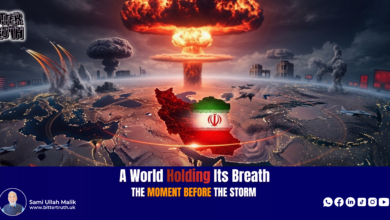
Within just a few months of returning to power, Trump’s peace overtures in Gaza and Ukraine have already faltered. Global uncertainty is mounting, and the world now teeters on the edge of what some fear could be a major international conflict. A seismic shift is underway in the balance of power across the Middle East, Europe, and the Pacific. Acting at the behest of Israel, the United States accuses Iran of possessing enough 60% enriched uranium to make a bomb—an allegation that threatens to spark a full-scale arms race across the region, potentially drawing in Saudi Arabia, Turkey, Egypt, and half a dozen other nations keen to develop their own nuclear programmes.
President Trump’s Ultimatum and the Gathering Storm
President Trump has granted Iran a two-month reprieve, urging it to acquiesce to a newly proposed agreement. Failing that, he has hinted at military intervention. Yet, analysts argue that such a compressed timeline renders any meaningful diplomatic resolution implausible—particularly when the 2015 Joint Comprehensive Plan of Action (JCPOA) took over two years to negotiate. Although a diplomatic overture appears to be underway, with time and venue fixed for talks, the pace is far too hasty for any substantive outcome.
One must recall that the JCPOA emerged in 2015 as a delicate fruit of sustained dialogue, aimed at curbing Iran’s nuclear ambitions in exchange for the lifting of international sanctions. However, in 2018, President Trump, in a unilateral move, withdrew the United States from the accord, reinstating global sanctions. This decision raised considerable disquiet among Washington’s European allies, who lamented the absence of consultation.
Simultaneously, Israel—through its Western allies—has waged an orchestrated campaign to portray Iran’s nuclear undertakings as an existential menace. This has once again turned the world’s gaze toward Tehran. Iran’s subsequent escalation of uranium enrichment has injected further volatility into the region. Intelligence suggests that Iran’s stockpile of 60% enriched uranium, if refined to weapons-grade at 90%, could yield as many as six nuclear warheads.
The United States insists that Iran’s nuclear programme poses a threat to global stability.
Washington demands not only a complete cessation of enrichment but also an end to Tehran’s patronage of regional proxies such as Hezbollah and the Houthis. Israel’s position is even more uncompromising: it seeks nothing short of the total dismantling of Iran’s nuclear infrastructure. Prime Minister Netanyahu has referenced the “Libyan model”—a nod to Muammar Gaddafi’s 2003 decision to abandon his nuclear ambitions in exchange for relief from sanctions. Yet, Iran is unlikely to emulate this precedent. Its nuclear sites are now dispersed and fortified, rendering surgical strikes ineffective. Moreover, its technical prowess has advanced considerably over the past decade.
While Israel has never formally acknowledged its nuclear arsenal, most experts believe it possesses between 80 and 90 warheads—reportedly developed at the Dimona reactor nestled in the Negev Desert. Furthermore, Israel is believed to maintain a full nuclear triad. The distinction lies stark: Iran aspires toward nuclear capability, while Israel remains a veiled yet formidable atomic power.
Upon returning to office, Trump reimposed his “maximum pressure” policy, penalising nations—such as China and India—for purchasing Iranian oil. Paradoxically, through Gulf intermediaries, he extended a hand for renewed dialogue. While Iranian President Masoud has responded favourably, Supreme Leader Ayatollah Khamenei remains resolute: nuclear deterrence, he asserts, is a guarantor of national survival.
Secret bilateral negotiations between the US and Iran have taken place in Oman, yet to no avail. The American delegation has insisted upon two cardinal terms: that Iran dismantle its nuclear programme in entirety and withdraw support for its regional proxies. Iran, in turn, has laid down its own conditions: the lifting of all sanctions and cessation of international inquiries into its nuclear facilities. Thus, the deadlock persists.
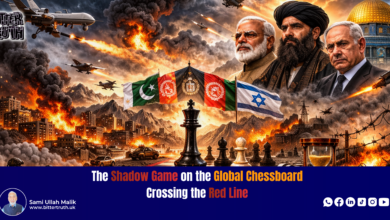
The spectre of a regional conflagration looms large. An attack on Iran could provoke a devastating retaliatory campaign against American bases, Israel, Saudi Arabia, and allied targets. Proxy groups—Hezbollah, Hamas, the Houthis—stand poised to open simultaneous fronts. This has prompted Israel, with tacit Western support, to wage pre-emptive strikes aimed at crippling these proxies. While it claims significant success, only time shall unveil the true measure of such efforts.
However, should hostilities erupt, the Strait of Hormuz may be blocked, halting nearly 20% of the world’s oil supply. A prolonged Middle Eastern war could follow, perhaps lasting a decade, plunging global markets into turmoil. A confrontation of this scale might also draw in China and Russia—potentially aligning with Iran—raising the spectre of direct military conflict with the United States. NATO, too, would be thrust into crisis: should it align with Washington or preserve neutrality? Trump’s prior antagonism towards both NATO and the European Union further complicates this calculus. One recalls his veiled threat to reclaim Greenland from Denmark—a symbolic gesture, yet one that betrayed the volatility of his geopolitical instincts.
Iran, meanwhile, could rely on diplomatic and military support from Beijing and Moscow. If this triangle of rivalry intensifies, the possibility of a world war may no longer be theoretical but imminent.
An air of dread now shrouds the region—and indeed the world at large. The failure of negotiations may well cast its shadow for centuries to come. President Trump has issued an ominous warning: should Iran refuse to dismantle its nuclear capabilities; it will be met with a bombardment “the likes of which the world has never seen.” Tehran, for its part, has responded in kind—its rhetoric equally unyielding, equally thunderous.
Israel may consider striking Iran’s subterranean nuclear sites, but doing so would almost certainly require American logistical and aerial support. Iran, in retaliation, may launch immediate strikes on Israeli and Saudi targets, including the vast American airbase in Qatar. From Lebanon and Syria to Iraq, Yemen, and the Gulf, the entire region could ignite into a vast theatre of war.
Such a conflagration would wreak havoc upon the global economy. Oil prices would surge. Refugees—driven by the devastation—would flood borders in waves unseen in modern times. The world would teeter on the brink of darkness, and history might record this moment as the prelude to a new and terrible era.
At the Precipice of Peril: A Diplomatic Plea in an Age of Atomic Anxiety
The world today stands at a perilous crossroads — a juncture where diplomatic inertia, military belligerence, and the looming spectre of nuclear catastrophe threaten to merge into a single, calamitous destiny. Should effective and timely diplomacy not prevail, a regional dispute may tragically escalate into a full-fledged Third World War. To avert such a cataclysm, the international community must act with both urgency and wisdom, embracing conciliatory measures that place the sanctity of humanity above the scourge of geopolitical ambition.
It is imperative, therefore, that:
Iran be conditionally permitted to continue uranium enrichment, albeit strictly under the comprehensive surveillance of the International Atomic Energy Agency (IAEA). Simultaneously, Israel must be held to equal standards, compelled to open all its nuclear facilities to IAEA inspections and to pledge, under binding international guarantees, that it shall refrain from any military aggression towards Iran. Likewise, Iran must be similarly restrained from any acts of provocation or hostility.
The unilateral sanctions imposed by the United States, Israel, and their Western allies must be declared illegitimate, as they stand in contravention of the principles of international law. The United Nations must review these punitive measures and, in parallel, turn its gaze upon Israel’s decades-long transgressions — including the systematic oppression and killing of countless unarmed civilians in Palestine and neighbouring states. One must recall that the International Court of Justice has already questioned the legitimacy of Israel’s actions on the global stage.
The 2015 Joint Comprehensive Plan of Action (JCPOA) — painstakingly negotiated and prematurely dismantled — must be revived through impartial mediation by the European Union, Germany, France, and China. In doing so, the world may once again anchor this crisis in the harbour of diplomacy, rather than allow it to drift toward the rocks of war.
Russia and China must be engaged not only as strategic actors but as guarantors of peace, offering Iran meaningful economic incentives in exchange for verifiable commitments to non-proliferation.
The inflammatory rhetoric emanating from Prime Minister Netanyahu, invoking a so-called “Libyan solution,” must be categorically rejected. This proposal, redolent of coercion and regime change, must be met with firm diplomatic censure — not only by the UN but also by key stakeholders, including Russia and China, who must caution Israel against reckless provocation.
The hour is grave. In accordance with the rulings of the International Court of Justice, the United Nations must now impose sanctions upon those states which, in open defiance of global norms, continue to sow discord and destabilise peace. The Middle East is no longer a confined theatre of tension — it has become a tinderbox, whose sparks may ignite a blaze beyond containment.
Though both Iran and its adversaries may profess no desire for war, the path to conflict is often paved not with intent, but with distrust and intransigence. The international community must therefore rise to the occasion, lest history record our silence as complicity. For in nuclear war, there are no victors — only survivors who inherit the ash.
Of Proxy Wars and Their Catastrophic Harvest
While the drums of open war may still beat faintly in the distance, the quiet theatre of proxy conflicts has already drenched many a soil in silent blood. In the shadows of regional politics, global powers play a dangerous game—arming factions, kindling insurrections, and sowing discord not with their own hands, but through others who bear the cost in life and liberty.
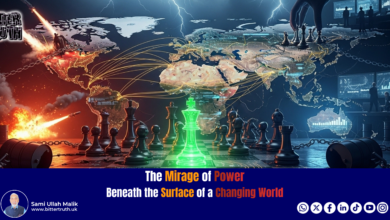
The Middle East, that ancient crucible of civilisation, now serves as the grand chessboard upon which foreign ambitions move pawns with little regard for the lives trampled beneath. In Syria, Yemen, Lebanon, and beyond, the agony of displacement, famine, and ruin does not stem from one belligerent alone, but from a chorus of interests who exploit the theatre of war to extend their own influence.
Let us speak plainly: such wars, fought through intermediaries, do not lessen guilt—they merely cloak it. When nations feed the fires of conflict through clandestine supply lines, intelligence support, or ideological sponsorship, they do not become spectators—they become culprits. And in the end, it is not the empires who bleed, but the shepherds, the students, the mothers, and the artisans who once built their homes in peace.
It is high time that the world called such wars by their true name: crimes by proxy. And those who wage them from afar should be made to stand before the judgment of history—if not in court, then in conscience.
The Economic Siege and the Exodus of the Forsaken
No less cruel than the sword is the silent vice of economic strangulation. Sanctions—those modern instruments of invisible war—claim no explosions yet destroy economies with ruthless efficiency. They claim to target governments, but in truth, they punish the governed. Bread disappears from the baker’s shelf, medicine from the apothecary’s drawers, and hope from the eyes of a generation.
In Iran, Venezuela, and other besieged lands, children grow old before their time. Grandmothers count coins they do not have. Doctors perform miracles without means. The siege, once a weapon of medieval warfare, has been reborn in our own age—packaged in diplomatic language but no less barbaric in consequence.
And what follows such hardship, inevitably, is exodus. The forsaken—millions of them—take to the roads, to the seas, to the shadows. They cross mountains, deserts, and borders not for conquest, but for bread; not for ideology, but for survival. These are not migrants—they are the exiled remnants of policies made in distant conference halls, under flags of civilisation.
If the international order still holds within its soul the spirit of justice, it must admit that collective punishment is a crime cloaked in legality. Sanctions that crush the innocent must be lifted; blockades that cause starvation must be condemned; and those who devise such tactics must answer—not only before tribunals, but before the tribunal of mankind.
On the Brink of Perdition: A Brief Lament on the Depths of Human Crisis
We stand today at a perilous crossroads—where the thunder of arms drowns the whisper of reason, and the bitter smoke of nuclear menace chokes the breath of hope. The world, trembling at the edge of a precipice carved by failed diplomacy, military belligerence, and unbridled ambition, risks descending into a new inferno—one not confined to the parched soil of the Middle East, but threatening to engulf the entire globe in flames unseen since the darkest hours of the last century.
Should wisdom not be swiftly rekindled—should the sails of reason not be unfurled—this hidden fire, now smouldering in desert winds, may yet roar into a tempest that consumes the very foundations of civilisation.
And thus, in such grievous times, prudence compels us to act with haste but not with haste alone—with clarity of mind, and balance of judgment.
Let Iran be granted conditional rights to enrichment, under the vigilant eye of the International Atomic Energy Agency. Let trust be nurtured not with rhetoric, but through transparent accountability. And let Israel—too long sheltered beneath an umbrella of exemption—submit likewise to such conditions. Let its vaults of weapons be opened to the same international scrutiny, and let it vow, in binding terms, to refrain from kindling the fire of war against its neighbour. The same solemn covenant must be expected of Iran.
Let us declare, with the weight of conscience and the voice of nations, that the unilateral sanctions imposed by the United States, Israel, and their Western allies are no longer tenable in a world that still dares to call itself just. The United Nations, standing as the final impartial arbiter, must weigh these measures, and summon Israel to account for the blood spilled in Gaza’s alleys, in West Bank’s ruins, and in the silent graves of the innocent. Has not the International Court of Justice already spoken, albeit in cautious tones, of the illegitimacy of Israel’s excesses?
The sacred accord known as the Joint Comprehensive Plan of Action—laboured over for years, a temple of peace wrought from the bricks of compromise—must be restored. Let the European Union, along with France, Germany, and China, act as noble mediators once more. Let this extinguished flame be rekindled not in the furnace of war, but beneath the gentle cloak of diplomacy.
Let us engage with China and Russia—not merely as spectators of conflict, but as guarantors of stability. Let them extend economic incentives to Iran, that it may tread the path of peace, not from fear, but from promise.
As for Mr. Netanyahu, who invokes the “Libyan solution” with alarming ease—let him remember the fate of Colonel Gaddafi, not as a triumph but a cautionary tale. Should he remain deaf to reason, let him be reminded—firmly yet diplomatically—by the voices of Moscow and Beijing, that the world can no longer afford to bow to the pride of any one man.
The hour has come when words must be followed by will. The judgment passed by the International Court of Justice must not gather dust in silence—it must inspire action. Those who flout the law must be made to taste its consequence.
If diplomacy falters, the embers in the Middle East shall leap beyond borders, fanned by winds of mistrust and the rigidity of entrenched positions. A regional spark may yet ignite a global tempest.
And though both sides may, in heart, abhor the prospect of war, the bitterness of suspicion and the intransigence of ambition may well provide the spark for its ignition.
On the Brink of Affliction: A Lament for Humanity in the Age of Siege and Exodus
In the age-old theatre of human history, few forces have wreaked more silent devastation than the calculated cruelty of economic blockade and the haunting tide of mass migration it so often engenders. The world we now inhabit is not the world that was — nor, it seems, the world it ought to be.
Across the battered landscapes of afflicted nations, the hand of embargo rests not as a shield but as a chain — cold, metallic, and unyielding. It is fastened not upon the guilty, but upon the innocent: the poor, the disenfranchised, the voiceless. Where once fields bore fruit and factories breathed life, now linger the spectres of unemployment, destitution, and despair — a tempest of economic torment, sweeping unchecked across continents.
These blockades, imposed by global powers cloaked in the vestments of justice and order, have become veritable fortresses of iron against the winds of freedom. They strangle nations not merely in policy but in spirit, robbing humble homes of hope, and extinguishing the lanterns that once burned for a brighter tomorrow.
And out of this tightening noose, migration emerges — not as a mere consequence, but as a cry. A cry from those who flee not for pleasure, but for breath. Men and women — the weary, the young, the desperate — abandoning hearth and homeland in search of shelter, of safety, of the simple dignity of survival. But what fate awaits them, these children of exile? Are they to be forever tossed upon the indifferent waves, or cast into the foreign chalice of cold hospitality?
This so-called “migration crisis” is not a logistical dilemma, nor a mere challenge of borders and bureaucracies. It is a wound — a weeping wound upon the conscience of mankind. Those who migrate do not do so merely to change their geography; they journey toward an idea — an idea of peace, of liberty, of the chance to live without fear. And it is this dream — shared, sacred, and painfully human — that drifts across oceans and deserts alike.
Yet this flood of the forsaken has brought with it not only movement, but misery — a blight so vast and so intimate that even the hardened pages of history quail before it. For migration in this age is not a story of triumph, but a tragedy without closure; an epic whose ending remains not only unwritten, but perhaps unimagined.
Of Metaphor and Memory: Siege, War, and the Fate of the Earth
And now, upon the very precipice of calamity, the world teeters. The delicate thread of diplomacy, frayed by arrogance and ambition, threatens to snap. In this perilous hour, great powers jostle for dominion, their own national appetites cloaked in the illusion of global order — while beneath their feet, the innocent are ground to dust beneath the wheels of politics.
Have we forgotten the time when humankind dwelt together in concord? When the tree of peace — firm-rooted and fruitful — cast its shade upon a grateful world? Or did we so soon tire of its abundance that we chose instead to hurl stones at its branches? The weight of this moment — this hour of fate — presses not only upon leaders, but upon every soul that calls this Earth home.
The fires that now burn in the heart of the world — whether in Gaza or Kashmir, in Ukraine, or upon the mountains of Persia — threaten not merely cities and states, but the very foundation of our shared existence. Shall we watch idly as the sparks of strife ignite the great pyre of civilisation? Will these flames burning in the heart of the Earth not become the cause of the fire of destruction of all existence?
It is not too late — not yet. But history does not wait forever. The storms of exile, the chains of blockade, the folly of war — these are not the fruits of destiny, but of decision. And the decisions we now make will echo, long and loud, through the corridors of time.
Epilogue: A Final Admonition to the World
Let it not be said by future generations that we stood at the brink and did nothing. Let the scribes of tomorrow not record that the world—armed with knowledge, memory, and conscience—still chose the path of destruction.
It is not too late. But the hour grows perilously nearby.
History waits—not only to record, but to judge.
For in the end, no nation can embargo hope. No army can march against conscience. And no wall can hold back the tide of human yearning.
O peoples of the world, a fleeting chance remains. Grasp it. For in a nuclear war, there are no victors—only the ashes of humanity remain.