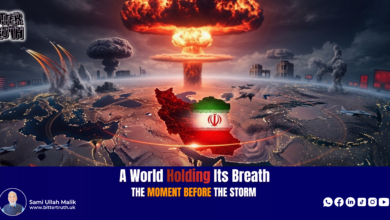
An Age on Trial
History’s Verdict

This is an age in which history appears to have quickened its pulse—an age where the events of centuries seem compressed into years, and the decisions of years into fleeting moments. It presents itself, at first glance, adorned with the gilded slogans of progress, democracy, human rights, and global concord; yet beneath this resplendent veneer there unfolds a quieter, more insidious contest—one that gnaws at the very sinews of civilisations, economies, and ideas. Herein lies the central tragedy of our time: that amid proclamations of light, the shadows deepen and take firmer root.
Ours is not merely a time in which history is written; it is etched in lines that seem almost to smoulder. Humanity has stretched its reach to the moon yet has proven curiously incapable of securing peace upon its own earth. This much-celebrated epoch—garlanded with the rhetoric of unity and advancement—reveals itself, upon closer scrutiny, as a portrait of profound unease, shaped by an unrelenting struggle for power, advantage, and dominion.
If one were to imagine history as a living organism, the present moment would register as a fever: its heartbeat accelerated, its breath unsettled, its gaze haunted by an indistinct but unmistakable apprehension. Global politics has long since ceased to be a measured exercise in principle, treaty, and diplomatic decorum; it has become, rather, an open theatre of contest, where power speaks plainly and interests contend without disguise. Words have assumed the character of weapons, narratives have hardened into battlefronts, and information itself has become an instrument so potent that it may refashion reality in its own image.
The modern world stands at a precarious juncture, where decisions are no longer confined to the chambers of state but are forged in fields, markets, and behind the carefully drawn curtains of media spectacle. Truth is recast into narrative; falsehood is dignified as strategy. The annals of history bear sombre witness: whenever power has cast aside the restraints of morality, humanity has paid the price in blood.
The present essay is, therefore, an earnest attempt to apprehend this intricate and elusive global landscape. It seeks not only to probe the deeper currents beneath recent political events, but also to illuminate those hidden forces, ambitions, and stratagems which, though seldom visible, exert a decisive influence upon the making of the world. It is not a mere aggregation of facts, but a journey of thought—one that invites the reader beyond the outward contours of events to a more searching encounter with their concealed realities.
What follows is, in essence, both reflection and remonstrance: not simply a political analysis, but an intellectual protest—a mirror held up to our age, in which its true countenance may be discerned. It does not merely inform; it provokes, urging the reader to think, to weigh, and to question. For this is no hour for silence, but for understanding—and for making understanding possible.
It is, at once, a question and a warning. A question—whether the world we perceive is indeed the world that is presented to us; and a warning—that failure to comprehend the spirit of our age may cost us not only the present, but the future as well.
This troubled era, in which politics has shed its moral essence and been reduced to a competition of power, bears the undeniable marks of those critical junctures in history when events cease to be mere events and instead become the instigators of destiny. Ours is an era that proclaims itself one of progress and harmony, but beneath its surface there is a turmoil born of civilizational tensions, strategic rivalries, and the relentless pursuit of interests. If history is likened to a river, we stand at that deceptive juncture where the surface appears calm, even as powerful undercurrents swirl beneath.
Within the context of this contemporary global disquiet, the present discourse advances a reflective and analytical proposition—one that endeavours not only to unravel the layers of modern politics but also to identify the forces, intentions, and latent dangers that operate behind the scenes. It aspires, through a union of literary grace and intellectual depth, to offer the reader not merely information, but insight.
It is not so distant a memory that, upon the horizon of global politics, the first presidency of Donald Trump rose like a sudden and disquieting sun. That moment did not merely signify the outcome of a democratic process; it marked, rather, the beginning of a perceptible shift in the balance of global power. Even at that time, it was suggested that this was no ordinary political transition, but the prelude to a gathering storm—one whose depths concealed the ominous possibility of a wider conflagration.
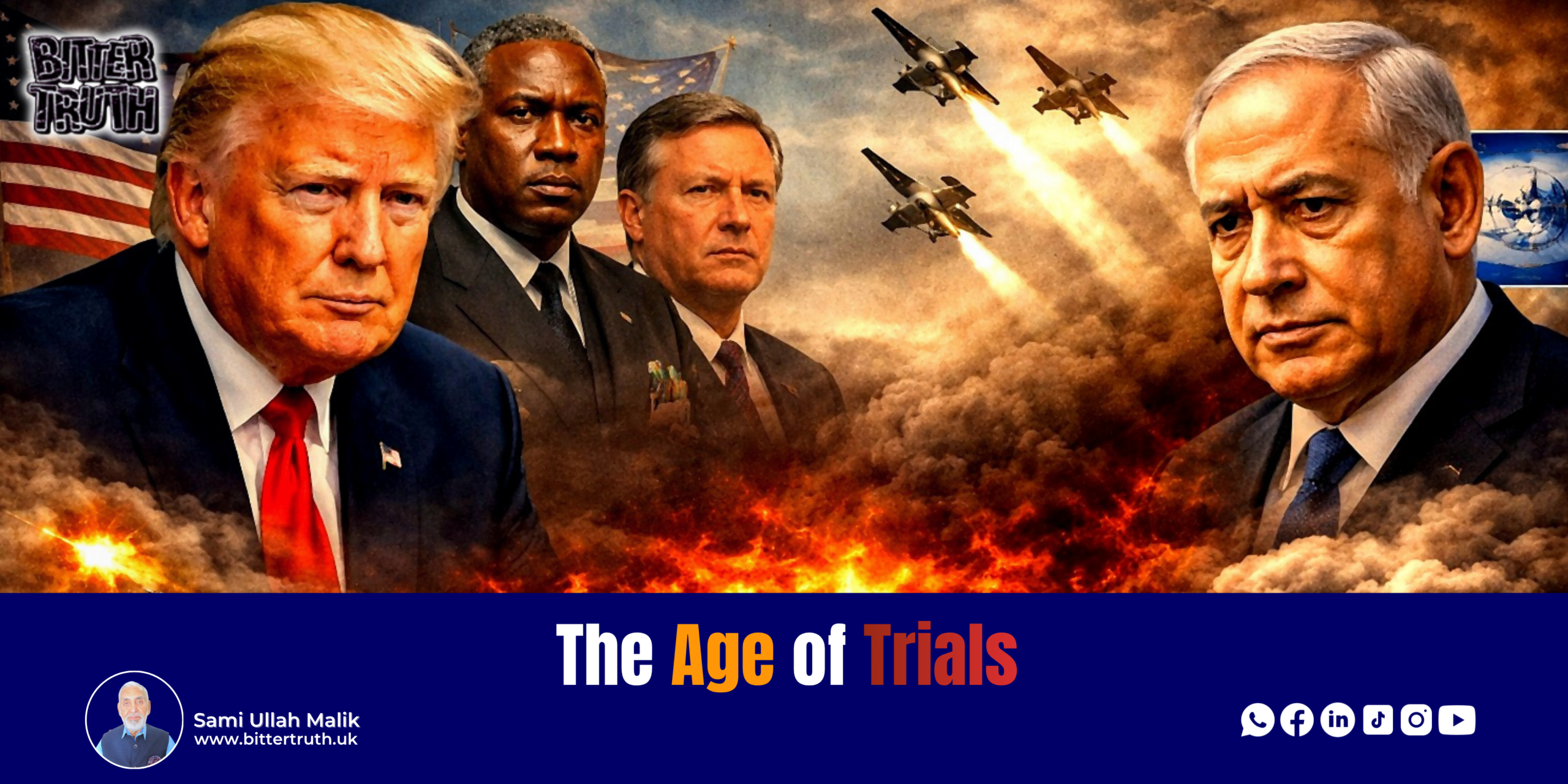
During that period, American foreign policy appeared to depart from the measured traditions of diplomacy, adopting instead a posture of assertive unilateralism. In the more combative dimensions of this approach, one discerned a preference for force over deliberation, for confrontation over restraint. Coupled with this was the strategic alignment with Israel, and the influential proximity of figures within the inner circle, forming a triangular dynamic whose vectors seemed, in no uncertain terms, oriented towards the Muslim world.
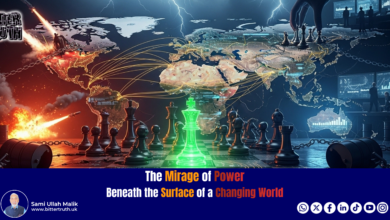
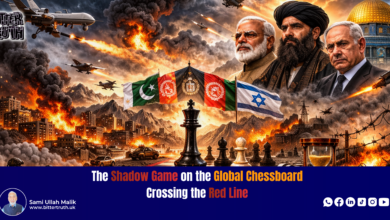
Heightened tensions with Iran, unwavering support for Israel in the Middle East, and a visible disdain for international institutions—all pointed towards the emergence of a new style of governance on the global stage. For the perceptive observer, it was not difficult to foresee that, unchecked, such a trajectory might lead the world towards a far more dangerous confrontation. To cast Iran as the point of ignition, while entangling Sunni states in sectarian rivalries, bore the unmistakable imprint of a calculated design—a strategic chessboard upon which the weakening of the Muslim world appeared a central objective.
When such phenomena first entered the public domain, they were met with skepticism in the Western world, especially among American audiences. To many, such analysis seemed exaggerated, even conspiratorial. Donald Trump was seen as an unconventional but effective leader. There is an important distinction here: the West often presents its policies in the language of democracy, peace, and development, while the East suffers the consequences on its own soil. It is this distortion of perception that gives rise to disagreement – not just of opinion, but of self-understanding.
Thus arose the question: if a country such as Pakistan could contemplate nominating Trump for the Nobel Peace Prize, and its leadership could credit him with averting nuclear war in South Asia, why entertain such apprehensions? Yet this question, in truth, reveals less about the validity of the concern than about the intellectual gulf that persists between Western narrative and Eastern experience—a gulf that continues to shape the discourse of our divided world.
History possesses, among its many attributes, this inexorable quality: that sooner or later, it delivers its verdict. And so it came to pass. Rather than restraining the unfolding tragedy in Gaza Strip, Donald Trump lent unequivocal support to Israel—thereby rendering unmistakable the affinity between himself and Benjamin Netanyahu, as though they were but two faces of the same coin.
When the suffering in Gaza reached its most harrowing intensity and the conscience of the world stood by in mute observation, it became painfully evident that the language of human rights, so often invoked, had been reduced to a mere instrument of political convenience. Trump’s overt endorsement of Israel only deepened this realisation: that in the theatre of global politics, morality enjoys no permanent station—it is, at best, subordinate to interest.
As the spectre of a possible strike against Iran began to gather form, and the Middle East once again appeared poised upon a powder keg, the familiar invocation of American democracy was deployed to suggest that no president could unilaterally plunge the nation into war. Yet the practice of politics proved less reassuring than its theory. In the event, such assumptions were not merely tested but overturned, as the very democratic norms so frequently extolled were brushed aside with disquieting ease.
The composition of Trump’s second administration offered a revealing indication that moderation would yield to a more strident disposition in the making of policy. The individuals assembled were not merely practitioners of governance, but exponents of a worldview in which confrontation was not a last resort but a preferred instrument. Institutions such as the United States Congress—long regarded as the citadels of democratic restraint—appeared, in practice, diminished, even ineffectual. The initiation of hostilities without its sanction stood as a stark reminder that institutions, for all their constitutional dignity, may falter before the force of determined personalities. A conflict extending beyond a fortnight was not merely an episode; it was a declaration—that the world had entered a new and more volatile era of contention. Such a trajectory is fraught with peril, for when institutions are enfeebled, decisions cease to be anchored in deliberation and become instead the captives of impulse and expediency.
Within this charged atmosphere, certain figures assume particular prominence. Senior officials within the American security establishment—among them those entrusted with defence and intelligence—embody a synthesis of military experience and ideological conviction, wherein elements of religious partiality and martial assertiveness appear intertwined. Statements and positions articulated by segments of the leadership suggest that this conflict is not confined to the material domains of geography or economy but extends into the realm of ideas and belief. Alarming discourse surrounding Al-Aqsa Mosque, coupled with overtly hostile rhetoric towards Muslims, signals a narrative that risks recasting political disagreement as civilisational confrontation—one that may divide the world along confessional lines.
Ours is an age defined, ostensibly, by the abundance of information; yet abundance does not guarantee veracity. The role of the media, in this regard, is both decisive and disquieting. Where certain facts are obscured and particular narratives amplified, public opinion is gradually moulded in accordance with that design. It is for this reason that the emergence of alternative accounts so often produces astonishment: not because the truth is new, but because it has long been withheld.
When the backgrounds and affiliations of influential figures were more closely examined, the disclosures proved startling to many. In particular, reported connections with organisations such as the Rashtriya Swayamsevak Sangh and the Bharatiya Janata Party prompted a telling silence—one that betrayed, perhaps, an unspoken recognition that prior understanding had been confined within narrow bounds.
Within Pakistan, a certain indulgent disposition towards Trump has, at times, been discernible—rooted less in careful analysis than in his rhetoric critical of India. Yet the maxim that “the enemy of one’s enemy is a friend” has seldom proved reliable in the calculus of international relations. In truth, there are neither permanent allies nor immutable adversaries—only enduring interests. It is a curious paradox that while criticism of Trump finds ready expression within the United States, he is, in some quarters of Pakistan, presented as a sympathetic figure. The notion that his mockery of Narendra Modi renders him a well-wisher is, upon closer reflection, a rather disarming simplicity. Global politics is not governed by sentiment, but by the cold arithmetic of advantage.
In due course, a number of observers conceded that the media had distanced them from the fuller truth. Such admissions serve as a sobering reminder that in the modern world, the dissemination of information has itself become a weapon, and the concealment of truth a calculated stratagem.
The wars of our time are no longer waged for mere tracts of land, but for the resources that lie beneath them. Oil, gas, and other reservoirs of energy constitute the true prizes over which great powers contend. In this regard, Iran occupies a position of undeniable strategic significance, and the prospect of conflict appears intimately connected with this reality.
The intervention in Venezuela, followed by the expected talk about Iran, can be read not as isolated events but as successive expressions of a single strategic design. The acquisition of energy reserves, in fact, represents a modern incarnation of imperial ambitions. The provisions outlined within the US National Security Strategy offered no ambiguous signal: that such developments were neither accidental nor improvisational, but rather deliberately designed.
When a state’s own policy documents declare an intention to deprive its adversaries of critical resources, it amounts, in substance, to a declaration of conflict—albeit couched in the tempered idiom of diplomacy. A careful reading of such doctrine reveals a clear objective: the securing of energy dominance at the expense of rivals. The strike against Iran in March 2026 stands, in this light, not as an aberration but as the logical execution of policy.
Yet a war directed against Iran cannot remain contained within its borders. It has already begun to draw the wider region into its orbit, with consequences reverberating across the Middle East and beyond, unsettling the global economy itself. Oil prices, trade routes, and political alignments alike bear the imprint of this upheaval. Concurrent anxieties surrounding Al-Aqsa Mosque and attempts to draw Muslim-majority states into the conflict, suggest the contours of a far more expansive design.
Modern warfare is not fought with weapons alone, but with art. Through so-called “false flag” operations, responsibility for an event can be falsely attributed, thus providing a pretext for escalation. Such actions are extremely dangerous, as they blur the distinction between truth and falsehood. Elements within the Iranian leadership have characterized certain attacks in these terms, while concerns have also been expressed about Turkey and Pakistan—though, in some quarters, a lingering complacency persists.
Within the US Senate, the description of Pakistan’s missile program as a threat—along with a conspicuous silence on India—can be seen as less than impartial. An exercise in strategic pressure versus an assessment. Such selectivity illustrates a broader reality: that the rules set by major powers often serve their interests. Excluding India from such scrutiny indicates a pattern of double standards, which reveals the inherent fragility of the international system.
The political trajectory of Tulsi Gabbard offers, in its own way, a telling illustration of how individuals may recalibrate their ideological positions in alignment with evolving interests. Her departure from the Democratic Party and subsequent association with Republican circles contributed to the shaping of a narrative calibrated to particular strategic ends. Reported links, financial support, and political alignment involving the Rashtriya Swayamsevak Sangh and the Bharatiya Janata Party further demonstrate that ideological affinities, no less than material interests, play a consequential role in the grand design of global politics.
The war against Iran has, paradoxically, revealed a measure of unintended consequence—one that may be counted, if cautiously, among its few constructive effects. Across the world, the once-entrenched sectarian fissures appear, if not wholly erased, then at least perceptibly diminished. The long-standing divide between Shia and Sunni, long exploited as an instrument of discord, has, under the pressure of a common crisis, receded into the background. In its place there emerges the faint but discernible outline of a broader consciousness—one in which individuals begin to conceive of themselves first as members of the faith, and only thereafter as adherents of particular schools or traditions.
Europe, meanwhile, finds itself suspended in a state of profound ambivalence. Bound by alliance to the United States, yet apprehensive of the war’s far-reaching consequences, it hesitates—torn between loyalty and prudence. Notwithstanding this hesitation, there persists an evident effort to frame the conflict within a religious narrative, thereby securing public assent. For when policy falters in persuasion, it often seeks refuge in the language of belief.
The region of Balochistan, by virtue of its formidable geostrategic significance, has drawn the attentive gaze of global powers. Any substantial change therein would reverberate far beyond its borders, unsettling the delicate equilibrium of the wider region. It is not inconceivable that, in pursuit of a sustained military presence, this territory might be rendered a focal point of intervention. Should such designs come to fruition, the balance of power in the region would stand gravely imperiled.
History offers a consistent lesson: that external incursions seldom succeed without first finding purchase in internal frailty. Where societies harbor elements of betrayal or weakness, the path of the adversary is markedly eased. The cultivation of networks within Iran and Lebanon exemplifies the manner in which internal vulnerabilities may be harnessed by external forces. The prospect of strategic control over Chabahar and Sistan and Baluchestan raises the specter of a geopolitical constriction—one in which Pakistan might find itself increasingly encircled.
Iran’s political system, in this regard, exhibits a certain resilience born of structural foresight: a mechanism for continuity of leadership that endures even under severe strain. It is this provision that has enabled the state to withstand sustained external pressure without succumbing to institutional collapse.
The strike upon Diego Garcia, followed by a flurry of diplomatic maneuvers, reflects the intricacy of a contest in which each move is calculated with deliberate care. Recent developments suggest that this conflict is waged not solely upon the battlefield, but equally within the corridors of diplomacy. Alternations between escalation and negotiation are not contradictions, but components of a single, coherent strategy.
The question that now presents itself with renewed urgency is this: what course shall Pakistan pursue at so delicate a juncture? Within this unfolding drama, it occupies a position of considerable consequence. With prudence and foresight, it may yet safeguard its own interests while contributing to regional stability. Its relations with Iran and China, together with the imperative of internal cohesion, will weigh heavily in determining its future trajectory.
All these conditions point, with gathering clarity, to a world poised upon a difficult threshold—subjected to a trial both severe and defining. Should the Muslim world and the Western nations alike fail to exercise wisdom, unity, and discernment, history may once again repeat its harsher lessons. The hour demands not passive spectatorship but active comprehension: that we apprehend the nature of our circumstances and determine our course accordingly, lest the flood of time carry us away unresisting. It calls for judgment over impulse, for long-term vision over transient gain. For those nations that neglect the lessons of history are seldom spared its discipline—and its instruction is rarely gentle.
When history delivers its verdict, it entertains no pleas in mitigation. It regards neither strength nor weakness in themselves but asks only how humanity has exercised its agency—whether with understanding, justice, and integrity, or otherwise. The present age stands upon precisely such a testing standard. The conflicts we witness are not merely contests over borders; they are struggles of narratives, of ideas, of interests—within which the distinction between truth and falsehood grows ever more obscure. Each party claims the mantle of righteousness, yet in the ensuing contention it is humanity that suffers most grievously. Economies tremble, societies fracture, and an atmosphere of pervasive uncertainty settles across the globe.
One must remember that the wheel of history does not pause. It turns, it judges, and in due course it reflects mankind back upon itself. The age through which we now pass is no fleeting disturbance; it is the prelude to an era whose consequences will shape the destinies of generations yet unborn. And yet, even in the deepest shadow, there remains some glimmer of light. It is at such moments that nations must look inward, acknowledge their frailties, and chart a renewed course upon firmer intellectual foundations. Unity, foresight, and wisdom—these are the pillars upon which a secure and dignified future may yet be built.
These wars, these narratives, these alliances and enmities—though they may appear transient, their effects are enduring. If humanity continues to privilege interest over conscience, if power persists in trampling justice, and if nations allow themselves to be guided by passion rather than reason, then the future may well prove darker than the past. To dismiss the present moment as a passing crisis would be a grave misjudgment. This age has not come merely to pass—it has come to test, to awaken, and to remind us that survival belongs only to those who can discern the pulse of their time.
And yet, the lamp of hope has not been extinguished. In every troubled age, there arise voices—however few—that stand in quiet defiance of the encroaching darkness. The imperative, therefore, is clear: that we come to know ourselves, learn from history, and determine our course with clarity, insight, and unity. In the final reckoning, the decision rests with us. Shall we be swept along by the current of history, or shall we summon the resolve to alter its course? For the generations to come will inherit not only the consequences of our actions but will bear witness to the choices we have made—and history, as ever, will not delay in pronouncing its judgment.
Time itself presents the question; the answer is ours to give. Should we fail to answer it wisely today, tomorrow’s history will not be inclined to absolve us.