A New Paradigm of Collective Defence
A Covenant of Defence and Destiny

History records, with an unblinking fidelity, that when nations choose to anchor their survival in mutual trust and shared vision, they do not merely sign agreements; they redirect the very current of history. In the annals of international relations, it is an established truth that individual security is seldom durable unless enclosed within the ramparts of collective security. The recently concluded defence agreement between Pakistan and the Kingdom of Saudi Arabia stands as an exceptional manifestation of this principle. Under its central provision, aggression against one state shall be deemed aggression against both. This clause is no mere assemblage of diplomatic words; it is a solemn declaration of shared destiny between two sovereign states. Its force is not confined to the military domain alone; it carries profound political, psychological, and strategic deterrent value—compelling any potential adversary to pause, reconsider, and reckon with consequences.
The strategic defence accord between Pakistan and Saudi Arabia marks a decisive stride towards the ideal of collective security within the Islamic world. It not only institutionalises bilateral defence cooperation but also lays the foundation for a broader Muslim security framework—one that addresses the balance of power in the region, safeguards the sovereignty of Muslim states, and responds with clarity to an evolving global security environment. This agreement gives practical expression to a doctrine long recognised in international security thought: that an attack on one is, in effect, an attack on all. In the days ahead, the potential inclusion of Türkiye and Iran could well transform this bilateral understanding into a wider Islamic defence compact of historic proportions.
The transition from national security to collective security has not occurred in a vacuum. The global security architecture today is marked by acute imbalance. Protracted conflicts in the Middle East, the humanitarian catastrophe in Gaza, nuclear tensions in South Asia, and sustained political and military pressure on Muslim states have collectively underscored the necessity of a Muslim collective defence model—one akin in structure to NATO, yet free from Western political hegemony.
At its core, the Pakistan–Saudi defence agreement rests upon a doctrine already validated by modern security arrangements. NATO’s Article 5 stands as the most evident precedent: a provision that offers not only military protection but also generates a powerful shared strategic deterrent. In much the same manner, this agreement establishes a unified defensive posture, designed to dissuade aggression before it materialises.
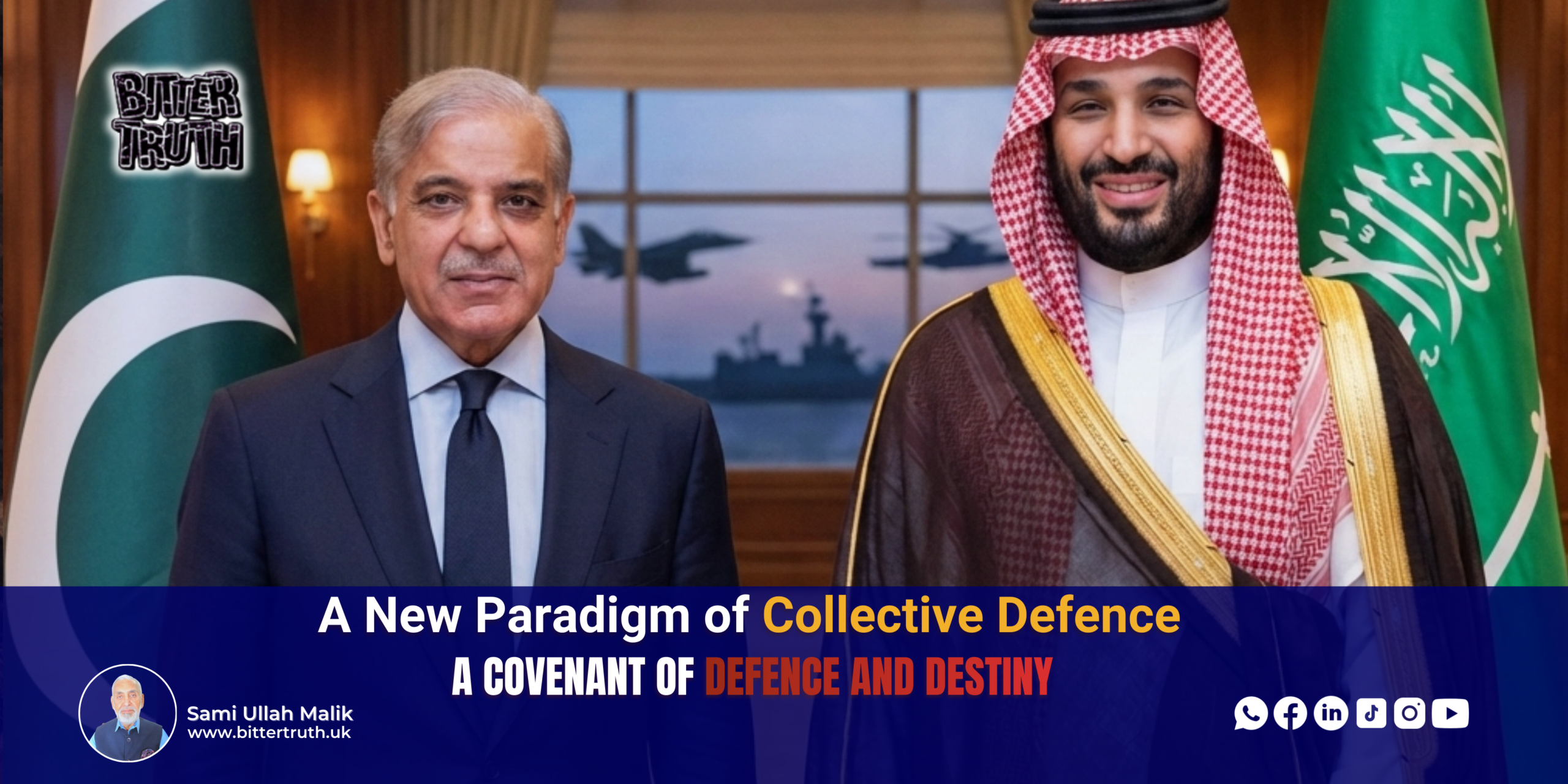
Formally brought into being through the signatures of His Royal Highness Crown Prince Mohammed bin Salman and the Prime Minister of Pakistan, Mian Muhammad Shehbaz Sharif, this strategic mutual defence agreement symbolises a deliberate elevation of historic ties—from cordial diplomacy to an operational defence partnership. It is a moment where diplomacy clasped hands with strategic foresight.
The strategic alignment between Crown Prince Mohammed bin Salman and Prime Minister Shehbaz Sharif has ensured that this accord is far more than symbolic. Under decisive leadership, it has been translated into a practical reality—widely interpreted as a pre-emptive strategic measure in response to regional instability, escalating geopolitical risks, and mounting pressures on the Muslim world.
This agreement proclaims a deeper truth: that within the Islamic world, the age of mere reaction is giving way to an ethos of anticipation and preparedness. Leadership, in this instance, has consciously favoured long-term security over transient diplomatic convenience. Mirroring the spirit of NATO’s Article 5, the Pakistan–Saudi pact establishes a shared deterrent mechanism against any potential aggressor.
Beyond strengthening the national security of both states, the agreement reflects a shared resolve to contribute meaningfully to regional and global peace. Its primary objective is to institutionalise defence cooperation and ensure an effective, united response to any act of aggression—thereby tipping the balance of power away from conflict and towards stability.
The institutionalisation of defence cooperation, joint preparedness against present and future threats, and a collective role in promoting peace constitute the central aims of this agreement.
In essence, it echoes the strategic vision that guided Europe in the aftermath of the Second World War through the creation of NATO. Yet its implications extend further: this pact is not merely bilateral, but foundational—offering the contours of a future regional security framework.
The joint communiqué makes it unequivocally clear that the Pakistan–Saudi partnership is no product of momentary interest. It is the culmination of over eight decades of steadfast, tested, and trusted relations—rooted not only in diplomacy but in military training, defence consultation, and intelligence cooperation. This agreement grants that historic bond formal legal and strategic protection, while also reaffirming a fraternity grounded in faith and shared responsibility.
In this context, the message conveyed to the international community is unambiguous: Pakistan regards the protection of the Haramain not merely as a strategic obligation, but as an article of faith and a means of seeking the pleasure of Allah and His Messenger ﷺ.
As the Qur’an declares:
وَاعْتَصِمُوا بِحَبْلِ اللَّهِ جَمِيعًا وَلَا تَفَرَّقُوا
“And hold fast, all together, to the Rope of Allah, and do not be divided.” (Āl ʿImrān 3:103)
And again:
وَأَعِدُّوا لَهُم مَّا اسْتَطَعْتُم مِّن قُوَّةٍ
“And prepare against them whatever force you are able.” (Al-Anfāl 8:60)
In their union of resolve and preparedness, Pakistan and Saudi Arabia have thus inscribed a new chapter—one in which collective strength is marshalled not for conquest, but for deterrence, dignity, and the preservation of peace.
This agreement stands as tangible proof of the deepening Pakistan–Saudi strategic partnership and the growing solidity of their defence cooperation. Pakistan’s military leadership—most notably the Chief of Army Staff, Field Marshal Syed Asim Munir—played a decisive role in translating this accord from diplomatic intent into operational reality. In the aftermath of this agreement, Pakistan has formally emerged as a partner in the protection of the Two Holy Mosques, assuming the stature of a responsible security state within the Islamic world. Such a role has seldom been entrusted to a non-Arab nation, and its conferral upon Pakistan marks a moment of exceptional historical significance.
This responsibility elevates Pakistan to the position of a central defensive pillar within the Muslim world. It is not a burden confined to the military sphere alone; it is at once doctrinal, civilisational, and historical. The safeguarding of the Haramain is thus framed not merely as a strategic duty, but as a trust rooted in faith, heritage, and collective memory.
Among the most consequential regional and global implications of the Pakistan–Saudi defence pact is its capacity to stabilise the balance of power in the Middle East, influence security dynamics in South Asia, and offer Muslim states a measure of emancipation from exclusive reliance on Western military architectures. According to leading international outlets, including Bloomberg, the potential inclusion of Türkiye would extend the agreement’s impact far beyond the Middle East, reshaping strategic equilibria across a wider geopolitical canvas.
The joint communiqué affirms that, in light of present and emerging threats, the agreement will enhance defence preparedness, integration, and operational coordination. As a result, both states will be better equipped to confront, in unison, any threat to their territorial integrity or national security. The accord explicitly addresses contemporary challenges encompassing conventional warfare, hybrid conflict, cyber warfare, missile and drone technologies, and regional instability—providing a framework for indispensable joint preparedness, integration, and strategic planning.
Expressions of interest from Iran and Türkiye signal a growing recognition across the Muslim world of a long-standing collective defence vacuum. Türkiye’s potential participation, informed by its NATO experience and advanced defence industry, could confer significant technical and operational advantages upon the alliance. In this broader context, a critical truth comes into sharper focus: the Organisation of Islamic Cooperation requires not merely a diplomatic identity, but a credible military pillar.
Under the agreement’s core provisions, any external armed attack against one signatory shall be considered an attack against both. While this clause bears resemblance to NATO’s Article Five, its resonance within the Islamic world is arguably deeper and more profound. Decades of shared military training, multinational exercises, and defence-industrial collaboration provide a firm foundation upon which this clause now rests.
In practical terms, this agreement represents the application of NATO’s collective defence doctrine within an Islamic framework. The distinction, however, is fundamental. NATO has historically functioned as the guardian of Western political and economic interests; a Muslim defence alliance, by contrast, has the potential to safeguard the very existence, sovereignty, and sacred sites of the Ummah. In this sense, the pact constitutes an Islamic interpretation of Article Five—addressing a strategic void that has long persisted. This comparison strengthens the agreement’s legal and normative standing. History attests that NATO became the guarantor of Europe’s collective defence, while SEATO and CENTO served predominantly American strategic interests. The Pakistan–Saudi agreement, for the first time, articulates a Muslim-centred defence vision anchored in sovereignty, sanctity, and collective welfare.
The benefits accruing from this defence pact extend across the domains of security, economy, and diplomacy for both Pakistan and Saudi Arabia. The defensive strength of one now stands in service of the other, rendering each a shield for its counterpart. By reinforcing the interdependence of security, economic stability, and diplomatic leverage, the agreement contributes to the protection of investments, the security of energy corridors, and enhanced coordination in global diplomacy. It is no coincidence that NATO member states have historically experienced fewer intra-alliance conflicts and stronger economic resilience.
From a policy perspective, this agreement may well serve as a model of defensive self-confidence
for Muslim states. It holds the potential to provide tangible deterrence in crises such as Gaza, Palestine, and Kashmir, while simultaneously enhancing the negotiating weight of Muslim countries in engagements with global powers.
It bears recalling that at Al-Yamamah Palace, Crown Prince Mohammed bin Salman accorded a warm reception to Prime Minister Shehbaz Sharif. Formal negotiations were held in the presence of both delegations, conveying best wishes for Custodian of the Two Holy Mosques King Salman bin Abdulaziz and undertaking a comprehensive review of historic and strategic relations. A wide range of matters of mutual interest were discussed in depth.
The Al-Yamamah deliberations made one reality unmistakably clear: trust between the two nations has transcended individual personalities and taken root within enduring institutions. Shared interests are no longer reliant on informal understandings; they are now enshrined in written agreements and legal guarantees—a hallmark of policy continuity and strategic maturity.
Yet it must be recognised that adversarial forces rarely view the success of Muslim defence arrangements with equanimity. Inevitably, challenges persist: internal political divergences within the Muslim world, potential pressure from global powers, and the demands of institutional coordination. Addressing these challenges will require transparent, lawful, and incremental strategies rooted in prudence rather than haste.
In this unfolding context, Iran has also expressed its desire to join the defence agreement. During his visit to Pakistan, the Speaker of the Iranian Parliament, Mohammad Baqer Ghalibaf, stated that Iran should be included in the pact and that the OIC ought to establish a joint military force along the lines of NATO. His remarks reflect a growing awareness within the Muslim world of the existing defence deficit and the urgent need for a credible military pillar within the OIC. Iran’s inclusion could transform the alliance into a pan-Islamic security bloc of unprecedented scope.
As the Qur’an reminds:
وَتَعَاوَنُوا عَلَى الْبِرِّ وَالتَّقْوَى
“And cooperate with one another in righteousness and piety.” (Al-Mā’idah 5:2)
In this spirit of cooperation, the Pakistan–Saudi defence agreement gestures towards a future in which unity is no longer rhetorical, preparedness is no longer deferred, and collective security becomes the lived reality of the Ummah.
The proposal advanced by the Speaker of the Iranian Parliament is, in essence, an acknowledgment of a profound and long-neglected truth: that the Ummah cannot be secured while remaining fragmented. Collective defence has ceased to be a matter of choice; it has become an inevitability. Should this proposal advance, it may yet breathe a martial spirit into the Organisation of Islamic Cooperation. The Pakistan–Saudi defence agreement thus stands as a strategic exemplar for the Islamic world—its first tangible step towards collective security and the cornerstone of a future Muslim defence alliance. To fulfil this promise, the alliance must be rendered multidimensional, supported by joint military exercises, an integrated command structure, and a defence framework anchored within the OIC. For collective defence is not merely a military arrangement; it is the guarantor of political sovereignty, moral dignity, and equilibrium in the international order.
The Iranian Speaker further urged that Islamic nations—particularly Pakistan—should deploy forces to Gaza for the protection and relief of the Palestinian people, and that no action be taken which might further entrench Israeli domination. The ongoing atrocities in Gaza and Kashmir have laid bare an uncomfortable reality: statements and diplomatic condemnations alone are insufficient. Only credible collective defensive power can generate the deterrence capable of shielding the oppressed. It is here, precisely, that the moral legitimacy of an Islamic defence alliance will be tested—and it is this challenge that simultaneously strengthens its ethical foundation.
Mohammad Baqer openly acknowledged that the solidarity demonstrated by Pakistan during periods of Israeli aggression against Iran will never be forgotten by the Iranian nation. In his words, Pakistan represents a priceless asset for the Ummah. Pakistan and Iran confront shared challenges that are best addressed collectively, while vast opportunities for cooperation exist across sectors such as healthcare, energy, and banking.
Iran’s recognition of Pakistan’s role is emblematic of a broader transformation: Pakistan has come to symbolise balance, prudence, and principled resistance. It is now acknowledged not only regionally but globally as a stable and parallel power—capable of restraint as well as resolve.
Cooperation in medicine, energy, and banking completes the architecture of defence partnership, and Iran now seeks a multidimensional role within the evolving Pakistan–Saudi security framework. In a further significant development, Türkiye has also expressed its desire to join the Pakistan–Saudi defence alliance. According to Bloomberg, a defence compact comprising Pakistan, Türkiye, and Saudi Arabia could recalibrate the balance of power not only in the Middle East, but far beyond it.
Türkiye’s inclusion—armed with advanced military technology, NATO experience, a sophisticated defence industry, and strategic geographic reach—could fundamentally reshape power dynamics across the Middle East, South Asia, and the Mediterranean. Its participation carries the weight of global strategic gravity and could well usher in a historic realignment.
It is noteworthy that Pakistan and Saudi Arabia had already signed, as early as last year, a defence agreement declaring that aggression against one would be treated as aggression against both—a principle identical to NATO’s Article Five. Türkiye, notably, is already a NATO member. History reminds us that SEATO and CENTO were conceived to serve American defence interests, while Europe secured itself through NATO. The question thus becomes unavoidable: does the Islamic world not possess the right to defend itself? Is it not entitled to collective security? This agreement constitutes a practical answer to that question.
Bloomberg further reports that negotiations to formally include Türkiye in this defence alliance may soon be concluded. Should this materialise, the alliance will transcend the character of a military bloc and emerge as a symbol of the Ummah’s collective self-respect, self-reliance, and defensive unity.
If Pakistan, Saudi Arabia, Türkiye, and Iran succeed in establishing institutionalised defence cooperation, joint command structures, and shared military exercises, such an alliance could become a force not for war, but for its prevention; not for domination, but for stability. It would stand as a guarantor of the Ummah’s dignity and evolve into a future-oriented Islamic collective defence architecture—capable of contributing not only to Muslim security, but to global peace itself.
This defence alliance is not merely a compact of state interests; it is a civilisational declaration—that when the Ummah awakens, it alters the course of history. If advanced with vision, moderation, and principled politics, it may well herald a new era of stability and sovereignty for the Islamic world. Nations do not survive by weapons alone, but by character and unity.
The Islamic world must now move beyond reaction and embrace anticipation—towards collective defence and strategic alliance. This agreement is not simply a defensive arrangement between two states; it is the foundation of collective security for the Muslim world and the opening chapter of a future Muslim security architecture. True power does not emanate from arms alone, but from unity, institution-building, and shared vision. This agreement is a beginning, not an end. When nations choose to safeguard themselves, history, in turn, safeguards their choice.
As the Qur’an affirms:
إِنَّ اللَّهَ يُحِبُّ الَّذِينَ يُقَاتِلُونَ فِي سَبِيلِهِ صَفًّا كَأَنَّهُم بُنْيَانٌ مَّرْصُوصٌ
“Indeed, Allah loves those who strive in His cause in ranks, as though they were a solid, cemented structure.” (As-Ṣaff 61:4)