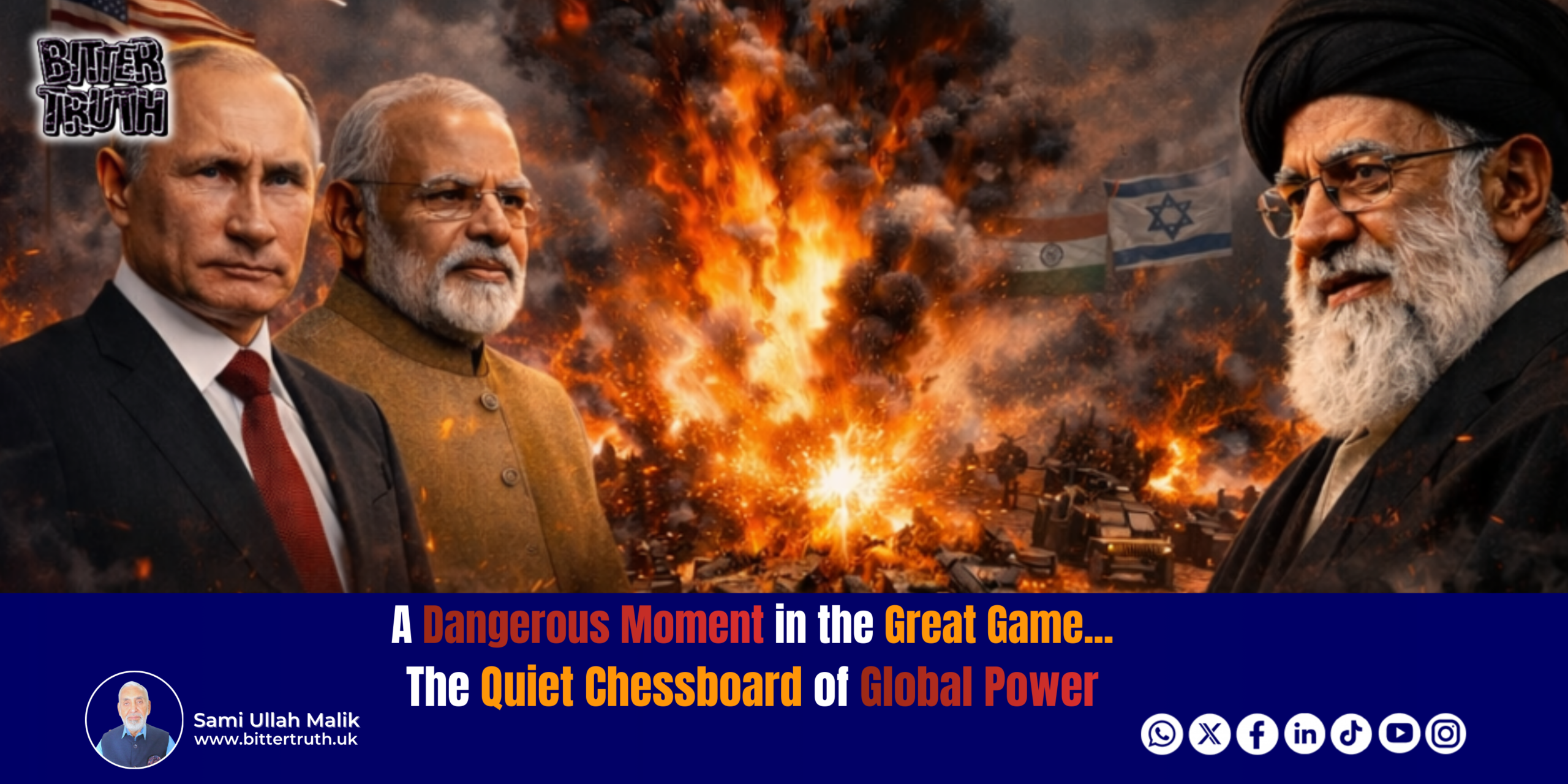
A Dangerous Moment in the Great Game
The Quiet Chessboard of Global Powe

In the long procession of history, certain occurrences rise above the level of mere events. They do not simply happen; they redirect the current of time itself. Such moments stand in the chronicles of nations like milestones upon a winding road—markers that signal not merely passage, but transformation. Nowhere is this phenomenon more evident than in the turbulent annals of the Middle East. From time to time the region appears to pause, as though history itself has drawn breath, awaiting the unfolding of some grave upheaval or unexpected turn of destiny. In that theatre of power and intrigue, certain incidents transcend the character of tragedy alone; they emerge instead as turning points that alter the course of the historical stream. There are chapters in the book of history which, once opened, leave the reader with the distinct impression that an entire epoch stands poised upon the threshold of change.
The present crisis appears to belong unmistakably to that sombre category. It has been widely interpreted in the light of the reported assassination of Iran’s Supreme Leader, Ali Khamenei, and the mounting tensions that followed in its wake. The increasing pressure exerted upon Iran by both the United States and Israel seemed to herald the approach of a gathering storm—one whose first rumblings were sufficient to unsettle the entire region. To many observers this moment appeared less an isolated disturbance than the opening movement of a far more consequential drama. The alleged killing of Iran’s supreme authority, combined with the intensifying strategic hostility directed towards Tehran, lent the unfolding crisis the character of a deeply unsettling chapter in contemporary history.
News of the killing of Ali Khamenei, accompanied by the increasingly assertive posture adopted by Washington and Tel Aviv, appeared to push the region towards a precipice from which the flames of conflict might easily have spread far beyond the Middle East itself. The political and military reverberations that followed his reported death gathered like darkening clouds upon the horizon of the region. What emerged was not merely a diplomatic dispute, but an atmosphere charged with foreboding—an eruption of tensions whose heat, one might suspect, could be felt by generations yet unborn.
This episode therefore seemed to signify more than the martyrdom of a single individual. It bore the unmistakable imprint of a political earthquake, one that shook the strategic architecture of the region to its foundations. The uncertainty that began to dominate the political horizon did not appear accidental or spontaneous. Rather, it suggested the quiet workings of a far subtler design—an intricate stratagem whose aim, some analysts argued, was to erode Iran’s defensive bastions from within. The climate of ambiguity and apprehension that followed the tragedy seemed less the by-product of chance than the early outline of a calculated and complex plan intended to weaken Iran’s strategic cohesion.
Indeed, the uncertainty that spread across the region in the aftermath seemed almost to mark the beginning of a broader project—one designed not only to undermine Iran’s defensive apparatus but also to plunge it into a condition of political and military disarray. The intensifying pressure applied by the United States and Israel hinted that a new contest was quietly unfolding upon the chessboard of power in the Middle East. What appeared before the world as a sudden crisis might, upon closer inspection, reveal itself as the opening move in a larger strategic game.
Behind the visible theatre of diplomacy, one could sense the gradual arrangement of pieces upon a far wider geopolitical board. The contours of that hidden contest were perhaps glimpsed in remarks delivered some time earlier by the Russian President, Vladimir Putin—a statement that reverberated through diplomatic corridors long after it was first uttered.
In that address, Putin warned the international community with unusual frankness that the territory of Afghanistan risked once again becoming a breeding ground for militant extremism. According to his account, the Afghan landscape was in danger of being transformed yet again into the arena of a dangerous strategic contest. More than twenty-five thousand trained fighters, he suggested, were being gathered there, many of them linked to Islamic State – Khorasan Province—militants hardened by the brutal theatres of war in Syria and Iraq.
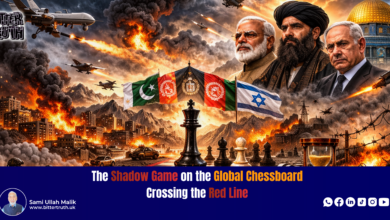
Within this wider context, Putin’s warning assumed a significance that few could ignore. By drawing attention to the concentration of extremist forces in Afghanistan, he effectively cautioned that the country might once again be drawn into the vortex of great-power rivalry. His words sounded, to many listeners, like the distant echo of a familiar phrase in geopolitical history: the advent of a new “Great Game.” It was the kind of contest in which the players change and the pieces are rearranged, yet the underlying objectives remain curiously constant.
Unsurprisingly, these remarks stirred unease in diplomatic circles across the globe. They appeared to suggest that Afghanistan might once again be destined to serve as the arena in which global powers tested their rival ambitions. In such a design, the recalibration of regional geopolitics would become inevitable. Within that framework, weakening Iran while simultaneously exerting pressure upon Pakistan could easily be interpreted as elements of a broader strategic calculation.
Another intriguing turn in this unfolding drama emerged when, amid the mounting pressure upon Iran, the Prime Minister of India, Narendra Modi, arrived in Israel for a high-profile visit. The symbolism of that moment did not escape the attention of seasoned observers. Barely two days before the clouds of crisis gathered over Tehran, Modi received an unusually elaborate welcome in Israel. His address before the Knesset and the series of meetings that accompanied it were not dismissed by certain defence analysts as mere diplomatic formalities.
According to several strategic commentators, the discussions extended well beyond ceremonial courtesies. They reportedly encompassed consultations on the broader security architecture of the region, including potential measures relating to Iran. Modi’s speech in the Israeli parliament generated a subtle yet unmistakable murmur within diplomatic circles—whispers that some defence observers refused to interpret as routine protocol.
Reports in defence journals and intelligence assessments suggested that elements of “operational coordination” were among the matters considered during the visit. Some analysts believe that, within this emerging strategy, Afghanistan was envisioned as a strategic pivot from which additional pressure might be applied upon Iran. In that larger contest, economic interests, the desire to undermine projects such as China–Pakistan Economic Corridor, and the relentless competition for regional influence all appeared woven together into a single and intricate geopolitical design.
Within this unfolding panorama there appeared, to many observers, the faint yet discernible outline of a strategic alignment between the United States, Israel and India—an alignment seemingly designed to consolidate their respective political and military interests across the
region. From this vantage point, the impression emerged that a new axis of cooperation was quietly taking shape among these states, one whose underlying purpose was to strengthen their strategic foothold in an already volatile geopolitical landscape.
According to several analytical circles, a broader strategic conception appeared to be under consideration within this emerging partnership. The idea, it was suggested, involved transforming Afghanistan into a geopolitical pivot—a base from which pressure upon Iran might gradually be intensified. Such a design, if indeed it existed, was believed to intertwine several ambitions: economic advantage, the contest for regional influence, and the weakening of China-backed infrastructure ventures—most notably the China–Pakistan Economic Corridor.
The annals of international politics offer abundant testimony to a familiar pattern. When great powers set their sights upon altering the political order of a state, they rarely begin with overt confrontation. Instead, history reveals a recurring and rather sobering truth: internal turmoil is often cultivated long before external intervention appears upon the stage. Time and again the historical record demonstrates that when powerful nations contemplate what is now commonly termed “regime change,” they seek forces capable of weakening a state from within—forces whose actions can erode institutional stability through internal conflict and bloodshed.
The past few decades alone furnish numerous examples of this method. Across different regions of the world, episodes have unfolded in which local or non-state actors were utilised to destabilise established political structures. The experiences of Libya, Syria and Iraq frequently surface in such discussions, where militant groups—operating amid complex and shifting alliances—played roles that extended far beyond the conventional boundaries of insurgency.
Yet in the case of Iran the strategic equation appeared rather different. At the domestic level there existed no political force capable of matching the formidable authority of the Islamic Revolutionary Guard Corps. Previous attempts to exert pressure through opposition figures such as Maryam Rajavi or Reza Pahlavi had produced little in the way of tangible results. In the absence of a viable internal challenger, external planners—so some analysts argued—may have turned towards a different instrument: seasoned fighters drawn from conflicts beyond Iran’s borders.
Reports consequently began to circulate suggesting that thousands of surviving militants from the battlefields of Syria and Iraq had been relocated to Afghanistan. According to these accounts, such fighters were expected to move towards Iran through routes associated with cities such as Herat and Mashhad. The strategic design, as some reports alleged, was to ignite simultaneous unrest across several Iranian provinces. In such circumstances Iran’s military and security institutions might become preoccupied with internal instability, thereby opening a window through which external actors could influence the country’s political trajectory.
The logic behind such a scenario is not unfamiliar in the study of geopolitics. When a state becomes engulfed in internal disorder, the barriers that ordinarily protect its sovereignty can weaken considerably. In the modern era, the use of advanced communication technologies, covert logistical routes and decentralised guerrilla tactics has frequently formed part of such designs. Indeed, several intelligence-oriented analyses suggested that similar operational concepts might have been contemplated within this broader strategic framework.
Amid these uncertainties, the role of Pakistan emerged in the eyes of many observers as a factor of considerable significance. Had militant networks operating near the frontier remained unchecked, the consequences might have proved far more alarming. At such a delicate juncture Pakistan’s position acquired heightened importance. The country shares a vast and rugged frontier with Afghanistan—stretching across thousands of kilometres of mountainous terrain where infiltration has historically been difficult to prevent.
Following the emergence of these reports, Pakistani security institutions reportedly intensified operations along the border regions. Militant hideouts were targeted, logistical routes disrupted and the movement of suspected fighters increasingly restricted. In this context Pakistan’s armed forces came to be portrayed by some analysts as a barrier that curtailed potential infiltration routes.
Meanwhile, within American political discourse, statements relating to the crisis also surfaced. Among them were the forceful remarks and appeals for public protest in Iran issued by the then President of the United States, Donald Trump. According to several commentators, had preventative measures not been undertaken along the frontier, thousands of militants stationed in Afghanistan might have found their way into both Iranian and Pakistani territory, unleashing a far wider wave of violence. In that sense Pakistan’s actions were viewed by some observers as having prevented the escalation of an already volatile situation.
The catalogue of militant groups active in Afghanistan’s borderlands is itself far from reassuring. Among the organisations frequently cited in security assessments is Islamic State – Khorasan Province, alongside other militant factions reportedly present in provinces such as Jowzjan Province, Nangarhar Province, Kunar Province and Khost Province. Certain reports have also claimed that groups linked to operations in Iran’s province of Sistan and Baluchestan Province had been provided safe havens in parts of Afghanistan. The objectives attributed to such networks extended beyond Iran alone; destabilisation in sensitive regions of Pakistan was also believed to form part of their agenda.
Under such circumstances, the issue was not merely one of assisting a neighbouring state. For Pakistan, it also involved the defence of its own internal security. Consequently, enhanced border surveillance, intelligence cooperation and targeted military operations were undertaken in an effort to contain the emerging threat.
At the same time another potential front of concern entered strategic discussions: the possible movement of armed Kurdish factions. Some reports suggested that attempts to facilitate the infiltration of such fighters into Iran from border areas adjoining Turkey and Iraq had been thwarted through regional cooperation. In this regard, the measures adopted by Pakistan and Turkey were viewed by certain analysts as efforts aimed at preserving regional stability.
Taken together, this complex chain of developments revealed a stark and unsettling reality. The presence of numerous non-state armed groups in Afghanistan had effectively created a reservoir of latent instability—an explosive store of forces which, if ignited, possessed the capacity to engulf the entire region in flames at a moment’s notice.
If this entire episode is examined from a wider vantage point, a sobering conclusion begins to emerge: both the Middle East and South Asia appear to be passing through an exceptionally delicate moment in their modern history. In such circumstances, the consequences of a single event rarely remain confined within the borders of one state. Rather, they possess the unsettling capacity to radiate outward, drawing an entire region into their gravitational pull. A seemingly minor incident, under such conditions, may become the prelude to a far larger conflagration.
Indeed, several analysts have suggested that had militant networks operating within Afghanistan succeeded in penetrating the territory of Iran, the resulting turmoil might well have escalated into a broader regional conflict—one in which global powers themselves could have found cause, or pretext, to intervene.
Against this perilous backdrop, it may reasonably be argued that the firm measures undertaken by Pakistan against cross-border militancy, combined with various forms of regional cooperation, contributed to preventing the expansion of a crisis that might otherwise have spiralled into a far wider war. In this light, certain observers have come to regard Pakistan as a stabilising pillar within the region—one whose actions were directed not merely towards the defence of its own territory but also towards preserving the fragile peace of neighbouring states.
To some commentators, this moment represented something more profound. It was, they suggest, a juncture at which Pakistan defended not only its own frontiers but, in a broader sense, the tranquillity of an entire region.
Viewed through the longer lens of history, such moments are comparatively rare. Only occasionally does the decision of a single state possess the capacity to influence the future trajectory of an entire geopolitical theatre. Had circumstances unfolded even slightly differently, it is conceivable that the Middle East might have been drawn into a conflict whose repercussions would have echoed far beyond the region itself, reverberating throughout the wider structure of international politics.
Within this context, Pakistan’s actions have been interpreted in some quarters as a significant effort to preserve regional equilibrium.
When the entire episode is considered from a still broader perspective, a deeper conclusion presents itself. Both the Middle East and South Asia appear to stand at a historical crossroads where even the smallest gesture may carry consequences of global magnitude. The political landscape of these regions now resembles a complex intersection where power, strategic interests and competing ideological visions converge in intricate and often unpredictable ways.
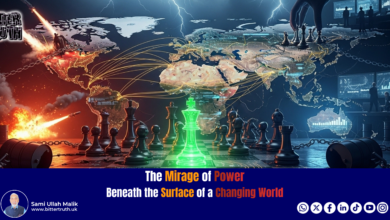
If the crisis were to be distilled into a single metaphor, one might say that the board of global politics is crowded with pieces—yet the decisive advantage belongs not to the player who merely possesses the most pieces, but to the one who advances them with patience, foresight and measured judgement.
Recent developments, some observers argue, have at least created the impression that regional cooperation played a meaningful role in averting a potentially grave crisis. Should this interpretation prove accurate, the outcome represents more than a diplomatic success. It may instead constitute a turning point in the preservation of regional peace.
Several analysts maintain that Pakistan’s determined actions against cross-border militancy helped prevent a volatile situation from evolving into a full-scale regional war. In that sense, it may be said that within the intricate chessboard of contemporary geopolitics Pakistan assumed, at least in this particular moment, a role that helped restrain the drift toward a far more destructive confrontation.Such are the moments when history quietly records its judgement—moments whose full significance may only be understood by future generations.
The lesson conveyed by this chapter of events is both simple and profound: within the complex arena of international politics, the timely and prudent decision of a single state can sometimes alter the destiny of an entire region. Had circumstances unfolded differently, the Middle East might easily have descended into a conflict whose repercussions would have extended across the globe.
In this perspective, the actions undertaken by Pakistan are viewed by some observers as forming a protective barrier that helped contain what might otherwise have grown into a far larger crisis.
Ultimately, this episode serves as a reminder that in the labyrinthine world of global politics, power alone does not determine the outcome of events. Wisdom, restraint and timely judgement often prove equally decisive. Had certain states not acted with foresight at that critical juncture, the crisis might well have transformed into a far more devastating war.
History, after all, occasionally requires only a single resolute and far-sighted decision to alter the course of its own relentless current.