Celestial Friendship, Terrestrial Rivalry
When Iqbal’s Dream Took Flight

Pakistan’s Historic Journey into Space, the New Age of Space Diplomacy, Delhi’s Strategic Anxieties and the Fulfilment of Iqbal’s Vision
From Dream to Destiny: A Journey Beyond the Stars
Last night, a cherished aspiration of many years found its fulfilment. In a dream, I was granted the singular privilege of beholding the illustrious philosopher-poet, Allama Muhammad Iqbal. It was a scene of extraordinary spiritual beauty. With my hand clasped around his finger, I soared through the boundless immensities of space, untroubled by fear and untouched by apprehension. Neither the dizzying heights nor the mysteries of uncharted worlds inspired any dread. There was only a profound tranquillity of the soul and the inexhaustible exhilaration of discovery.
What lent this dream its deepest significance was that my celestial journey had begun in the very hall of the Tameer-i-Nau Trust where, last year, an international conference devoted to Iqbal’s thought and teachings had been convened. Within this sanctuary of learning, thousands of young boys and girls continue to labour with quiet determination, drawing inspiration from Iqbal’s philosophy as they strive to fashion a brighter future for themselves and their beloved homeland.
Yet amid this sense of spiritual exaltation, there remained a poignant disquiet. For reasons that defy comprehension, the corridors of officialdom appear to have turned a blind eye to this noble intellectual, educational and national endeavour. And yet it is precisely through the illumination of such lamps of learning that the Pakistan of Iqbal’s dreams might one day emerge from aspiration into reality.
When I awoke, the enchantment of that nocturnal vision had scarcely receded. On the one hand lingered the image of my own flight through the heavens, holding Iqbal’s finger; on the other stood the historic achievement of Pakistan’s astronaut, Muhammad Zeeshan Ali, in humanity’s continuing exploration of space. It seemed as though Iqbal’s timeless summons to intellectual adventure had thrown a bridge across the seemingly impenetrable divide between dream and reality.
ستاروں سے آگے جہاں اور بھی ہیں
ابھی عشق کے امتحاں اور بھی ہیں
Beyond the stars lie worlds as yet unexplored;
Love’s trials are not exhausted — there are still more to endure.
It was this dream, this stirring of the heart, and this confluence of intellectual reflection and spiritual awakening that furnished the inspiration for the essay that follows.
There are moments in the history of nations which are destined not merely to occupy a place in the calendar of human achievement, but to determine the intellectual temper of an age, the course of political affairs and the collective destiny of generations yet unborn. An event of seemingly modest proportions may contain within itself the aspirations of centuries, the unfulfilled ambitions of generations and the promise of worlds still awaiting discovery. When the historian, from the vantage point of posterity, surveys the landscape of the past, it is often in such extraordinary moments that he discerns the beginnings of a new epoch.
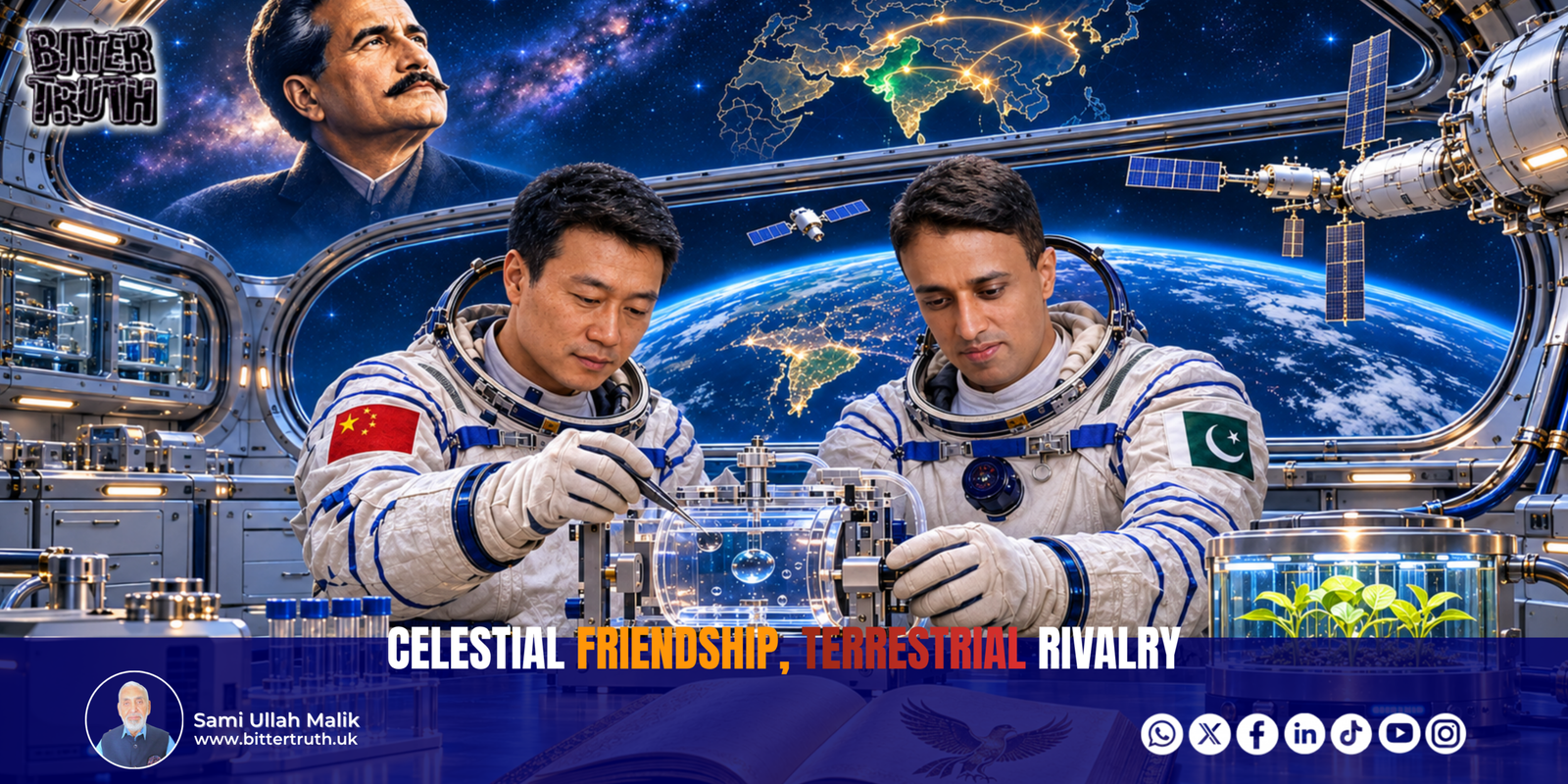
The arrival of Pakistan’s first astronaut, Muhammad Zeeshan Ali, aboard China’s Shenzhou 24 mission at the Tiangong Space Station constitutes one such luminous chapter in history. Its significance transcends the boundaries of scientific accomplishment. It embodies the aspirations of a nation, the mutual confidence of two sovereign states, the changing architecture of international relations and the emergence of a new diplomacy founded upon scientific knowledge and technological endeavour.
The friendship between Pakistan and China, traditionally described as higher than the Himalayas, deeper than the oceans and sweeter than honey, has now attained a dimension for which terrestrial metaphors scarcely suffice. A relationship conceived within the geographical confines of Earth has extended into the boundless dominion of the heavens.
Yet perhaps the most moving episode of this historic enterprise occurred when a Pakistani astronaut, hundreds of kilometres above the Earth, within a Chinese space station, gave expression to his national identity and intellectual inheritance through the immortal verse of Allama Muhammad Iqbal:
ستاروں سے آگے جہاں اور بھی ہیں
ابھی عشق کے امتحاں اور بھی ہیں
Beyond the stars lie worlds yet unexplored;
And love has trials still greater than before.
It was as though Iqbal’s metaphorical falcon, once the embodiment of intellectual emancipation and spiritual ascent, had emerged from the realm of poetic imagination to enter the domain of scientific achievement.
Iqbal’s Call to Discovery Resounds in Tiangong
During a brief ceremony held aboard the space station on Wednesday, the three astronauts of the Shenzhou 24 mission spoke in turn of their experiences and aspirations. Muhammad Zeeshan Ali expressed his profound happiness at becoming the first Pakistani astronaut to enter space and to arrive at the Chinese orbital station.
The occasion acquired a remarkable cultural and philosophical resonance when, having recited Iqbal’s verse in Urdu, he rendered its meaning into Chinese for the benefit of his fellow astronauts, whose appreciative response lent the moment an unmistakable warmth.
This was no mere recitation of poetry. It was the introduction of a civilisation, the articulation of a
national consciousness and the expression of a philosophy of existence.
To Iqbal, the universe was never an inert spectacle suspended before the human eye. It was an ocean of inexhaustible possibilities, whose exploration constituted one of the noblest manifestations of human intellect.
وَيَتَفَكَّرُونَ فِي خَلْقِ السَّمَاوَاتِ وَالْأَرْضِ
The Holy Qur’an, too, summons mankind to contemplate the mysteries of creation:
“And they reflect upon the creation of the heavens and the earth.”
— Qur’an, 3:191
Iqbal’s philosophy of Khudi — the awakening and cultivation of the self — represents a profound intellectual expression of this Qur’anic invitation to contemplation. Human greatness, in his conception, resides not merely in existence, but in ceaseless endeavour, creative energy and the capacity to comprehend the laws of nature.
By reciting Iqbal in the celestial solitude of a space station, Muhammad Zeeshan Ali reminded his countrymen that their intellectual inheritance already contains the summons to transcend limitations. What remains is to translate that inheritance into the enduring disciplines of knowledge, research and action.
Six Decades of Friendship Beneath a New Firmament
The history of international relations bears abundant testimony to the ease with which friendships between nations are proclaimed and the difficulty with which they are preserved.
The vicissitudes of political fortune, the redistribution of power and the imperatives of national interest have frequently consigned even long-established alliances to the graveyard of diplomatic expediency.
It is against this historical background that the extension of Pakistan–China relations into the realm of space exploration assume particular significance.
Chinese media have characterised the Pakistani astronaut’s journey as the culmination of six decades of unbroken friendship. Shenzhou 24, in this interpretation, carried not merely three astronauts into orbit, but also the accumulated legacy of confidence and cooperation cultivated between two nations over successive generations.
Anshuman Narang, a retired Indian brigadier and specialist in Chinese affairs, has likewise drawn attention to this development. He observed that Pakistan and China had long described their partnership in almost poetic terms, but that their cooperation was now ascending beyond the Earth itself.
The observation is noteworthy precisely because it emanates not from Pakistani or Chinese celebratory circles, but from an Indian commentator on strategic affairs.
Space exploration belongs to that select category of modern enterprises in which scientific
proficiency intersects with national security, sovereign priorities and advanced technological
capability.
Pakistan’s participation in such an undertaking therefore constitutes an important manifestation of mutual confidence, although it would be imprudent to interpret this cooperation as conferring unrestricted access to the entirety of China’s sensitive technological capabilities.
A New Debate in the Corridors of Delhi
The historic journey of the Pakistani astronaut has provoked considerable discussion within India’s media, political establishment and strategic community. Prominent newspapers, television channels and digital publications have devoted considerable attention to its implications.
The Indian broadcaster NDTV described the development as a major diplomatic signal. Whilst acknowledging that Pakistan had not established an independent programme capable of launching human beings into space, it nevertheless recognised the historical significance of the Shenzhou 24 mission for Pakistan.
In its assessment, the arrival of a Pakistani astronaut at the Tiangong Space Station represented considerably more than a scientific expedition. It constituted a political statement, a diplomatic signal and a conspicuous demonstration of the strategic partnership between Beijing and Islamabad.
Within this assessment lies a truth of considerable consequence.
Contemporary diplomacy is no longer confined to embassies, ceremonial declarations and conferences between heads of government. Scientific collaboration, technological assistance, joint research and the development of human expertise have become instruments through which nations cultivate influence and establish durable relationships.
Where once the strength of an alliance was measured by the solemnity of its treaties, it may increasingly be measured by the sophistication of its shared scientific endeavours.
Indian media reactions, however, have not been uniform.
The right-leaning television channel Times Now adopted a more derisive tone, describing the Pakistani astronaut as having reached space upon China’s back. It further contrasted the approximately six-month residence of Chinese astronauts aboard the station with the Pakistani astronaut’s anticipated stay of merely one week.
Yet the history of scientific endeavour teaches that the significance of a pioneering achievement cannot invariably be measured by its duration.
A single week of practical research, properly assimilated into a nation’s scientific institutions, may furnish the foundations of progress extending across several decades.
Pakistan must nevertheless remain conscious of the distinction between an achievement made possible through the assistance of a friendly power and the attainment of independent technological capability. Between the two lies a considerable distance, traversable only through learning, perseverance and sustained investment.
Institutional Uncertainty and India’s Gaganyaan Programme
The Indian debate surrounding Pakistan–China space cooperation has emerged at a time when the Indian Space Research Organisation, ISRO, is itself confronting questions of institutional and administrative uncertainty.
According to the original report, scientists and employees associated with ISRO have sought formal written clarification from the organisation’s leadership concerning the possibility of privatisation, the transfer of rocket manufacturing and associated operations to private enterprises, and the implications of such developments for their professional futures.
These concerns possess particular significance for those Indian circles which regard their country’s space capabilities as indispensable to national prestige and international influence.
Several Indian commentators have consequently advocated accelerating the Gaganyaan human spaceflight programme, strengthening ISRO and expanding international scientific partnerships.
Such appeals suggest that the Pakistani astronaut’s journey is regarded in certain Indian quarters not simply as a neighbouring country’s scientific accomplishment, but as an occasion for reconsidering India’s own national priorities.
It would, however, be premature to equate administrative uncertainty within ISRO with a decline in its scientific competence. Serious political and historical judgement requires a proper distinction between temporary institutional difficulties and enduring national capabilities.
The Five Strategic Dimensions of Space Cooperation
Within the Indian debate, five principal dimensions of the developing Pakistan–China space partnership have emerged. Together, they provide a framework through which the scientific, political and strategic future of South Asia may be considered.
First, China is extending its longstanding strategic partnership with Pakistan into the sphere of advanced space technology, thereby introducing a new scientific and technological dimension into bilateral relations.
Secondly, Pakistan is acquiring opportunities to benefit from Chinese expertise in space systems, astronaut training and practical scientific research. Such experience may prove invaluable in preparing future generations of Pakistani astronauts and scientists.
Thirdly, the dual-purpose character of space technology cannot be disregarded. Satellite-based navigation, communications and reconnaissance possess applications in both civilian development and national defence.
Fourthly, China appears increasingly disposed to employ space diplomacy as an instrument for extending its international influence and cultivating scientific partnerships.
Fifthly, the development has strengthened arguments within India for accelerating its own space programme, reinforcing ISRO and broadening international cooperation.
These considerations illuminate a defining characteristic of the twenty-first century: outer space is no longer solely the province of scientists and their instruments. It has become a consequential arena of international politics, economic competition, national security and diplomatic intercourse.
Satellites and the Architecture of Strategic Anxiety
The Indian publication ThePrint introduced a further dimension to the debate by alleging that China and Pakistan were developing an interconnected satellite network capable of maintaining persistent surveillance over Indian territory.
Citing research attributed to Digantara, a company specialising in monitoring the movement of satellites, the publication claimed that Chinese and Pakistani satellites were engaged in what it characterised as a continuous, twenty-four-hour watch over India.
Intellectual honesty demands that these assertions be treated as claims attributed to the institutions concerned, rather than as independently established facts.
Nevertheless, the controversy illustrates the profound transformation which space technology has wrought upon traditional conceptions of national security. The interests of terrestrial states are increasingly dependent upon communications and observational systems situated far beyond their geographical frontiers.
Yet the utility of satellites extends considerably beyond military considerations.
Disaster preparedness, agricultural planning, the study of climate change, the management of water resources and urban development are amongst the numerous fields capable of benefiting from space-based technology.
For Pakistan, the wiser course would be to transform space research into an instrument of comprehensive national development, rather than regarding it exclusively through the narrow prism of regional rivalry.
The Indian Opposition and the Changing International Chessboard
Pawan Khera, spokesperson for India’s opposition Congress Party, has also drawn attention to the significance of Pakistan’s participation in the Chinese space programme.
In his assessment, China has traditionally exercised considerable caution in sharing its advanced technological capabilities with foreign countries. The inclusion of a Pakistani astronaut therefore represents, in his view, a notable departure from established Chinese practice.
He further observed that Pakistan participates in a project associated with the Asia-Pacific Space Cooperation Organisation, under which observational stations have been established in Pakistan, Iran and Peru.
These developments, he argued, warranted the immediate attention of the Indian government.
An Indian journalist, commenting upon the partnership within a broader international context, also referred to what he regarded as Washington’s comparatively conciliatory disposition towards China and its continued engagement with Pakistan.
Under such circumstances, he contended, India could scarcely afford to avert its gaze from the deepening scientific and technological relationship between Islamabad and Beijing.
These observations remain the political assessments of their respective authors. They nevertheless demonstrate that the Pakistani astronaut’s journey is being examined within the wider context of evolving relations amongst the principal powers of the international system.
From ICUBE-Q to Human Spaceflight
Muhammad Zeeshan Ali’s journey into space ought not to be regarded as an isolated triumph which appeared suddenly upon the horizon. It represents a further stage in a gradually developing history of scientific cooperation between Pakistan and China.
Professor Dr Khurram Khurshid, a member of the team responsible for the ICUBE-Q project at Pakistan’s Institute of Space Technology, has explained that Pakistan has, in recent years, collaborated with China in satellite design and launch operations.
In 2024, with the assistance of China’s Chang’e 6 lunar mission, Pakistan dispatched its ICUBE-Q satellite towards lunar orbit. According to the original report, this achievement made Pakistan the sixth country to place a satellite in orbit around the Moon.
The importance of the undertaking resided not merely in the dispatch of a scientific instrument into lunar orbit, but also in the curiosity and enthusiasm which it generated amongst Pakistan’s younger generation.
Speaking to BBC Urdu, Professor Khurshid described space as the final frontier of human curiosity.
The dispatch of a Pakistani astronaut and the conduct of scientific experiments in space, he explained, formed part of Pakistan’s long-term space programme, whose purpose was to establish an enduring national presence in this field.
In his estimation, Muhammad Zeeshan Ali’s anticipated week aboard the space station would yield invaluable experience. Upon returning to Pakistan, the astronaut would be able to transmit the knowledge thus acquired to other prospective Pakistani astronauts, thereby contributing to future training and scientific research.
The original report also refers to plans for a Pakistani lunar vehicle to land upon the Moon in the following year.
Should that undertaking proceed in accordance with its stated objectives, it would constitute another substantial milestone in Pakistan’s developing history of space exploration.
Four Days of Conflict and the Imperative of Scientific Sovereignty
According to Professor Khurram Khurshid, the four-day confrontation between Pakistan and India in the preceding year prompted the Pakistani government to increase financial allocations for space research.
In his judgement, contemporary political circumstances render progress in space technology, artificial intelligence and semiconductor chip design increasingly important to the preservation of national integrity and sovereignty.
This assessment points towards a fundamental reality of the modern age.
National sovereignty can no longer be understood exclusively as the defence of geographical frontiers. It is intimately connected with intellectual independence, freedom of communication, technological competence and command over the instruments through which information is acquired and disseminated.
Nations which remain perpetually dependent upon the intellectual production of others may discover that their political and economic independence is likewise constrained by various forms of technological dependence.
Pakistan must therefore ensure that increased investment in space research does not remain a transitory response to regional hostilities but becomes an enduring principle of national policy.
Its universities, research establishments and industrial institutions must cultivate a sufficiently coherent relationship to enable the country to advance, gradually but purposefully, towards technological self-reliance.
For sovereignty proclaimed in political rhetoric is one thing; sovereignty sustained by intellectual and scientific capacity is quite another.
China’s Space Diplomacy and Ninety Scientific Endeavours
An equally significant dimension of this historic development concerns China’s own ambitions.
According to the Chinese state-affiliated newspaper Global Times, Beijing intends to undertake further missions involving astronauts from other countries.
The instructional materials developed for Pakistani astronauts are reportedly to be employed in the future training of astronauts from additional nations.
Pakistan’s participation thus acquires significance as an early model within China’s developing framework for international human spaceflight cooperation.
China Central Television, the country’s state broadcaster, has reported that the Shenzhou 24 mission incorporates joint scientific experiments, alongside the installation of experimental specimens and research equipment.
Approximately ninety scientific experiments and research projects are expected to be conducted during the mission as a whole.
These encompass space biology, advanced materials research, the behaviour of matter under conditions of microgravity, fundamental physics, space medicine and emerging space technologies. It is important to distinguish the collective scientific programme of the Chinese mission from the individual responsibilities of the Pakistani astronaut. The entire complement of ninety experiments should not be attributed exclusively to his participation.
For China, such undertakings provide both an avenue for scientific advancement and an opportunity to demonstrate its intellectual capabilities and diplomatic reach upon the international stage. For Pakistan, the greater opportunity lies in converting the scientific fruits of this cooperation into an enduring national inheritance.
Iqbal’s Falcon and the Awakening of a Generation
Perhaps the most enduring consequence of Muhammad Zeeshan Ali’s journey will be the impression it leaves upon the imagination of Pakistan’s younger generation.
The destiny of a nation begins to change when the dreams of its children begin to change; when their aspirations escape the confinement of inherited limitations; when laboratories become objects of fascination; and when books cease to be mere instruments for passing examinations and become keys to the mysteries of existence.
Somewhere in a remote Pakistani village, a young student may witness a compatriot reciting Iqbal aboard a space station and find himself confronted by a profoundly simple question:
If one Pakistani can reach such heights, why should I not aspire to do likewise?
That question may contain within itself the beginnings of an intellectual revolution.
Yet it would constitute a lamentable failure of collective responsibility were such enthusiasm to be dissipated in patriotic slogans, congratulatory declarations and ceremonies whose significance expires with the passing of a few days.
Genuine service to the nation demands that its young people be furnished with modern laboratories, education of the highest attainable quality, opportunities for original research and the freedom to exercise their creative faculties.
Iqbal expressed his confidence in the latent possibilities of his people with singular eloquence:
Iqbal despairs not of his barren field;
Let but a little moisture fall, and this soil shall yield abundant harvests.
It is not sufficient merely to proclaim the fertility of Pakistan’s soil. That soil must be nourished by the life-giving waters of knowledge, intellectual enquiry and scientific endeavour.
Beyond the Stars: Not a Destination, but a Beginning
Muhammad Zeeshan Ali’s arrival at the Tiangong Space Station represents an occasion of legitimate national pride, a manifestation of the expanding dimensions of Pakistan–China friendship and a significant advance towards a future rich in scientific possibilities.
History, however, offers a lesson which nations disregard at their peril.
Nations do not become great merely because great events occur within their history. They attain greatness when they possess the wisdom, discipline and perseverance to convert extraordinary opportunities into enduring national achievements.
China has opened an important gateway of scientific cooperation for Pakistan. The responsibility for passing through that gateway, strengthening its intellectual foundations and erecting the edifice of technological self-reliance belongs to Pakistan itself.
The true measure of this accomplishment will lie in the number of young Pakistanis who enter the realms of scientific research in the years ahead; in the laboratories which are established; in the satellites conceived and developed through indigenous expertise; and, ultimately, in the country’s ability to lay the foundations of an independent and sustainable human spaceflight programme.
Pakistan is entitled to celebrate this achievement. But celebration must be accompanied by a heightened consciousness of responsibility.
If celebration fails to mature into resolution, if enthusiasm refuses the discipline of action, and if dreams remain untouched by the refining furnace of scientific enquiry, even the most remarkable achievement will gradually recede into the distant landscape of national memory.
Today, Muhammad Zeeshan Ali has recited Iqbal amongst the stars.
Tomorrow, Pakistan’s younger generation must furnish the living interpretation of that poetry through the distinction of its intellectual and practical achievements.
The friendship between Pakistan and China has transcended the frontiers of Earth and entered the immensity of space. Pakistan’s journey towards intellectual and technological sovereignty, however, remains unfinished.
In the immortal words of Iqbal:
قناعت نہ کر عالمِ رنگ و بو پر
چمن اور بھی، آشیاں اور بھی ہیں
Be not content with this world of colour and fragrance;
There are other gardens still, and other dwelling places.
Today, one Pakistani has ventured towards the stars. The greater task now confronting the nation is to liberate itself from the encircling walls of ignorance, intellectual stagnation and scientific backwardness, and to advance with purpose towards those unexplored horizons.
For reaching the stars is not the ultimate destiny of a nation.
Its true greatness resides in its capacity, through knowledge, character and the sovereign power of human endeavour, to create new worlds of possibility for generations yet to come.
From the Soil of Balochistan to the Stars — Iqbal’s Dream Unfolding
Today, as the verses of Allama Muhammad Iqbal, the Sage of the Ummah, resonated across the vast expanse of space through the voice of one of his cherished falcons, my heart filled with profound admiration and reverence for Mr Fazal Haq Mir, the founder of Tameer-i-Nau Trust, Quetta, and its visionary elders, who, last year, brought together distinguished Iqbal scholars from several nations on the soil of Balochistan, embarking upon a noble journey towards transforming the aspirations of the Muslim Ummah into living realities.
From the depths of my heart, I extend my warmest congratulations and sincerest tribute to these men of vision, who have conveyed an inspiring message to the nations of the world: that Iqbal’s philosophy is not confined to books, speeches or commemorative gatherings. Rather, the journey towards the fulfilment of his dream has begun on the soil of Balochistan, reaching towards the stars, and is now flourishing in its fertile land through knowledge, selfhood (Khudi), character and purposeful action.
I salute these architects of the nation who, in the nurturing embrace of Balochistan, are raising Iqbal’s falcons — whose destiny lies not merely in the heavens, but in the worlds beyond the stars.
May Almighty Allah make their magnificent intellectual and educational endeavours a harbinger of the renaissance of the Muslim Ummah.
Ameen!