The Price of Proximity
A Contract for Praise?

When friendship between nations becomes dependent upon commercial arrangements, when professional intermediaries stand sentinel along the corridors of diplomacy, and when the personal intimacy of rulers becomes entangled in questions concerning payments from the public purse, the matter ceases to be one of a few telephone conversations. It becomes, instead, a searching examination of political morality, diplomatic independence and the dignity of nations.
The annals of political history abound in curious and instructive episodes. There have been kings whose ambassadors altered the destinies of empires, courtiers whose influence brought sovereigns into one another’s confidence, and royal households in which access to power itself became a commodity, purchasable with gold and precious stones. Although elected governments have largely succeeded crowns and thrones, proximity to authority, political influence and admission to the chambers of decision-making remain possessions of considerable value. The essential difference is that the courtiers of antiquity have yielded their places to lobbying firms, political advisers and professional practitioners of public relations.
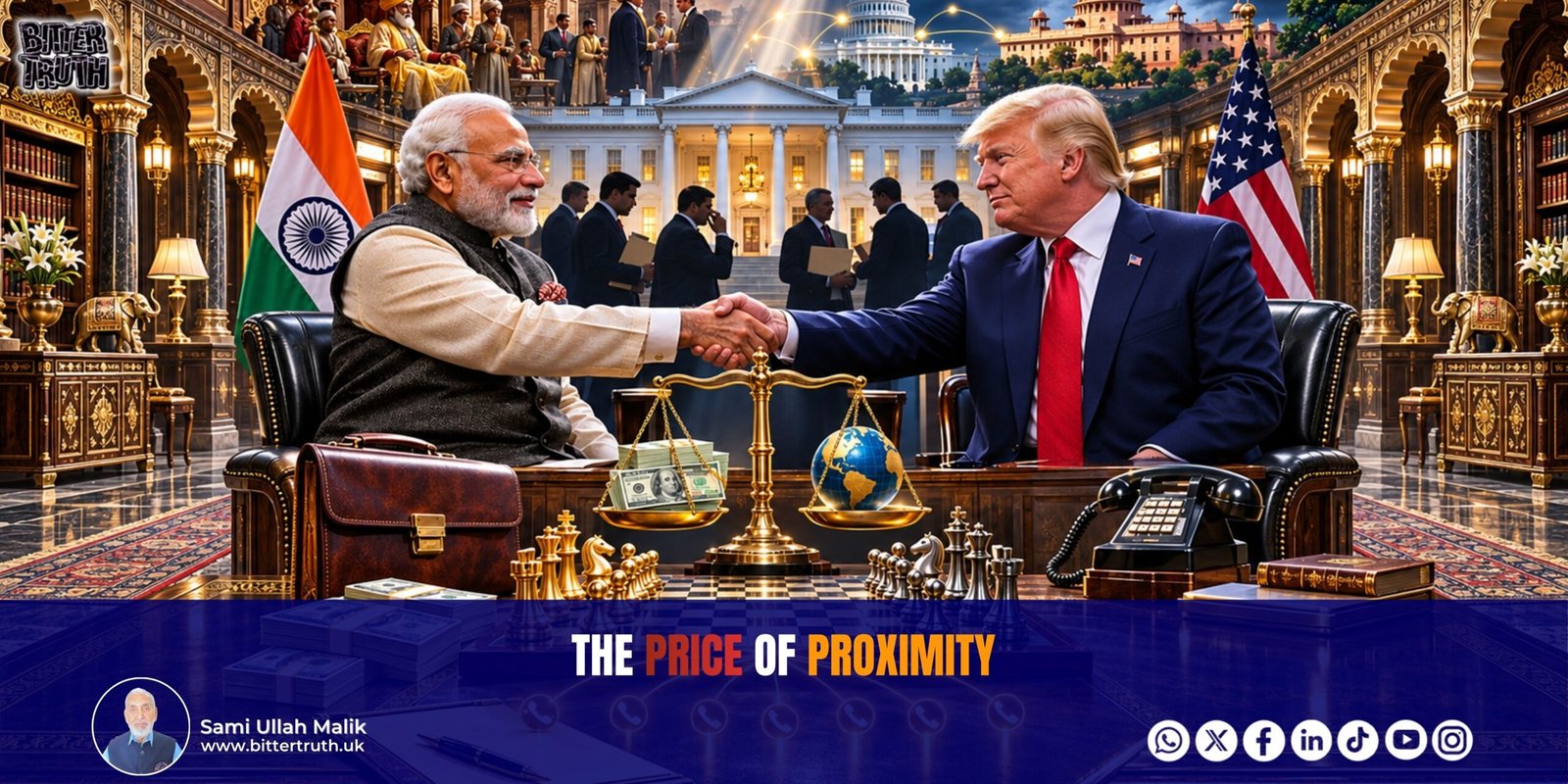
It is against this historical background that disclosures concerning Indian Prime Minister Narendra Modi, United States President Donald Trump and professional lobbying firms in Washington have raised questions whose reverberations extend far beyond the political thoroughfares of New Delhi. They reach into the very principles of diplomacy and the obligations of democratic accountability.
The question appears simple, yet its implications are profound: did the Indian government engage, at considerable expense, the services of firms whose principals enjoyed connections with President Trump’s political circle, in order to secure access to the centres of American power, cultivate political relationships and advance India’s diplomatic interests? And is there sufficient factual foundation for associating those professional arrangements with the American President’s public expressions of admiration for Prime Minister Modi, or is such an association merely a political allegation?
Answers to these questions must be sought not amid the clamour of political passions, but through a careful examination of documents, historical precedents, official explanations and competing political statements.
Diplomacy, in the conduct of international affairs, has never been confined exclusively to foreign ministries and the formal observances of diplomatic protocol. States have long employed institutions and individuals possessing influence within the governmental, parliamentary and public spheres of other countries to advance their political, economic and strategic interests.
In the United States, such activities are subject to a legal and administrative framework, of which the Foreign Agents Registration Act (FARA) is an important component. Under specified circumstances, individuals and organisations representing foreign interests are required to register their activities, contractual arrangements and associated information. The fundamental purpose of this framework is to introduce transparency into the representation of foreign interests.
Yet a distinction of considerable importance must be preserved. The engagement of an American lobbying firm by a foreign government is not, in itself, an unlawful undertaking. Nor does the establishment of political contacts through such a firm necessarily constitute evidence of corruption.
The difficulty arises when the relationship between professional representation and governmental decision-making becomes insufficiently clear.
Is a lobbying firm merely explaining a foreign government’s position to members of the legislature? Is it presenting that government’s arguments through the media? Or does its remit extend to arranging direct communication with senior officials within the presidential administration?
It is precisely this distinction that has brought the relationship between the Indian government and American lobbying companies into the arena of political controversy.
According to a statement by India’s Ministry of External Affairs, the Indian Embassy in Washington has employed the services of American lobbying firms since 1948. This historical reference is significant, for it places the present controversy within the context of an established diplomatic practice.
Relations between modern states are not conducted solely through ceremonial receptions, official meetings and joint declarations. Behind the visible architecture of diplomacy lies a continuing process of political consultation, institutional engagement and efforts to cultivate opinion favourable to national interests.
Yet the longevity of a practice does not confer immunity from scrutiny upon every new manifestation of it.
If an embassy has relied upon professional representation for several decades, that circumstance certainly demonstrates that lobbying is no recent innovation. It does not, however, establish that the character of every agreement, the purpose of every payment or the method of every political approach has remained unchanged.
The present disagreement therefore concerns less the mere existence of lobbying firms than the precise nature of the services they were engaged to provide.
Citing a report published in The Indian Express, the account under examination states that the Indian government entered into an agreement with the American firm SHW Partners LLC in April 2025. According to that report, the agreement was subsequently extended for a further year. The firm was headed by Jason Miller, described as a figure associated with Donald Trump’s close political circle.
Referring to documents filed under the American Foreign Agents Registration Act, the report asserted that the company played a part in arranging eight telephone contacts between the Indian government and senior White House officials during May and June.
These eight communications constitute one of the most consequential elements of the entire affair. The contacts were reportedly classified in the relevant filings as political activities, while their principal subject was identified as bilateral relations between the United States and India.
Here, two propositions must be carefully distinguished. The first is that, according to the report, a lobbying firm assisted in facilitating communications at senior governmental level. The second is the assertion that the purpose of those arrangements was necessarily to obtain expressions of personal admiration for a particular political leader.
The existence of the former cannot, without further evidence, be treated as proof of the latter. According to the details presented in the account, a number of telephone contacts between senior officials of the two governments were arranged ahead of a visit to India by the American Secretary of State, Marco Rubio.
Among the American officials mentioned in the report were Treasury Secretary Scott Bessent, Deputy National Security Adviser Michael Needham, and senior official Jane Lang, associated with matters concerning counter-terrorism and financial intelligence.
The significance of these names lies in the character of the institutions and responsibilities involved. The contacts described were not presented merely as exercises in general public relations. They concerned individuals connected with important administrative and policy-making circles within the American government.
The Treasury, national security establishment and financial intelligence apparatus occupy positions of particular consequence in the formulation and execution of state policy.
The report further stated that additional high-level contacts took place following Marco Rubio’s visit in June.
Such details make a careful examination of the original documentation indispensable. The nature of the communications, their stated objectives, the authority under which they were arranged and the formal responsibilities of the institutions concerned must each be considered on their own merits.
Another noteworthy aspect of the affair concerns a change in Jason Miller’s professional position. According to the account, the Indian government’s agreement with SHW Partners came to an end on 23 June, when Miller became associated with the Trump administration in the capacity of a special government employee.
This development draws attention to the delicate boundary separating private political influence from public responsibility.
When individuals engaged in political consultancy, governmental access and professional representation assume official positions, the need for transparent rules and effective safeguards against potential conflicts of interest becomes especially pronounced.
The change in Miller’s status therefore raises a question extending well beyond the circumstances of a single contract: how clearly, and how effectively, should modern political systems maintain the boundaries between private advisory enterprises and the institutions entrusted with the exercise of public power?
Among all the figures associated with this controversy, none has attracted greater political attention than the sum of $75,000 a month.
According to the account, following Donald Trump’s re-election to the presidency, the Indian Embassy in Washington engaged two prominent lobbying firms.
One was Mercury Public Affairs, reportedly retained at a monthly fee of $75,000. Among the principal members of the firm’s team was Brian Lanza, who had previously served as communications director on Trump’s presidential transition team.
This detail indicates that the Indian Embassy had entered into a professional arrangement with individuals whose experience included previous connections to the American President’s political environment.
From the standpoint of diplomatic strategy, such a choice may possess considerable practical significance. Access to influential circles in Washington has long been regarded by foreign governments as an asset of substantial value.
Yet it is precisely at this juncture that questions of financial transparency and political ethics begin to arise.
What specific services were to be provided in return for the monthly payment of $75,000? What activities fell within the contractual remit? How far did the firm’s responsibilities extend into media-related work? And was there any direct connection between these payments and particular expressions of political praise or social-media statements?
These are questions that cannot be settled by political assertion alone.
In the theatre of international politics, personal cordiality between leaders is frequently presented as evidence of friendship between nations.
When two heads of government describe one another as friends, trusted partners or indispensable allies, their words serve a purpose extending beyond the expression of personal sentiment. They also contribute to the public construction of political confidence.
The impression of friendship between Narendra Modi and Donald Trump has likewise occupied a conspicuous place in political discourse.
The recent lobbying controversy, however, has placed that impression beneath a rather different light.
India’s opposition parties have alleged that American lobbying companies, and the funds expended upon their services, played a part in securing or encouraging Trump’s complimentary statements and social-media posts concerning Modi.
The allegation is politically serious, for it suggests that the public appearance of personal friendship may have been created, cultivated or reinforced through financial arrangements.
According to the account, the Indian National Congress adopted a sharply critical position towards Prime Minister Modi on the social-media platform X.
Congress alleged that Modi had effectively paid to secure favourable posts from Trump and that payments of $75,000 a month to Mercury Public Affairs were connected with that purpose. This is an allegation of unusual political gravity.
It brings together three questions of fundamental importance: the expenditure of public resources, the promotion of an individual political leader, and the character of a government’s relationship with a foreign centre of power.
Within a democratic order, the national treasury is not the personal estate of those who govern. It is a collective trust, held on behalf of the people.
To question the use of public money is therefore not an act of political impertinence; it is part of the legitimate responsibility of parliamentary opposition.
Yet that responsibility carries a corresponding obligation: the distinction between accusation and proof must remain inviolate.
If a government employs lobbying firms for lawful diplomatic purposes, further evidence is required before the expenditure may properly be characterised as the purchase of personal political publicity.
Equally, it is insufficient for a government merely to observe that lobbying is a customary practice. Where particular questions have been raised concerning particular contracts and payments, particular explanations are required.
The controversy thus becomes a test of two things at once: governmental accountability and the intellectual discipline of political criticism.
Mahua Moitra, a Member of Parliament representing the Trinamool Congress, also expressed a critical view of the matter.
According to the account, she argued that when Donald Trump speaks favourably of Narendra Modi, the explanation lies in the fact that Indian taxpayers are paying money to an American lobbying firm.
The central concern of her statement was the accountability of the public purse.
Her criticism directed attention less towards the general conduct of foreign policy than towards a more immediate question: for what purposes are the taxes contributed by ordinary citizens being spent?
Expenditure in the affairs of state is never merely an arithmetical matter. Every disbursement of public money carries questions of necessity, utility, legality and public benefit.
If a diplomatic agreement advances the interests of the nation, its value must be assessed by reference to that public purpose.
But if the expenditure is alleged to have served the personal promotion of a ruler, the accusation requires evidence of a different and more compelling order.
Moitra’s intervention is therefore significant as an expression of political objection and a demand for financial accountability.
Congress leader Pawan Khera approached the controversy from another direction.
He asked why circumstances had reached such a point that Modi should require the services of a lobbying firm even to communicate with his friend Donald Trump.
Khera also sought to connect Trump’s expressions of admiration for Modi with the alleged financial arrangements.
Beneath the immediate financial criticism lies a question concerning political identity and public image.
When a government presents the personal closeness of its leader to a powerful foreign counterpart as an emblem of diplomatic achievement, the practical means by which that closeness is maintained inevitably acquire political significance.
Khera’s objection must therefore be understood both as political irony and as a question of accountability.
Seen through the lens of moral philosophy, the controversy brings into focus three enduring principles governing the use of national resources: trusteeship, justice and accountability.
In Islamic political thought, authority is not an ornament of personal distinction, but an office of responsibility.
The true honour of government rests upon the separation of public trust from private advantage and the vanities of political self-display.
Justice, however, demands something more.
No allegation against an individual, a political party or a government should be elevated into established truth without adequate examination.
The Qur’anic principle of verification calls upon human beings to scrutinise information before accepting or acting upon it. The demands of justice likewise require that political disagreement should not distort the faithful presentation of facts.
In this light, two obligations stand side by side.
The Indian government bears a responsibility to provide transparent explanations. Its political opponents bear a responsibility to support their allegations with evidence.
Neither obligation cancels the other.
The dignity of political discourse cannot be sustained by the volume of accusation or the vigour of denial. Its foundations are reason, responsibility and truth.
History teaches that influence, in one form or another, has always occupied a place in relations between states.
In earlier centuries, access to royal courts was mediated by ambassadors, counsellors and privileged circles of influence.
In the modern age, comparable functions may be performed through lawful agreements, registered companies and professional channels of communication.
Yet history imparts a second lesson, no less important than the first.
The dignity of a state does not rest merely upon its proximity to powerful rulers. It rests upon the competence of its institutions and its capacity to represent its own interests with independence, effectiveness and honour.
Access to the political circles of a great power may indeed form one instrument of diplomatic success.
To make such access the supreme measure of national prestige, however, would be to mistake the means of diplomacy for its ultimate purpose.
The controversy surrounding Modi and Trump consequently raises a question larger than the personal relationship of two leaders.
How do modern states choose to demonstrate their diplomatic strength?
Do they repose confidence in the capacity of their institutions, or do they attach disproportionate importance to the outward symbols of personal political intimacy?
No single report, allegation or official statement can conclusively answer that question. But neither can it prudently be ignored.
In the matter under consideration, three distinct levels of evidence and interpretation must be kept separate.
First, according to the cited report, the Indian government engaged American lobbying firms; a monthly retainer of $75,000 was reported in relation to Mercury Public Affairs; and it was claimed that SHW Partners had facilitated eight high-level governmental contacts.
Second, Indian opposition parties associated these arrangements with Trump’s complimentary statements and social-media posts concerning Modi.
Third, India’s Ministry of External Affairs described that interpretation as misleading, referring to the historical practice of employing lobbying firms and offering explanations concerning the nature of the
relevant publicity activities.
These three elements are connected, but they do not possess the same evidential standing.
Whether the controversy that arose in Washington will subside into a passing dispute within the political chambers of New Delhi or become the beginning of a wider examination of diplomatic accountability, will depend upon the evidence that emerges and the explanations supplied by the institutions concerned.
For the present, it has brought renewed attention to three fundamental principles of foreign policy: transparency in the representation of national interests, accountability in the expenditure of public resources, and intellectual honesty in the examination of political claims.
In the mirror of history, the greatness of political authority is not measured by how frequently one powerful ruler has described another as his friend.
It is measured by the fidelity with which a state has guarded the trust of its people, the dignity it has bestowed upon its institutions, and the extent to which it has subordinated its diplomatic strategy to the enduring interests of the nation.
Declarations of friendship may change with the winds of circumstance. The seats of power pass from one occupant to another with the turning of the years. The lamps of political intimacy, however brightly they burn for a season, may fade when the climate of international affairs changes.
But the self-respect of nations is a possession of a higher order, too precious to be weighed against the transient currency of flattering words.
The essential question, therefore, is not simply why a lobbying firm was paid $75,000 a month.
It is what services were obtained in return, how those services related to the national interest, and whether the explanations offered concerning them withstand the scrutiny of evidence and public accountability.
For before the tribunal of history, the integrity of rulers matters more than their friendships; and the dignity of nations is determined not by the compliments they receive, but by the conduct of those entrusted with their affairs.
Contemporary international politics sometimes resembles a motion picture in which the politician is both financier and director.
If the allegations advanced by India’s opposition were translated into the language of cinema, Narendra Modi would appear as the producer and financial patron of the production, while Donald Trump would occupy the role of its principal actor, delivering lines of admiration which critics allege were connected with paid publicity.
In this political allegory, the producer desires that the screen should resound with declarations of his own greatness, that the audience should applaud, and that the production should triumph before the world.
Yet between the world of cinema and the world of politics there remains one distinction of profound and enduring consequence.
The success of a film is judged at the box office.
The truth of politics is judged by history, by evidence, and by the public to whom power must ultimately answer.