Exiles on Earth
Home or Prison?

Is Earth Truly Our Home
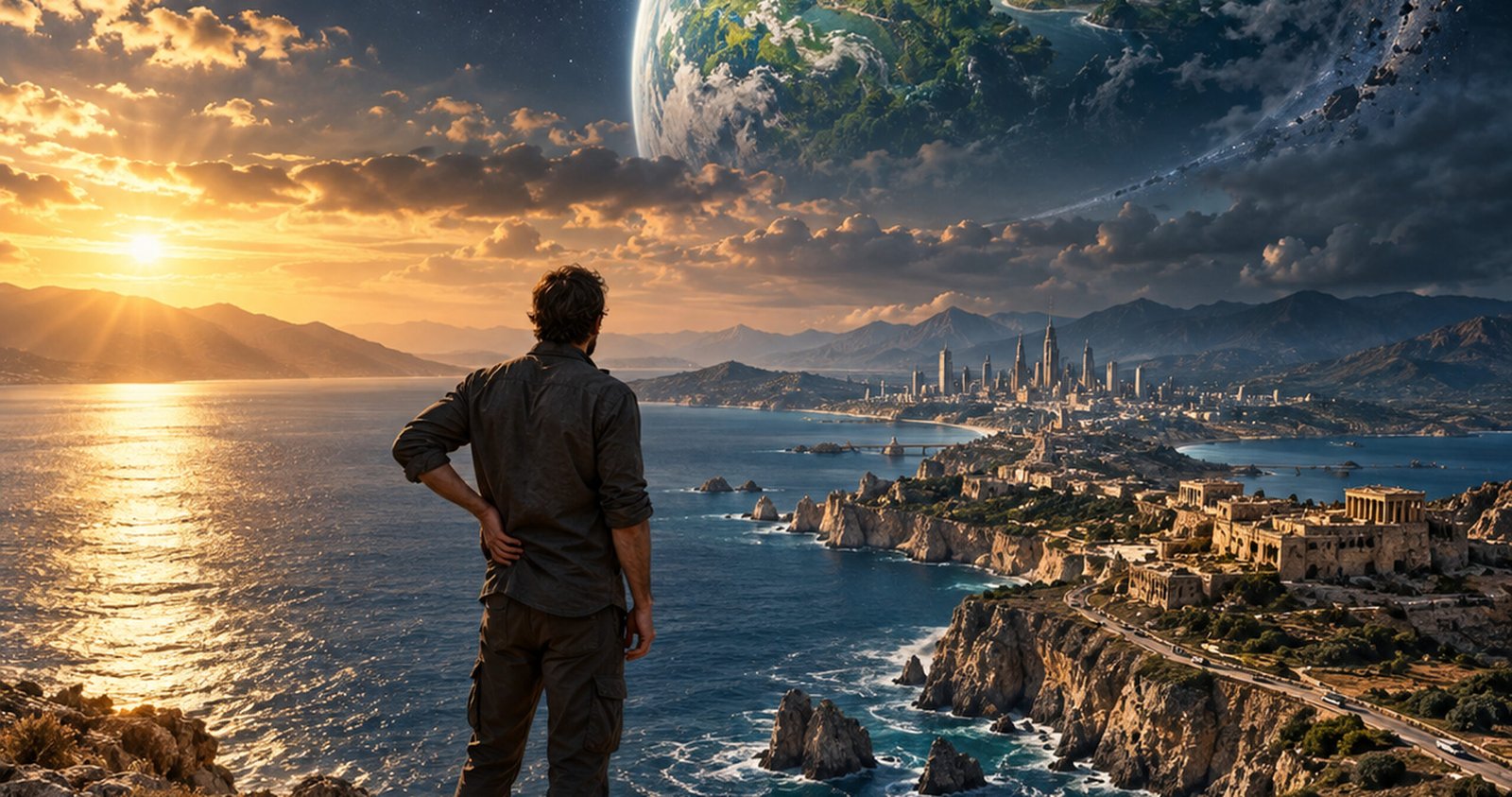
This planet is not humanity’s own. Upon the Earth, the human being is an alien.
In his book, Dr Ellis Silver advances a startling proposition: humanity is not native to this planet. Human beings, he contends, were created elsewhere and, for some reason, cast out of their original world and deposited upon the Earth, which they now inhabit.
His book, Humans Are Not from Earth: A Scientific Evaluation of the Evidence, develops this argument further. Silver offers seventeen reasons why human beings are ill-suited to life on this planet. In his view, these difficulties suggest that our true origins lie in another world. Although the Earth meets some of our needs as a species, he argues, it is less congenial to us than those who brought us here had initially supposed.
To illustrate this supposed mismatch, Silver points to several aspects of the human condition. We do not, he observes, readily tolerate prolonged exposure to sunlight, although we encounter it every day. He interprets the prevalence of chronic back pain across the world as evidence that humanity originated on a planet with weaker gravity. He further maintains that our biological rhythms are better adapted to a day of twenty-five hours than to the twenty-four-hour cycle by which earthly life is ordered.
Silver also entertains the possibility that we came from Alpha Centauri. Under this hypothesis, some catastrophic event may have overtaken our ancestral planet, leaving a handful of survivors able to escape and reach the Earth.
The book sets out thirteen principal hypotheses and seventeen factors upon which Silver bases his account of humanity’s extraterrestrial origins. Alongside them, he raises questions of a more fundamental kind. How did we arrive here? When did we arrive? What is our home planet like?
Which stars are the most likely to harbour that ancestral world in their orbit? If extraterrestrial beings exist, why have we been unable to detect them? And might we ourselves be the aliens?
Silver addresses these questions by drawing upon the evidence and ideas circulating within the scientific community and beyond it. He also provides links to websites where the evidence and its attendant questions receive fuller consideration. The purpose of this short book is to awaken interest, encourage debate and invite readers to contribute further evidence.
Consider, then, the words of Dr Ellis Silver, a scientist, researcher, author and distinguished American archaeologist. Bear in mind that these are the words of a scientist who professes no religious belief.
His contention is that the environment in which humanity was first created, and in which it
originally dwelt, was exceptionally comfortable, tranquil and well suited to human needs: a world of almost sovereign privilege. There, human beings lived in surroundings of exquisite gentleness. Their delicate constitution and inclination towards ease suggest that they had no need to labour for their daily bread. Humanity was a cherished creature, accustomed to a life of extraordinary luxury.
The climate knew neither the rigours of winter nor the oppression of summer but resembled a perpetual spring. Nor was there the fierce glare of a dangerous star such as our Sun, with ultraviolet rays that inflict suffering and exceed the limits of human endurance.
Then this creature, the human being, committed some transgression.
For that offence, humanity was expelled from its comfortable, indulgent surroundings and cast upon the Earth. Whoever banished it from its original planet appears to have been a being of immense power, holding the order of planets and stars within its command. Such a being could dispatch whom it wished to whatever world it chose, by way of punishment or reward. It possessed, too, the power to bring creatures into existence.
Silver suggests that the Earth may have served as a place of imprisonment, to which offenders alone were sent to undergo punishment. In this account, the Earth resembles the penal exile of Kala Pani: a tract of land encircled on every side by the sea, to which humanity was consigned.
Silver is a scientist who forms his judgement only after examining the results of observation. His book contains a formidable body of scientific arguments which admit no denial.
Among the established points on which the greater part of his argument rests are the following.
1. There is a considerable difference between the Earth’s gravity and that of the world from which humanity came. On our original planet, gravity was much weaker, making it easier for human beings to walk, move about and carry burdens. The prevalence of back pain among us is a consequence of the stronger gravitational pull we now endure.
2. No other creature inhabiting the Earth suffers from the range of chronic ailments found in humanity. Silver writes that, were someone to show him a single person anywhere on Earth who was entirely free from disease, he would be prepared to withdraw his claim. By contrast, he maintains that, apart from passing or temporary illnesses, no animal is afflicted by disease.
3. No human being can endure sitting in the sun for very long. Before long, dizziness may set in, followed by the possibility of sunstroke. Animals, by contrast, face no such difficulty: even after months of exposure, they develop neither skin disease nor any other ailment attributable to the Sun’s fierce rays or heat.
4. Every human being carries a sense that this planet is not truly home. At times, an inexplicable melancholy descends upon us, like the sorrow of someone living in exile, even when we are sitting in our own house, surrounded by our closest kin.
5. The temperature of every other earthly creature is regulated automatically from moment to moment. Under fierce sunlight, its body temperature adjusts of its own accord; should clouds gather, it adjusts again to the shade. Humanity possesses no equivalent system and instead falls ill as the weather and environment change. The very notion of seasonal fever belongs to the human condition alone.
6. Humanity differs profoundly from the other living beings found on this planet. Its DNA and the number of its genes are markedly different from, and far greater than, those of the Earth’s other organisms.
The original world in which humanity was created did not possess the Earth’s unclean environment. Our soft, delicate skin, which burns and darkens beneath the earthly sun, was fashioned to suit the planet of our birth. So sensitive was the human constitution that, even after arriving here, we continued trying to recreate surroundings appropriate to it. Accustomed in our own world to sleeping upon comfortable, luxurious beds, we still strive to secure the greatest possible ease. We seek to build beautiful, costly and substantial houses and palaces resembling those once available to our parents there. Other animals and creatures remain indifferent to such ambitions.
The creatures of the Earth lack reason and are accustomed to an inferior order of existence. They aspire neither to finer thought nor to better living, nor even to a life of peace and tranquillity. In watching them, humanity itself became bloodthirsty, although its original nature belonged to love, the fine arts and peaceful living. The human being is thus a prisoner, dispatched to an inferior planet as punishment, to serve a sentence and then return.
Silver argues that human intelligence, consciousness and progress suggest that the parents of this alien creature arrived from their own planet relatively recently: only a few thousand years have passed. Humanity is still labouring to make its present existence as luxurious as life upon its former world, inventing motor cars at one moment and mobile telephones at another. Had even a few hundred thousand years elapsed since our arrival, the inventions we see today would have appeared thousands of years ago. For you and I are hardly so diminished that we would have spent hundreds of thousands of years living like animals, in helplessness and pitiable want.
Silver’s book has much more to say on this subject. Above all, no one has yet succeeded in disproving his arguments.
As I reflected upon his scientific arguments and hypotheses, I was struck by the account before me. Here was a scientist telling it; yet this was no mere story, but a true account narrated in precisely this manner in every revealed scripture known to humanity. I shall not dwell upon it, for you are already well acquainted with the story of our father Adam and of Eve, peace be upon them. Science has begun its journey towards God. Scientists have found themselves compelled to say what the prophets had long taught the generations entrusted to them. I had begun writing about the human race; after this essay, I shall be able to carry that enquiry forward with greater coherence.
The theories of evolution have been borne to their grave. Human thought is now finding its proper direction. This planet is not ours. That assertion is not mine alone: our beloved Prophet, peace and blessings be upon him, told us so on countless occasions. In His glorious Book, the Holy Qur’an, God has repeatedly conveyed a message whose meaning is this: O humankind, the life of this world is the place of your trial, not your permanent abode. From here, you will pass to punishment or reward according to your deeds. For righteous deeds, you will receive that Paradise whose life is supremely beautiful, peaceful and rich in every comfort.
Someone once asked the noble Prophet, peace and blessings be upon him, where Paradise was. He replied: ‘In the heavens.’ The questioner then asked where Hell was. He replied: ‘Upon this very Earth.’