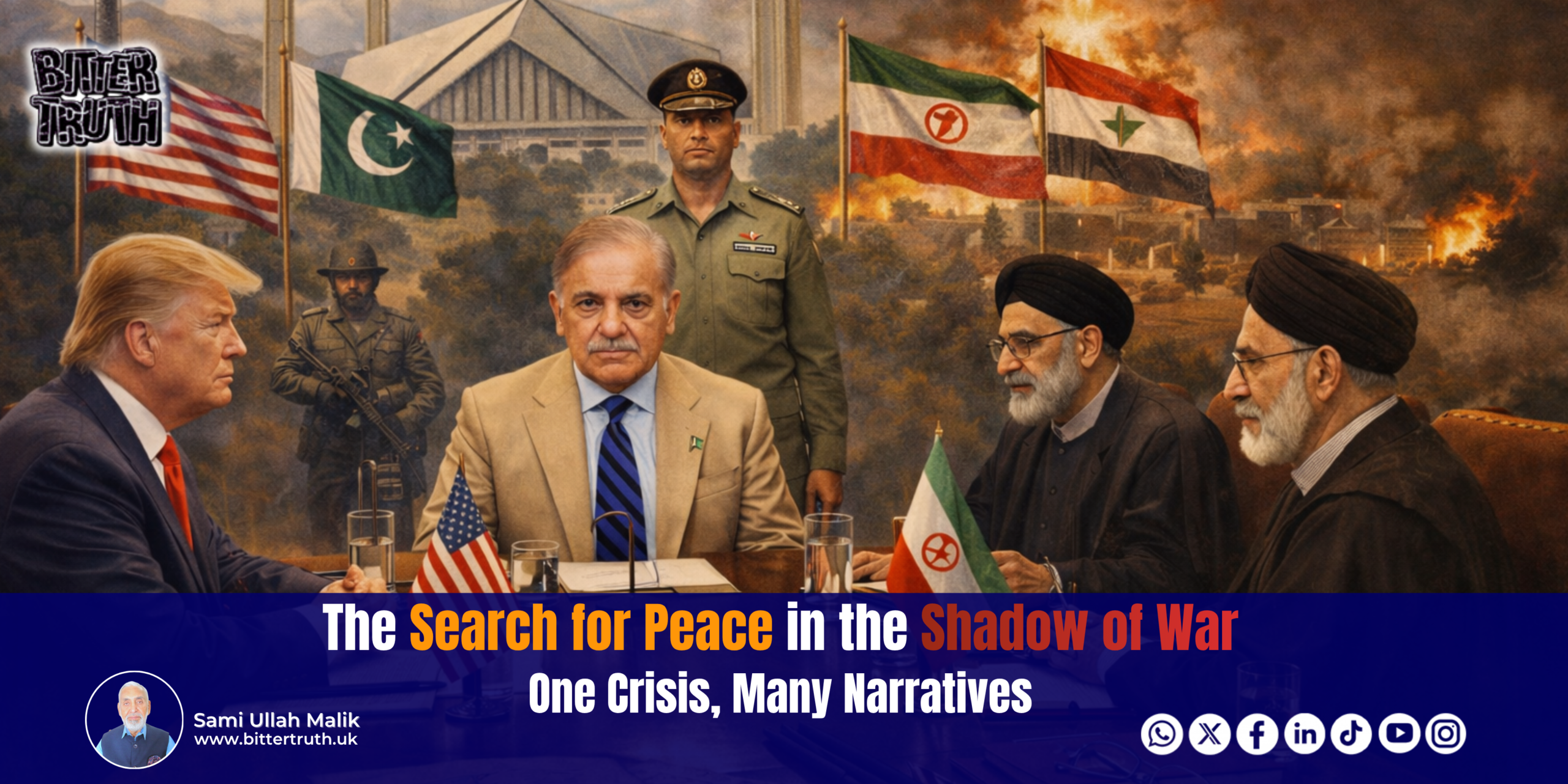
The Search for Peace in the Shadow of War
One Crisis, Many Narratives

The age is turning upon its hinge, and upon the parchment of history a new inscription strains to be set. The Middle East—long the theatre of civilisations risen and undone—finds itself once more the arena of great-power contest. Time shifts its posture; history, restless in its breast, seems impatient to deliver yet another chapter. That ancient land, where once the lamps of learning were lit and caravans of wisdom set forth, now stands tainted by the acrid scent of powder and the tragic spoor of blood. The assaults upon Iran by Israel and the United States have brought world politics to a grave and fateful juncture, casting the region into a vortex wherein each swell conceals a gathering storm, and every decision threatens to determine the tenor of years yet unborn. This is no mere war of arms; it is an encounter of ideas—of power and morality, of interest and principal, of aggression set against the fragile promise of conciliation.
Across the horizon of international affairs there rages a tumult in which the odour of gunpowder mingles uneasily with the finer vapours of diplomacy, and the ceaseless contest for equilibrium of power is everywhere apparent. The ferocity of the strikes upon Iran has placed the Middle East upon the very lip of a volcano; yet, in striking contrast, the quiet but telling diplomacy of Islamabad has drawn the attentive gaze of the world. What appears, at first glance, a theatre of war reveals itself, upon closer inspection, as a crucible in which new standards of global leadership may well be forged.
Amid this turbulence, Pakistan’s role emerges as a lamp of guarded hope—a light possessing the rare capacity to illumine pathways through encroaching darkness. The community of nations has begun to concede that Pakistan stands forth as a discerning intermediary: one endowed not merely with the faculty to comprehend the complexities of the hour, but with the prudence required to shape them towards a more temperate end.
The mediatory course charted by Pakistan in this crisis is no stratagem of convenience; rather, it is the echo of a deeper civilisational inheritance—one grounded in reconciliation, balance, and the disciplined exercise of wisdom. Though statements by Iran’s Foreign Minister, Abbas Araghchi, suggest that Tehran remains, for the present, disinclined towards formal negotiation, the quiet exchange of messages behind the curtain intimates that the doors of diplomacy are not yet wholly closed. In this intricate tableau, the endorsement of Pakistan’s efforts by the United States marks an uncommon and notable development, elevating its role from the merely regional to one of credible global consequence.
The tensions between Iran and the Western powers are no sudden quarrel born of recent provocations; their roots run deep into decades of mistrust, ideological divergence, and competing geopolitical designs. Israel’s military initiatives, coupled with unwavering American support, have served not merely to inflame this long-standing dispute but to propel it into a decisive and perilous phase. This is not solely a contest of frontiers, but of narratives: on one side, the assertive confidence of power and a Western discourse inclined towards dominance; on the other, Iran’s insistence upon sovereignty and its philosophy of resistance. Between these contending visions lies the ominous spectre of wider devastation.
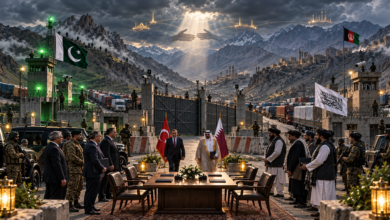
At such a delicate hour, the diplomacy of Islamabad assumes an importance of uncommon magnitude. The city is no longer merely a seat of administration; it has, in effect, become a crucible of diplomatic engagement. With measured restraint, strategic patience, and a notable clarity of judgement, Pakistan has embraced the path of mediation—reflecting a political acuity not often acknowledged, yet now difficult to ignore. This is a land where, in earlier times, quiet understandings between great powers were wrought in silence; today, that tradition reappears in altered form, yet with undiminished relevance. The eyes of the world are fixed upon it, even as unease stirs in the corridors of New Delhi, where observers find themselves confronted with the disquieting reality that the state they long derided now stands forth as a plausible harbinger of peace.
The international order itself is passing through an interregnum. The unipolar arrangement that followed the Cold War shows signs of exhaustion, yielding gradually to the emergence of a more diffuse, multipolar world. Within this evolving dispensation, the influence of regional powers grows in stature—and among these, Pakistan appears increasingly as a state whose moment may be approaching.
The voice of India’s opposition figure, Shashi Tharoor, captures something of this unease. His admission—that India ought to have seized the initiative in peace efforts—reads less as counsel than as a lament for an opportunity foregone. The forward movement of Pakistan, alongside Egypt and Turkey, has rekindled the prospects of peace even as it casts into sharp relief India’s diplomatic inertia. History, it would seem, has once again affirmed its stern lesson: that nations inattentive to the demands of their time are apt to find themselves stranded as the caravan of opportunity moves inexorably on.
Pakistan’s foreign policy has long possessed a certain refinement—a subtlety rooted in balance, caution, and dialogue. Its fraternal ties with Iran, combined with its strategic relationship with the United States, confer upon it a singular vantage: that of a bridge between estranged powers. It is precisely this quality which lends credibility to any mediator, elevating it beyond mere convenience to the realm of necessity.
Islamabad, therefore, stands today not simply as an administrative capital, but as a centre of diplomatic intelligence and quiet resolve. The meetings convened, the discreet messages conveyed, and the unseen channels maintained all testify to a state prepared to assume a serious and responsible role upon the global stage.
There has always been, in Pakistan’s diplomacy, a deliberate equilibrium. It neither surrenders itself wholly to any single bloc, nor permits itself to drift into isolation. It is this moderation that renders it a trustworthy intermediary. The emergence of Field Marshal Asim Munir in such a mediatory capacity is not merely the story of an individual’s ascent; it is the expression of a broader national will and institutional coherence. To serve as a bridge between Washington and Tehran is no ordinary undertaking; it is an achievement that enhances Pakistan’s political stature and underscores its regional significance. In such moments, history does not merely proceed—it inscribes anew.
The endorsement extended by the United States to Pakistan’s mediatory endeavour constitutes a development of no ordinary significance. It is not merely the issuance of a diplomatic communiqué, but rather an articulation of confidence—confidence cultivated through years of engagement, shared interests, and the slow, exacting labour of strategic familiarity. The disposition of President Donald Trump’s administration in this regard may yet prove a valuable diplomatic asset for Pakistan. Meanwhile, the declaration by Iran’s Foreign Minister, Abbas Araghchi, that Tehran is, for the present, disinclined towards negotiation, may appear at first glance to be a position of unyielding severity. Yet in the subtle grammar of diplomacy, the closing of one door seldom precludes the quiet opening of several windows. It is in the very nature of diplomatic language that denial may carry within it the faintest intimation of assent. The continued exchange of messages—however discreet—attests to the fact that the avenues of engagement have not been entirely foreclosed, and that behind the formal posture, a quieter dialogue persists.
The unease discernible within India in response to these developments is no mere flourish of political rhetoric; it is reflective of deeper anxieties. There are moments in international affairs when the success of one rival becomes an implicit interrogation of another’s judgement. The reaction emerging from Indian quarters bears precisely this character. That certain Indian commentators have described Pakistan’s prospective success as a “diplomatic revolution” is, in itself, a striking and somewhat bitter concession. This is, after all, the very Pakistan so often cast as an object of reproach—now, paradoxically, assuming the aspect of a potential custodian of peace.
Those who for years were inclined to characterise Pakistan as a failing state now find themselves compelled, however reluctantly, to acknowledge the weight of its role. Should Pakistan succeed in quelling this conflagration, it would signify not merely the cessation of hostilities, but a perceptible recalibration in the balance of global influence. Analysts are of the view that such an outcome would deliver a notable diplomatic jolt to India, compelling a moment of introspection in New Delhi. The remarks of the Indian opposition figure, Shashi Tharoor, amount in essence to an admission—one that speaks of an opportunity missed at a moment of consequence. His observation that India ought to have taken the initiative in peace negotiations serves as a mirror in which the limitations of its recent diplomacy are rendered starkly visible and suggests that a significant strategic opening has been allowed to slip away.
In the estimation of international observers, mediation is no miracle in itself; yet its success can elevate a nation’s standing to uncommon heights. At present, the eyes of the world are fixed upon Islamabad. A city once regarded merely as an administrative capital now assumes the aspect of a diplomatic fulcrum. Each statement, each encounter, each incremental development is subjected to careful scrutiny, as though the city itself had been transformed into a grand stage upon which the drama of global politics unfolds at full intensity. History offers its own testimony: Islamabad has, in earlier chapters, served as a bridge between great powers. It was here that quiet efforts contributed to the rapprochement between Washington and Beijing—an achievement that endures as part of its diplomatic inheritance. That tradition, far from extinguished, appears once more in renewed and contemporary form.
Pakistan’s strategy—anchored in conciliation and equilibrium—renders it particularly suited to the office of mediation. The present convergence of global attention upon Islamabad reflects not only circumstance, but recognition. The support extended by the United States further underscores the degree to which major powers now acknowledge Pakistan’s capacity in this regard. Indeed, this confidence recalls the role Pakistan played with notable dexterity in facilitating the Doha negotiations between the United States and Afghanistan, an effort that contributed materially to Washington’s eventual withdrawal. Such precedents lend both weight and credibility to its present undertaking.
Yet prudence demands that Pakistan proceed with measured caution. It must craft, with clarity and foresight, a comprehensive policy to guide its next steps, lest the confidence reposed by the Trump administration become, in time, a source of fresh trial rather than advantage. To characterise Pakistan’s potential success as a “diplomatic revolution” is not merely rhetorical flourish; it is an acknowledgement of the magnitude of the moment. The emergence of Field Marshal Asim Munir as a mediating figure reflects not only individual agency, but the coherence and resolve of the state itself. His leadership speaks to a decisiveness in policy—one that resonates both domestically and upon the international stage. Through sustained diplomatic engagement and active communication with global leaders, Pakistan demonstrates that it is not a passive respondent to crises, but a state capable of shaping adversity into constructive possibility.
India’s policy towards the Middle East was, for a considerable period, regarded as a model of balance and circumspection. Its relations with Iran, the Gulf states, and Israel were maintained upon a delicate but deliberate equilibrium. In recent years, however, this balance appears to have been significantly disturbed. A discernible shift has taken place in India’s foreign policy orientation; one marked by a diminishing subtlety and an increasingly pronounced alignment in a particular direction. Such a transformation carries consequences, not least in the realm of regional relationships, where nuance is often the currency of stability.
A visible tilt towards one side inevitably erodes the credibility of neutrality. In the aftermath of the strikes upon Iran, India’s posture has appeared markedly inclined towards the positions of the United States and Israel. This one-sided disposition has not only called into question its claim to impartiality, but has also recast it, in the eyes of many, as a participant rather than an arbiter. In diplomacy, the loss of balance is akin to a mariner deprived of his compass—direction falters, and the horizon grows uncertain.
This conflict has assumed a character at once intricate and precarious, wherein each step must be taken with deliberation and foresight. The struggle involving Iran resembles a game of high chess—each move calculated, each manoeuvre laden with layered meanings and unforeseen consequences. Israel, the United States, Iran, and a constellation of regional actors occupy the principal squares upon this board. Pakistan, for its part, has assumed the role of mediator—a position at once the most exacting and, if skilfully discharged, the most efficacious. Its relative detachment from the immediate theatre renders the task more arduous yet paradoxically enhances its credibility. The support extended by Washington has furnished Pakistan with that essential currency of diplomacy—confidence—upon which great decisions are ultimately founded. In the conduct of international affairs, equilibrium remains the cardinal principle; those nations that preserve it are those that leave an enduring impress upon the world. Pakistan’s present strategy reflects precisely this doctrine, drawing strength from the confidence it commands and from its unique position between Washington and Tehran.
India, by contrast, appears to have aligned itself from the outset with a particular camp. Its economic entanglements with the Gulf states and its strategic partnership with the United States have inclined it in a discernible direction, a tendency reflected in both its pronouncements and its conduct. Consequently, its role in the present crisis appears constrained, if not diminished. It is a matter of some note that India has not, at any serious juncture, offered itself as a mediator. The absence of confidence reposed in it by major powers speaks, perhaps, to this omission. Thus, rather than emerging as an independent arbiter, India finds itself perceived as an adjunct to a broader alignment. In effect, its policies have placed it not in the position of a conciliator, but as an active associate of one side in the conflict.
Within India itself, a growing current of criticism suggests that its foreign policy has, to some degree, lost clarity of direction. From Gaza to Iran, the relative quietude—or perceived equivocation—of its voice has had a discernible impact upon its diplomatic standing. In the theatre of global politics, silence is seldom neutral; it is often interpreted as a sign of diminished weight.
The critiques emanating from within Indian circles underscore a deeper unease. In matters concerning a significant regional actor such as Iran, silence—or overt partiality—is widely regarded as a diplomatic misstep of consequence. When war stands, as it were, at the threshold, reticence may itself be construed as a form of frailty. In such moments, the contrast between differing styles of leadership becomes unmistakably clear upon the international stage.
Across the region, the balance of power remains in a state of restless transition. Iran’s posture of resistance, Israel’s assertiveness, and the intervention of the United States have together produced a configuration of notable complexity. Israel remains an indispensable factor in any prospective resolution, while the Gulf states, by virtue of their economic weight and strategic positioning, hold a decisive influence over the trajectory of events. Their calculations and alignments will inevitably shape the contours of the future. The region appears to be moving towards a reconstituted equilibrium, one in which each actor seeks to define its place. In this sense, the present crisis may well inaugurate a new chapter in global politics—marked by shifting balances and the emergence of novel alignments.
Should Pakistan succeed in its mediatory endeavour, the enhancement of its international standing would be both immediate and profound. Such a success would not merely bring an end to hostilities; it would establish a precedent for the resolution of future conflicts. For India, the moment carries the character of a lesson—an illustration of the enduring importance of balance, foresight, and timely decision-making in the conduct of foreign policy.
It must also be recognised that this crisis may serve as a prelude to the reconfiguration of the international order itself. Pakistan’s role within it is already conferring upon it a renewed identity upon the global stage. A successful mediation would not only conclude a war but would also furnish a model for the future, demonstrating the enduring value of measured diplomacy. Conversely, it presents India with an occasion for reflection—an opportunity to reassess the efficacy of its present course. History, as ever, reserves its sternest judgements for those nations that falter at moments of consequence.
The divergence in the styles of leadership between Pakistan and India stands in sharp relief. Where, on the one hand, there is evidence of decisiveness and clarity of purpose—qualities that have reinforced Pakistan’s role—there appears, on the other, a measure of hesitation and ambiguity. It is precisely this attribute of leadership—the capacity for resolute action guided by coherent vision—that has, in many instances, altered the destinies of nations.
In the final analysis, it would not be an exaggeration to suggest that Pakistan stands upon the threshold of a new diplomatic epoch. Should its mediation bear fruit, it will signify not merely the cessation of a single conflict, but the inauguration of a new global narrative. For India, by contrast, this moment assumes the aspect of a reckoning—an occasion in which the limitations of its present policies are brought into sharp focus. The wheel of history continues its inexorable turn, and in its present rotation, Pakistan’s stature appears, unmistakably, to be on the ascent.
History, in its enduring judgement, remembers those nations that act with discernment in times of trial. Pakistan now stands at such a juncture. The days ahead will determine the ultimate course of this crisis, yet one conclusion already suggests itself with clarity: Pakistan has asserted its presence with unmistakable force. It is not unreasonable to contend that it moves towards a new diplomatic horizon—one in which, should its efforts prevail, the end of war may coincide with the laying of foundations for a reimagined international order. One is left, therefore, with the distinct impression that upon the horizon of history there gathers the light of a new dawn—one in which Pakistan’s voice may yet resound as an echo of the world’s conscience.